The word comfort means a warm feeling of safety, calm, or ease that makes you feel happy and relaxed. Imagine a young boy named Sam who comes home after a long, cold day of playing outside in the rain. His mother wraps him in a soft, dry blanket and hands him a warm cup of cocoa. Sitting by the heater in that warm blanket is what we call comfort.
People use synonyms for comfort in talks about feelings, home life, and daily conversations. Because feeling safe and helping friends when they are sad. Every day, comfort is an important word for young students to master.
Learning synonyms for comfort is necessary for English learners and young writers. . It enables you to describe making a sad friend feel better. Enjoying a cozy bed, or relaxing after hard work without repeating the same word every time. This article aims to discuss the meaning of the key word and its 30 synonyms with simple examples, grammar facts, word history, pronunciation guides, and easy categories written in short, smooth sentences.
Meaning of Comfort
Definition
Comfort (Noun): A feeling of physical ease, warmth, or relief from pain and sadness.
Examples
- The soft pillow gave him great comfort at bedtime.
- Her warm hug brought comfort to her sad friend.
Connotative Meaning
- Positive tone: Shows warmth, love, safety, rest, and peace.
- Negative tone: Points to being too lazy or staying in a place without growing or learning.
- Neutral tone: Used by doctors and teachers to talk about physical rest and simple relief.
Etymology
- Source language: Came from the Latin word confortare, which meant to strengthen or make strong.
- Old English (450–1100): Early children used words like frōfrie when helping a sad friend feel better.
- Middle English (1100–1500): French words like confort entered English stories to mean help and cheer.
- Modern English (1500–Present): Became the common word comfort used today in storybooks and family talks.
Pronunciation
- US: /ˈkʌmfərt/
- UK: /ˈkʌmfət/
Syllables
com-fort (2 parts)
Affixation Pattern of Comfort
- Root: Comfort
- Prefix: Dis- (in discomfort)
- Suffix: -able (in comfortable), -ing (in comforting)
- Word Formation:
- Noun: Comfort, Discomfort
- Verb: Comfort
- Adjective: Comfortable, Comforting
- Adverb: Comfortably
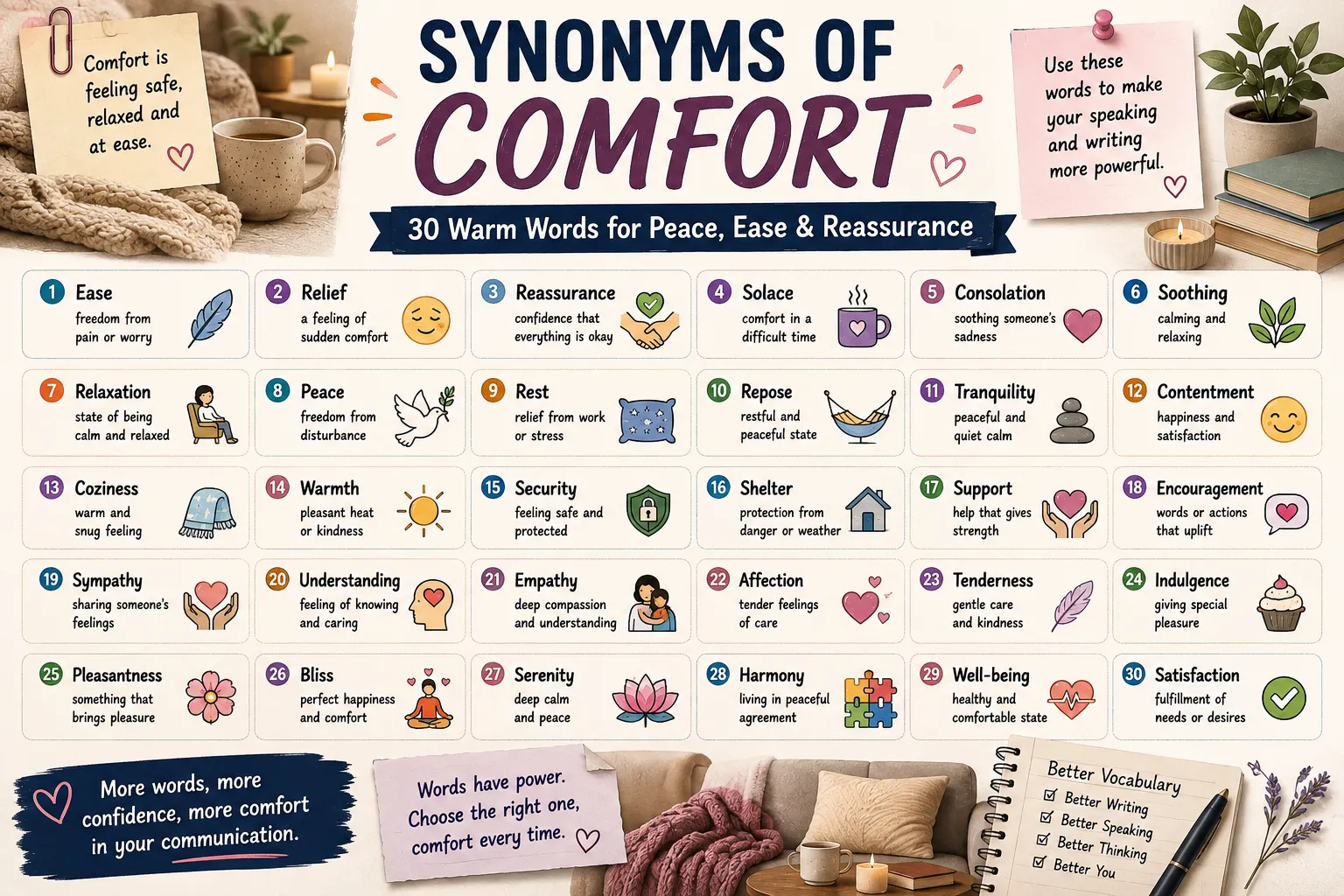
Synonyms of Comfort
1. Ease (Noun) — US: /iːz/ | UK: /iːz/
Meaning: A feeling of freedom from pain, worry, or trouble.
Examples:
Sitting in the shade brought ease to his tired legs.
She finished her art project with total ease.
2. Relief (Noun) — US: /rɪˈliːf/ | UK: /rɪˈliːf/
Meaning: A good feeling when pain or worry stops.
Examples:
It was a great relief when the rain stopped.
Finding his lost dog brought instant relief.
3. Solace (Noun) — US: /ˈsɑːlɪs/ | UK: /ˈsɒlɪs/
Meaning: Help or peace given to someone who is sad.
Examples:
Reading her favorite story gave her solace.
He found solace in music after a hard day.
4. Peace (Noun) — US: /piːs/ | UK: /piːs/
Meaning: A quiet state without noise, worry, or fighting.
Examples:
The quiet library gave us a sense of peace.
She sat in peace by the blue lake.
5. Rest (Noun) — US: /rɛst/ | UK: /rest/
Meaning: Time spent relaxing to get your energy back.
Examples:
A good night of rest helps you grow strong.
The runner took a short rest under the tree.
6. Cheer (Noun) — US: /tʃɪr/ | UK: /tʃɪə/
Meaning: A happy feeling that makes sadness go away.
Examples:
Her bright smile brought cheer to the class.
A sweet song can bring cheer on a gray day.
7. Cozy (Noun) — US: /ˈkoʊzi/ | UK: /ˈkəʊzi/
Meaning: A warm, snug, and safe feeling in a small place.
Examples:
The small cabin had a lovely feeling of cozy.
She enjoyed the warmth and cozy of her bed.
8. Warmth (Noun) — US: /wɔːrmθ/ | UK: /wɔːmθ/
Meaning: A gentle, comfortable heat or a friendly feeling.
Examples:
The fire gave off nice warmth in the room.
Her mother’s smile was full of warmth.
9. Quiet (Noun) — US: /ˈkwaɪət/ | UK: /ˈkwaɪət/
Meaning: A peaceful state with very little or no noise.
Examples:
He enjoyed the quiet of the morning park.
The room fell into a soft, calm quiet.
10. Calm (Noun) — US: /kɑːm/ | UK: /kɑːm/
Meaning: A state of being quiet and free from fear or anger.
Examples:
Deep breaths brought calm to the nervous child.
The sea was in a state of complete calm.
11. Support (Noun) — US: /səˈpɔːrt/ | UK: /səˈpɔːt/
Meaning: Help and kindness given to someone during a hard time.
Examples:
Her best friend gave her lots of support.
Family support makes tough days easier.
12. Safety (Noun) — US: /ˈseɪfti/ | UK: /ˈseɪfti/
Meaning: The state of being kept away from harm or danger.
Examples:
Holding her dad’s hand gave her safety.
The mother bird gave her eggs full safety.
13. Contentment (Noun) — US: /kənˈtɛntmənt/ | UK: /kənˈtentmənt/
Meaning: A happy feeling of being pleased with what you have.
Examples:
The sleeping cat showed total contentment.
He felt contentment after eating his lunch.
14. Relaxation (Noun) — US: /ˌriːlækˈseɪʃən/ | UK: /ˌriːlækˈseɪʃn/
Meaning: The act of letting your muscles and mind rest.
Examples:
A warm bath gives deep relaxation.
Listening to rain sounds is great for relaxation.
15. Reassurance (Noun) — US: /ˌriːəˈʃʊrəns/ | UK: /ˌriːəˈʃɔːrəns/
Meaning: Kind words that help someone stop worrying.
Examples:
His teacher gave reassurance before the quiz.
A hug from mom offers full reassurance.
16. Help (Noun) — US: /hɛlp/ | UK: /help/
Meaning: Useful work or kind words that make a task easy.
Examples:
His sister offered help with his math page.
A bit of help can make a sad day better.
17. Care (Noun) — US: /kɛr/ | UK: /keə/
Meaning: Looking after someone with love and attention.
Examples:
The sick puppy received great care from the vet.
Grandma showed loving care for her garden.
18. Protection (Noun) — US: /prəˈtɛkʃən/ | UK: /prəˈtekʃn/
Meaning: Keeping someone safe from bad weather or hurt.
Examples:
An umbrella gives protection from the rain.
A warm coat offers good protection in winter.
19. Happiness (Noun) — US: /ˈhæpinəs/ | UK: /ˈhæpɪnəs/
Meaning: The feeling of being joyful and glad.
Examples:
Playing with friends brings pure happiness.
Her eyes were filled with happiness today.
20. Luxury (Noun) — US: /ˈlʌkʃəri/ | UK: /ˈlʌkʃəri/
Meaning: Great ease and fancy items that make life very pleasant.
Examples:
Soft silk sheets are a nice luxury.
Sleeping late on Saturday felt like a luxury.
21. Pleasure (Noun) — US: /ˈplɛʒər/ | UK: /ˈpleʒə/
Meaning: A fun and enjoyable feeling.
Examples:
It was a pleasure to meet the new teacher.
Eating sweet ice cream is a simple pleasure.
22. Consolation (Noun) — US: /ˌkɑːnsəˈleɪʃən/ | UK: /ˌkɒnsəˈleɪʃn/
Meaning: Something small that makes you feel better after losing.
Examples:
A shiny star sticker was a nice consolation.
Getting a hug was her consolation after the fall.
23. Tranquility (Noun) — US: /træŋˈkwɪləti/ | UK: /træŋˈkwɪləti/
Meaning: A deep, quiet peace with no loud sounds.
Examples:
The forest was full of quiet tranquility.
He loved the tranquility of the quiet room.
24. Well-being (Noun) — US: /ˌwɛlˈbiːɪŋ/ | UK: /ˌwelˈbiːɪŋ/
Meaning: The state of being healthy, happy, and safe.
Examples:
Eating fruit is good for your overall well-being.
Fresh air helps your health and well-being.
25. Softness (Noun) — US: /ˈsɔːftnəs/ | UK: /ˈsɒftnəs/
Meaning: The gentle, smooth feel of something pleasant.
Examples:
The softness of the blanket helped him sleep.
She liked the softness of the new rug.
26. Serenity (Noun) — US: /səˈrɛnəti/ | UK: /səˈrenəti/
Meaning: A calm and peaceful state of mind.
Examples:
The blue sky gave a feeling of serenity.
She sat with serenity during story time.
27. Hope (Noun) — US: /hoʊp/ | UK: /həʊp/
Meaning: A good feeling that good things will happen soon.
Examples:
His kind words gave her hope for tomorrow.
Spring flowers bring fresh hope to everyone.
28. Delight (Noun) — US: /dɪˈlaɪt/ | UK: /dɪˈlaɪt/
Meaning: A strong feeling of happiness and joy.
Examples:
The surprise cake brought great delight.
The kids giggled with pure delight.
29. Easefulness (Noun) — US: /ˈiːzfəlnəs/ | UK: /ˈiːzfəlnəs/
Meaning: Being free from worry or hard work.
Examples:
The holiday brought a feeling of easefulness.
They rested in easefulness by the pool.
30. Warm-heartedness (Noun) — US: /ˌwɔːrmˈhɑːrtədnəs/ | UK: /ˌwɔːmˈhɑːtɪdnəs/
Meaning: Being kind, friendly, and loving to others.
Examples:
Her warm-heartedness made everyone feel welcome.
We loved the teacher for her warm-heartedness.
Prototype Meaning
When children hear the word comfort, they usually picture wrapping up in a soft blanket on a chilly day, sitting by a warm fire. Getting a gentle hug from a parent when they feel sad.
Prototype Categorization
- Cozy & Physical Rest: Ease, Rest, Cozy, Warmth, Relaxation, Softness, Luxury.
- Feeling Safe & Helped: Relief, Solace, Support, Safety, Reassurance, Help, Care, Protection, Consolation.
- Quiet & Peaceful Feelings: Peace, Quiet, Calm, Contentment, Tranquility, Serenity, Well-being, Easefulness.
- Happy & Kind Feelings: Cheer, Happiness, Pleasure, Delight, Hope, Warm-heartedness.
Antonyms of Comfort
- Pain
- Hurt
- Worry
- Fear
- Sadness
- Trouble
Short Questions and Answers
- What does comfort mean?
- Comfort means a warm, happy feeling of safety, rest, or relief.
- When should comfort be used?
- Use comfort when writing about cozy beds, helping sad friends, or resting after play.
- Is comfort positive or negative?
- Comfort is almost always positive because it brings peace and good feelings.
- How is it different from similar words?
- Comfort means general warmth and ease, while relief means pain has stopped, and peace means quietness.
CONCLUSION
Synonyms for comfort strengthens your overall English vocabulary. Relying on the same basic word every day can make your class stories sound plain. Using exact synonyms for comfort like cozy for soft beds, solace for sad moments, or relief when trouble ends makes your sentences clear. Synonyms for comfort sharpens your vocabulary writing. Builds speaking confidence, and helps you get higher marks on school tests. Start practicing two or three of these easy synonyms in your daily reading and writing today.

I’m Zahid Abbas, an educator, researcher, and digital publishing strategist with a passion for linguistics, grammar, and clear communication. As a content creator and SEO specialist, I craft research-driven, reader-focused content that empowers learners and makes knowledge accessible worldwide.