Sassy means bold and full of confidence, often with a playful or cheeky attitude. Think about a young girl who answers back with a clever joke when her older brother teases her. She isn’t rude, just quick, bold, and full of personality. That lively boldness is what “sassy” means.
People use synonyms for sassy a lot, to describe someone’s personality, a funny comment, or even a bold outfit. It usually shows confidence mixed with a bit of playful attitude.
But saying “sassy” again and again can make writing feel plain. English learners and writers need synonyms for sassy too. Synonyms for sassy help show different shades of this bold, lively spirit, from playful to a bit more daring. They also help your writing sound more colorful and fun.
This article looks at the word “sassy” in a simple way. You will learn what it means, how to say it, where it came from, and how to use it. Then you will learn 30 other words that mean almost the same thing.
Meaning of Sassy
Definition
Sassy (adjective): Bold and confident, often with a playful or cheeky attitude.
Examples
- The sassy puppy barked back at the bigger dog.
- She gave a sassy reply that made everyone laugh.
Connotative Meaning
- Positive tone: “Sassy” often feels fun and admirable, showing confidence and quick wit.
- Negative tone: “Sassy” can feel rude if the boldness crosses into disrespect.
- Neutral tone: In casual talk, “sassy” is often just a light, playful description, like “she has a sassy sense of style.”
Etymology
- “Sassy” is an American English form of the older word saucy.
- “Saucy” came from the word sauce, based on the Latin word salsa, meaning “salted.”
- Over time, “saucy” grew to mean bold or full of spirit, much like a strong, flavorful sauce. “Sassy” developed as its own American variant in the 1800s.
Short History
- Old English (450–1100): The word “sassy” did not exist. Boldness in speech was described with words like “beald,” meaning bold.
- Middle English (1100–1500): “Saucy” formed from “sauce,” first meaning flavored with sauce, then growing to mean bold or cheeky in behavior.
- Modern English (1500–Present): “Sassy” appeared in American English in the 1800s as a variant of “saucy.” It became a common, friendly word to describe someone bold, playful, and full of confidence.
Pronunciation (US & UK – IPA)
- US: /ˈsæsi/
- UK: /ˈsæsi/
Syllables
sas-sy
Affixation Pattern of Sassy
- Root: sassy (a variant of “saucy,” from “sauce”)
- Prefix: none
- Suffix: -y (forms the adjective “sassy” from “sass”)
Word formation: This root gives us a few related words. “Sassy” is an adjective. “Sass” is a noun or verb meaning bold or cheeky talk, as in “don’t give me any sass.” “Sassily” is an adverb. “Sassiness” is a noun that means the quality of being sassy.
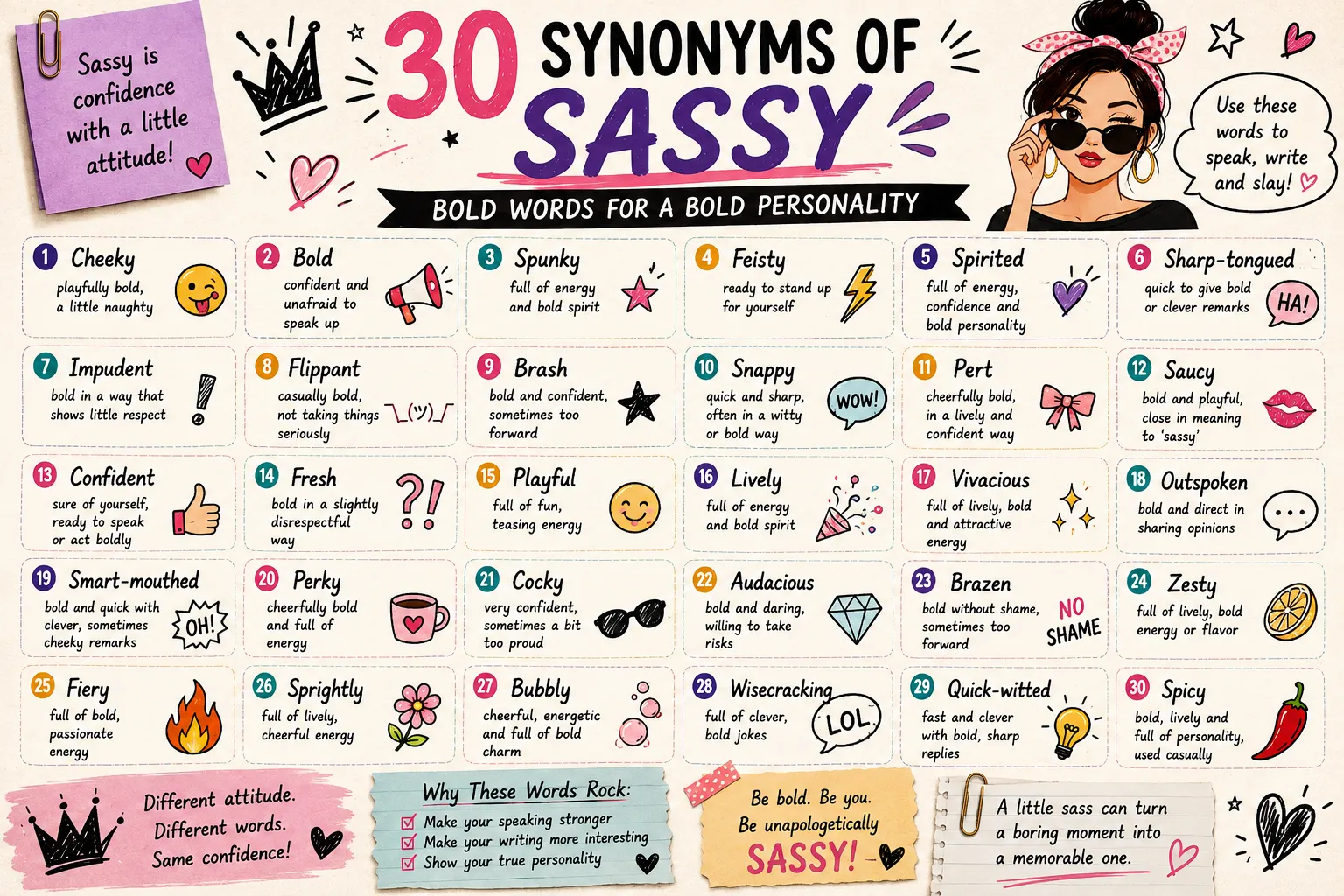
Synonyms of Sassy
1. Cheeky (adjective) — US /ˈtʃiːki/ | UK /ˈtʃiːki/
Meaning: Bold and playful, sometimes a little disrespectful in a fun way. Examples:
- The cheeky kid stuck out his tongue and smiled.
- She gave a cheeky wink before leaving the room.
2. Bold (adjective) — US /boʊld/ | UK /bəʊld/
Meaning: Confident and unafraid to speak up. Examples:
- She made a bold comment during the meeting.
- His bold attitude surprised the new students.
3. Spunky (adjective) — US /ˈspʌŋki/ | UK /ˈspʌŋki/
Meaning: Full of energy and bold spirit. Examples:
- The spunky puppy chased everyone around the yard.
- She has a spunky personality that lights up the room.
4. Feisty (adjective) — US /ˈfaɪsti/ | UK /ˈfaɪsti/
Meaning: Full of energy and ready to stand up for yourself. Examples:
- The feisty toddler refused to share her toys.
- He gave a feisty answer during the debate.
5. Spirited (adjective) — US /ˈspɪrɪtɪd/ | UK /ˈspɪrɪtɪd/
Meaning: Full of energy, confidence, and bold personality. Examples:
- She gave a spirited performance on stage.
- His spirited reply won over the crowd.
6. Sharp-tongued (adjective) — US /ˈʃɑːrp tʌŋd/ | UK /ˈʃɑːp tʌŋd/
Meaning: Quick to give bold or clever remarks. Examples:
- The sharp-tongued comedian never missed a joke.
- She was known for her sharp-tongued comebacks.
7. Impudent (adjective) — US /ˈɪmpjədənt/ | UK /ˈɪmpjʊdənt/
Meaning: Bold in a way that shows little respect, a more formal word. Examples:
- His impudent remark surprised the teacher.
- The impudent reply annoyed her manager.
8. Flippant (adjective) — US /ˈflɪpənt/ | UK /ˈflɪpənt/
Meaning: Casually bold, sometimes not taking things seriously. Examples:
- His flippant answer made the topic feel less serious.
- She gave a flippant shrug instead of a real reply.
9. Brash (adjective) — US /bræʃ/ | UK /bræʃ/
Meaning: Bold and confident, sometimes too forward. Examples:
- His brash comments surprised the quiet room.
- She has a brash way of speaking her mind.
10. Snappy (adjective) — US /ˈsnæpi/ | UK /ˈsnæpi/
Meaning: Quick and sharp, often in a witty or bold way. Examples:
- She gave a snappy reply to the tricky question.
- His snappy humor kept the audience laughing.
11. Pert (adjective) — US /pɜːrt/ | UK /pɜːt/
Meaning: Cheerfully bold, in a lively and confident way. Examples:
- The pert waitress joked with every customer.
- She had a pert little smile after winning the game.
12. Saucy (adjective) — US /ˈsɔːsi/ | UK /ˈsɔːsi/
Meaning: Bold and playful, close in meaning to “sassy.” Examples:
- She gave a saucy grin before answering.
- His saucy reply made the whole table laugh.
13. Confident (adjective) — US /ˈkɑːnfɪdənt/ | UK /ˈkɒnfɪdənt/
Meaning: Sure of yourself, ready to speak or act boldly. Examples:
- She walked into the interview feeling confident.
- His confident tone impressed the judges.
14. Fresh (adjective) — US /frɛʃ/ | UK /frɛʃ/
Meaning: Bold in a slightly disrespectful way, used casually. Examples:
- Don’t get fresh with your teacher.
- He was a little fresh with his answer, but it made everyone smile.
15. Playful (adjective) — US /ˈpleɪfəl/ | UK /ˈpleɪfʊl/
Meaning: Full of fun, teasing energy. Examples:
- She gave a playful nudge before teasing him.
- His playful attitude made the class enjoyable.
16. Lively (adjective) — US /ˈlaɪvli/ | UK /ˈlaɪvli/
Meaning: Full of energy and bold spirit. Examples:
- The lively puppy ran circles around the yard.
- Her lively personality made every party fun.
17. Vivacious (adjective) — US /vɪˈveɪʃəs/ | UK /vɪˈveɪʃəs/
Meaning: Full of lively, bold, and attractive energy. Examples:
- Her vivacious personality lit up every room.
- The vivacious host kept the show exciting.
18. Outspoken (adjective) — US /aʊtˈspoʊkən/ | UK /aʊtˈspəʊkən/
Meaning: Bold and direct in sharing opinions. Examples:
- She is outspoken about issues she cares about.
- His outspoken nature surprised the quiet room.
19. Smart-mouthed (adjective) — US /ˈsmɑːrt maʊðd/ | UK /ˈsmɑːt maʊðd/
Meaning: Bold and quick with clever, sometimes cheeky remarks. Examples:
- The smart-mouthed kid always had a comeback ready.
- Her smart-mouthed humor made the meeting fun.
20. Perky (adjective) — US /ˈpɜːrki/ | UK /ˈpɜːki/
Meaning: Cheerfully bold and full of energy. Examples:
- The perky assistant greeted every guest with a smile.
- She stayed perky even after the long day.
21. Cocky (adjective) — US /ˈkɑːki/ | UK /ˈkɒki/
Meaning: Very confident, sometimes a bit too proud. Examples:
- His cocky attitude annoyed his teammates.
- She gave a cocky grin before the match started.
22. Audacious (adjective) — US /ɔːˈdeɪʃəs/ | UK /ɔːˈdeɪʃəs/
Meaning: Bold and daring, willing to take risks. Examples:
- Her audacious plan surprised the whole team.
- He made an audacious move that paid off.
23. Brazen (adjective) — US /ˈbreɪzən/ | UK /ˈbreɪzən/
Meaning: Bold without shame, sometimes too forward. Examples:
- His brazen comment shocked the whole room.
- She gave a brazen answer without hesitation.
24. Zesty (adjective) — US /ˈzɛsti/ | UK /ˈzɛsti/
Meaning: Full of lively, bold energy or flavor. Examples:
- Her zesty personality made the show fun to watch.
- He gave a zesty reply that made everyone smile.
25. Fiery (adjective) — US /ˈfaɪəri/ | UK /ˈfaɪəri/
Meaning: Full of bold, passionate energy. Examples:
- She gave a fiery speech at the rally.
- His fiery personality made him stand out.
26. Sprightly (adjective) — US /ˈspraɪtli/ | UK /ˈspraɪtli/
Meaning: Full of lively, cheerful energy. Examples:
- The sprightly puppy jumped around the yard.
- Her sprightly steps matched her cheerful mood.
27. Bubbly (adjective) — US /ˈbʌbli/ | UK /ˈbʌbli/
Meaning: Cheerful, energetic, and full of bold charm. Examples:
- Her bubbly personality made everyone smile.
- The bubbly host kept the party lively.
28. Wisecracking (adjective) — US /ˈwaɪzkrækɪŋ/ | UK /ˈwaɪzkrækɪŋ/
Meaning: Full of clever, bold jokes. Examples:
- The wisecracking comedian kept the crowd laughing.
- She has a wisecracking sense of humor.
29. Quick-witted (adjective) — US /ˈkwɪk ˈwɪtɪd/ | UK /ˈkwɪk ˈwɪtɪd/
Meaning: Fast and clever with bold, sharp replies. Examples:
- Her quick-witted comebacks always got a laugh.
- He is quick-witted, even during tough questions.
30. Spicy (adjective) — US /ˈspaɪsi/ | UK /ˈspaɪsi/
Meaning: Bold, lively, and full of personality, used casually. Examples:
- Her spicy comments made the show entertaining.
- He gave a spicy answer that surprised everyone.
Prototype Meaning
When people hear the word “sassy,” they usually picture someone confident and playful, quick to speak up with a clever or bold reply. It could be a witty comeback, a bold outfit, or a lively personality. This simple picture of bold, cheerful confidence sits at the center of the word. Other synonyms add detail, showing whether the boldness feels playful, sharp, proud, or daring.
Prototype Categorization
You can group these synonyms by the kind of boldness they show:
- Playful and cheeky: cheeky, saucy, fresh, playful, smart-mouthed
- Full of lively energy: spunky, feisty, spirited, lively, perky, sprightly, bubbly, zesty
- Sharp or witty: sharp-tongued, snappy, wisecracking, quick-witted
- Bold and confident: bold, confident, outspoken, fiery
- Bold in a stronger way: cocky, brazen, audacious, brash, impudent, flippant
- Full of charm: vivacious, spicy, pert
Antonyms of Sassy
shy, timid, quiet, meek, reserved
Short Questions and Answers
- What does “sassy” mean? It means bold and confident, often with a playful or cheeky attitude.
- When should “sassy” be used? Use it to describe someone’s bold, playful personality, a witty comment, or a confident style.
- Is “sassy” positive or negative? It is mostly positive and playful. It can feel negative only if the boldness turns disrespectful.
- How is it different from similar words? “Sassy” is warm and playful. “Cocky” leans toward too much pride. “Impudent” sounds more formal and disrespectful. “Feisty” focuses more on energy and standing up for yourself.
Conclusion
Synonyms for sassy will help your English grow strong. Each word shows a different shade of bold, playful confidence, from a light “cheeky” comment to a bold “audacious” move. synonyms for sassy help your writing sound clear and full of personality, not repeated. They also help you describe people and moments with more color and fun. Anyone learning English can use synonyms for sassy to speak and write with more confidence. Try to learn one new word each day. Use it in a sentence about someone bold and lively you know. Over time, this small habit will make your English much stronger.

I’m Zahid Abbas, an educator, researcher, and digital publishing strategist with a passion for linguistics, grammar, and clear communication. As a content creator and SEO specialist, I craft research-driven, reader-focused content that empowers learners and makes knowledge accessible worldwide.