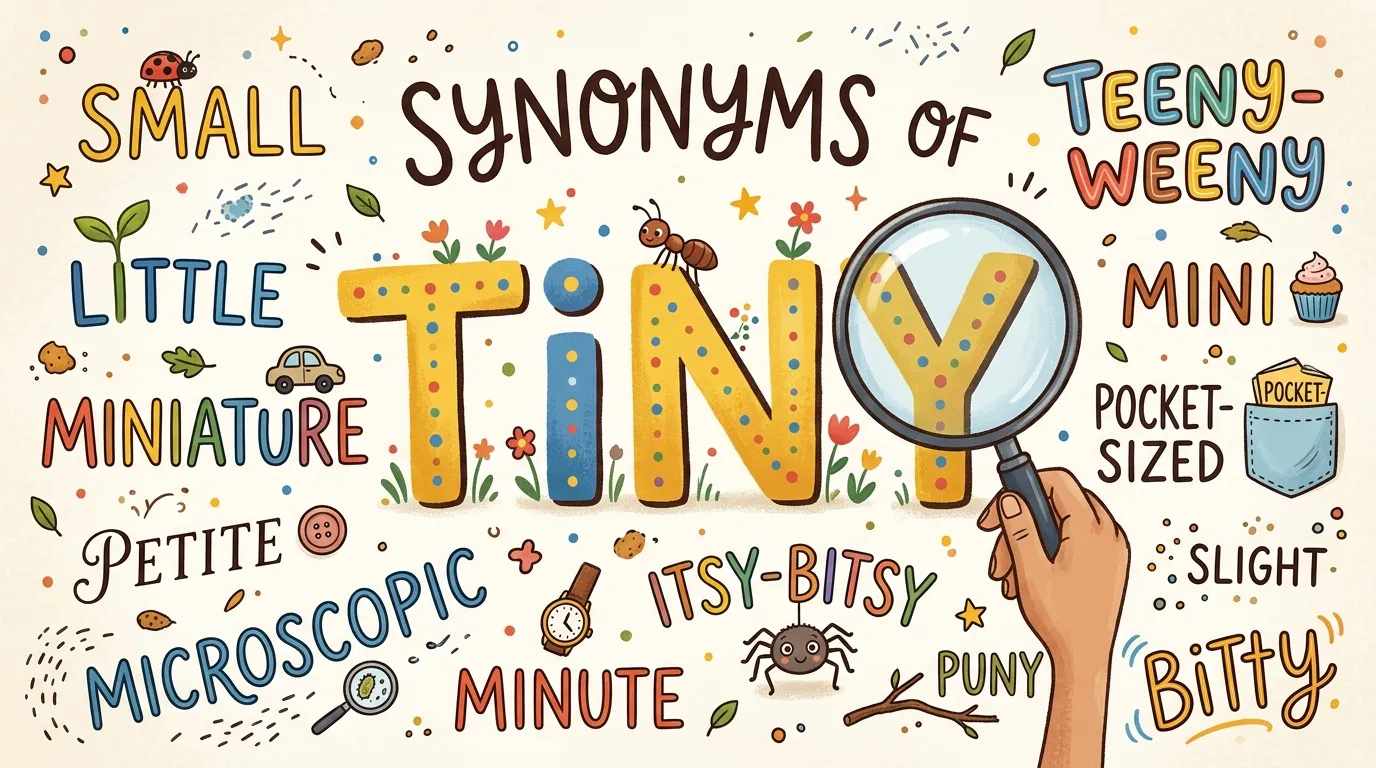
The word tiny means very small. We use it when we talk about things that are much smaller than usual. For example, a child may find a tiny kitten in the garden. The kitten may fit in a small box. This is a simple way to use the word tiny in daily life.
Tiny is a common word in English. We use it to talk about small toys, little insects, small homes, and many other things. But using the same word again and again can make our writing less interesting.
Learning synonyms helps us use new words and share our ideas in better ways. It is useful for students, English learners, teachers, and content writers. Some words show small size, while others show that something is short, slight, or very little.
In this article, you will learn the meaning of tiny, 30 synonyms, and their examples. You will also learn its pronunciation, word history, grammar, tone, and antonyms. This guide will help you choose the right word for speaking and writing.
Meaning of Tiny
Definition
Tiny (Adjective): Very small in size, amount, or degree.
Examples
- A tiny bird sat on the tree.
- She found a tiny button under the bed.
Connotative Meaning
Connotation is the feeling or idea that a word brings to mind, beyond its basic meaning.
- Positive tone: Tiny can suggest something cute, sweet, or lovely. Example: The baby has tiny hands.
- Negative tone: Tiny can suggest that something is too small or not enough. Example: We live in a tiny room.
- Neutral tone: Tiny can simply describe size. Example: A tiny seed fell on the ground.
The tone depends on the sentence and the situation.
Read more about:https://synonymhunting.com/synonyms-of-naive-2/
Etymology of Tiny
The word tiny has an old history.
- Source language: Middle English, with roots linked to older words meaning small or little.
- Original meaning: Small or little in size.
- Word type: Adjective.
Short History of Tiny
Old English (450–1100)
The word tiny was not a common word in Old English. People used other words, such as lytel, to mean small.
Middle English (1100–1500)
Tiny appeared in English during the later Middle English period. Its early use was linked to the idea of something small or little.
Modern English (1500–Present)
Tiny became a common word for something very small. Today, people use it in daily speech, books, stories, and online writing.
Pronunciation (US and UK – IPA)
- US: /ˈtaɪ.ni/
- UK: /ˈtaɪ.ni/
Syllables
ti-ny — 2 syllables.
Affixation Pattern of Tiny
- Root: tiny
- Prefix: None
- Suffix: The word ends in -y, which is part of the word.
- Part of speech: Adjective.
Word Formation
Tiny can form or appear in several related word forms and expressions:
- Tininess (noun): The state of being tiny.
- Tinier (comparative adjective): Smaller than something else.
- Tiniest (superlative adjective): The smallest.
- Tiny-sized (compound adjective): Very small in size.
Examples:
- The tininess of the seed surprised me.
- This box is tinier than that one.
- She found the tiniest shell on the beach.
Synonyms of Tiny
The following 30 words can replace tiny in different situations. Some mean very small, while others describe a small amount, a short length, or a slight degree.
1. Small (Adjective) — US /smɔːl/ | UK /smɔːl/
Meaning: Not large in size.
Examples:
- I live in a small house.
- He bought a small bag.
2. Little (Adjective) — US /ˈlɪt̬.əl/ | UK /ˈlɪt.əl/
Meaning: Small in size or amount.
Examples:
- She has a little dog.
- Please give me a little water.
3. Miniature (Adjective) — US /ˈmɪn.i.ə.tʃɚ/ | UK /ˈmɪn.i.ə.tʃə/
Meaning: Much smaller than the usual size.
Examples:
- He has a miniature car.
- She made a miniature house.
4. Minute (Adjective) — US /maɪˈnuːt/ | UK /maɪˈnjuːt/
Meaning: Extremely small.
Examples:
- A minute crack appeared in the glass.
- The insect had minute wings.
5. Microscopic (Adjective) — US /ˌmaɪ.kroʊˈskɑː.pɪk/ | UK /ˌmaɪ.krəˈskɒp.ɪk/
Meaning: So small that a microscope may be needed to see it.
Examples:
- The water had microscopic germs.
- A microscopic cell can hold important parts of life.
6. Minuscule (Adjective) — US /ˈmɪn.ə.skjuːl/ | UK /ˈmɪn.jə.skjuːl/
Meaning: Extremely small in size or amount.
Examples:
- The ant left a minuscule mark.
- We found a minuscule piece of paper.
7. Petite (Adjective) — US /pəˈtiːt/ | UK /pəˈtiːt/
Meaning: Small and often delicately shaped, especially when describing a person.
Examples:
- She is petite and graceful.
- The shop sells clothes for petite women.
8. Wee (Adjective) — US /wiː/ | UK /wiː/
Meaning: Very small; used often in informal speech.
Examples:
- The child held a wee kitten.
- We saw a wee house near the road.
9. Diminutive (Adjective) — US /dɪˈmɪn.jə.tɪv/ | UK /dɪˈmɪn.jə.tɪv/
Meaning: Small in size or shorter than usual.
Examples:
- A diminutive bird sat on the fence.
- The diminutive plant grew in a pot.
10. Compact (Adjective) — US /kəmˈpækt/ | UK /kəmˈpækt/
Meaning: Small and arranged to take up little space.
Examples:
- We bought a compact camera.
- This compact desk fits in my room.
11. Pocket-sized (Adjective) — US /ˈpɑː.kɪt.saɪzd/ | UK /ˈpɒk.ɪt.saɪzd/
Meaning: Small enough to fit in a pocket.
Examples:
- He carries a pocket-sized notebook.
- I bought a pocket-sized guide.
12. Mini (Adjective) — US /ˈmɪn.i/ | UK /ˈmɪn.i/
Meaning: Smaller than the usual size.
Examples:
- She wore a mini skirt.
- We ordered a mini pizza.
13. Slight (Adjective) — US /slaɪt/ | UK /slaɪt/
Meaning: Small in amount, degree, or size.
Examples:
- There was a slight change in the plan.
- I felt a slight pain in my hand.
14. Scant (Adjective) — US /skænt/ | UK /skænt/
Meaning: Less than enough or barely enough.
Examples:
- We had scant food for the trip.
- The report gave scant details.
15. Meager (Adjective) — US /ˈmiː.ɡɚ/ | UK /ˈmiː.ɡə/
Meaning: Too small in amount or not enough.
Examples:
- He earned a meager wage.
- The family had a meager meal.
16. Trivial (Adjective) — US /ˈtrɪv.i.əl/ | UK /ˈtrɪv.i.əl/
Meaning: So small or unimportant that it may not matter.
Examples:
- They argued over a trivial issue.
- Do not worry about trivial mistakes.
17. Negligible (Adjective) — US /ˈneɡ.lə.dʒə.bəl/ | UK /ˈneɡ.lɪ.dʒə.bəl/
Meaning: So small that it can almost be ignored.
Examples:
- The cost was negligible.
- The change in size was negligible.
18. Fractional (Adjective) — US /ˈfræk.ʃən.əl/ | UK /ˈfræk.ʃən.əl/
Meaning: Very small or related to a fraction of a whole.
Examples:
- There was a fractional increase in price.
- The machine showed a fractional change.
19. Modest (Adjective) — US /ˈmɑː.dɪst/ | UK /ˈmɒd.ɪst/
Meaning: Not large, costly, or great.
Examples:
- They live in a modest home.
- She made a modest profit.
20. Limited (Adjective) — US /ˈlɪm.ɪ.t̬ɪd/ | UK /ˈlɪm.ɪ.tɪd/
Meaning: Small in amount, number, or range.
Examples:
- We have limited space.
- The shop has a limited supply of milk.
21. Fine (Adjective) — US /faɪn/ | UK /faɪn/
Meaning: Very thin or made of very small parts.
Examples:
- The sand was fine and soft.
- A fine line appeared on the wall.
22. Subtle (Adjective) — US /ˈsʌt̬.əl/ | UK /ˈsʌt.əl/
Meaning: Small or hard to notice.
Examples:
- I noticed a subtle change in her voice.
- The painting has subtle details.
23. Slender (Adjective) — US /ˈslen.dɚ/ | UK /ˈslen.də/
Meaning: Thin in shape or width.
Examples:
- A slender branch moved in the wind.
- The bird stood on a slender twig.
24. Narrow (Adjective) — US /ˈner.oʊ/ | UK /ˈnær.əʊ/
Meaning: Not wide.
Examples:
- We walked through a narrow path.
- The room has a narrow window.
25. Short (Adjective) — US /ʃɔːrt/ | UK /ʃɔːt/
Meaning: Not long in length or time.
Examples:
- He wrote a short note.
- We took a short break.
26. Brief (Adjective) — US /briːf/ | UK /briːf/
Meaning: Lasting for a short time or using few words.
Examples:
- We had a brief talk.
- She gave a brief answer.
27. Insignificant (Adjective) — US /ˌɪn.sɪɡˈnɪf.ɪ.kənt/ | UK /ˌɪn.sɪɡˈnɪf.ɪ.kənt/
Meaning: Too small or unimportant to matter much.
Examples:
- The error was insignificant.
- The difference was insignificant.
28. Puny (Adjective) — US /ˈpjuː.ni/ | UK /ˈpjuː.ni/
Meaning: Very small or weak compared with others.
Examples:
- The plant looked puny beside the tree.
- He lifted the puny box with ease.
29. Dinky (Adjective) — US /ˈdɪŋ.ki/ | UK /ˈdɪŋ.ki/
Meaning: Small and often cute or simple.
Examples:
- They live in a dinky little cottage.
- She gave me a dinky toy car.
30. Teeny (Adjective) — US /ˈtiː.ni/ | UK /ˈtiː.ni/
Meaning: Very small; used in informal speech.
Examples:
- The baby wore teeny shoes.
- I found a teeny bug on the leaf.
Prototype Meaning
The most common meaning of tiny is very small in size. When people hear this word, they often imagine something much smaller than usual, such as a little insect, a small button, or a baby animal. Tiny can also describe small amounts, such as a tiny drop of water. It often makes an object sound cute or delicate, but it can also show that something is too small to be useful.
Prototype Categorization
Synonyms of tiny can be placed into groups based on their meanings.
- General small size: Small, little, mini, miniature.
- Extremely small size: Minute, microscopic, minuscule, diminutive, teeny.
- Cute or informal meaning: Wee, dinky, teeny.
- Small amount: Scant, meager, slight, fractional.
- Small or unimportant effect: Trivial, negligible, insignificant.
- Small and space-saving: Compact, pocket-sized.
- Small width or shape: Slender, narrow, fine.
- Small or hard-to-notice details: Subtle.
- Small in range or degree: Limited, modest.
- Short length or time: Short, brief.
- Small or weak compared with others: Puny.
- Small body size or shape: Petite.
These groups help writers choose the right word. For example, use microscopic for something extremely small, compact for a space-saving item, and brief for a short talk. The right synonym makes your meaning clear.
Antonyms of Tiny
Antonyms are words with opposite meanings.
- Huge: Very large.
- Big: Large in size.
- Large: Greater than usual in size.
- Enormous: Extremely large.
- Giant: Much bigger than normal.
- Massive: Very large and heavy.
- Immense: Extremely large in size or amount.
- Vast: Very large in area or range.
- Gigantic: Extremely big.
- Colossal: Very large or great.
Examples:
- Tiny: The dog has a tiny bed.
- Huge: The dog has a huge bed.
Short Questions and Answers
- What does tiny mean?
Tiny means very small in size, amount, or degree. - When should tiny be used?
Use tiny when you want to describe something that is much smaller than usual. - Is tiny positive or negative?
Tiny can be positive, negative, or neutral. It may describe a cute kitten, a room that is too small, or an object in a simple way. - How is tiny different from similar words?
Tiny means very small. Small is more general. Microscopic describes things that are extremely small. Compact means small and arranged to take up little space. Petite often describes a person with a small body size.
Conclusion
Learning the word tiny and its synonyms can help you improve your English. You can use these words to describe objects, people, places, and small amounts. Each synonym has a different meaning or tone. For example, miniature describes something made in a smaller form, while microscopic describes something extremely small.
Using different words makes your writing more clear and interesting. It also helps you avoid repeating the same word many times. Students can use these words in school work, while content writers can use them to make articles more natural. English learners can also use them to speak with more confidence.
Try to learn three new synonyms each day. Write a sentence for each word and use it in daily conversation. With regular practice, your vocabulary will grow.

I’m Zahid Abbas, an educator, researcher, and digital publishing strategist with a passion for linguistics, grammar, and clear communication. As a content creator and SEO specialist, I craft research-driven, reader-focused content that empowers learners and makes knowledge accessible worldwide.










