The word concept means an idea, a thought, or a general plan in your mind about how something works. Imagine a young boy named Leo who sits at his desk with a blank sheet of paper. He wants to build a mini cardboard fort, so he draws a quick sketch of the towers and door before he cuts any boxes. That big thought or plan in his head before building is what we call a concept.
People use synonyms of concept in science projects, lessons, art classes, and daily conversations. Because planning projects and sharing new thoughts happen every day. Concept is an important word for young students to master.
Learning synonyms for concept is necessary for English learners and young writers. Synonyms of concept enables you to describe inventing a game, sharing a story plan with accuracy. This article aims to discuss the meaning of the key word. 30 synonyms of concept with simple examples, grammar facts, word history, pronunciation guides, and easy categories written in short, smooth sentences.
Meaning of Concept
Definition
Concept (Noun): An idea, mental picture, or general understanding of how something is or how it works.
Examples
- She understood the math concept after her teacher explained it.
- His concept for the school play was set in outer space.
Connotative Meaning
- Positive tone: Shows smart thinking, creativity, clear planning, and discovery.
- Negative tone: Points to wild guesses, confusing thoughts, or impractical dreams.
- Neutral tone: Used by teachers and books to describe simple lesson topics and basic ideas.
Etymology
- Source language: Came from the Latin word conceptum, which meant something held or caught in the mind.
- Old English (450–1100): Early children used words like geþanc to mean a thought or mental picture.
- Middle English (1100–1500): Changed into words like concepte when talking about new plans.
- Modern English (1500–Present): Became the common word concept used today in textbooks and science classes!
Pronunciation
- US: /ˈkɑːnsept/
- UK: /ˈkɒnsept/
Syllables
con-cept (2 parts)
Affixation Pattern of Concept
- Root: Concept
- Prefix: Pre- (in preconcept)
- Suffix: -ual (in conceptual), -ualize (in conceptualize)
- Word Formation:
- Noun: Concept, Conception
- Verb: Conceptualize
- Adjective: Conceptual
- Adverb: Conceptually
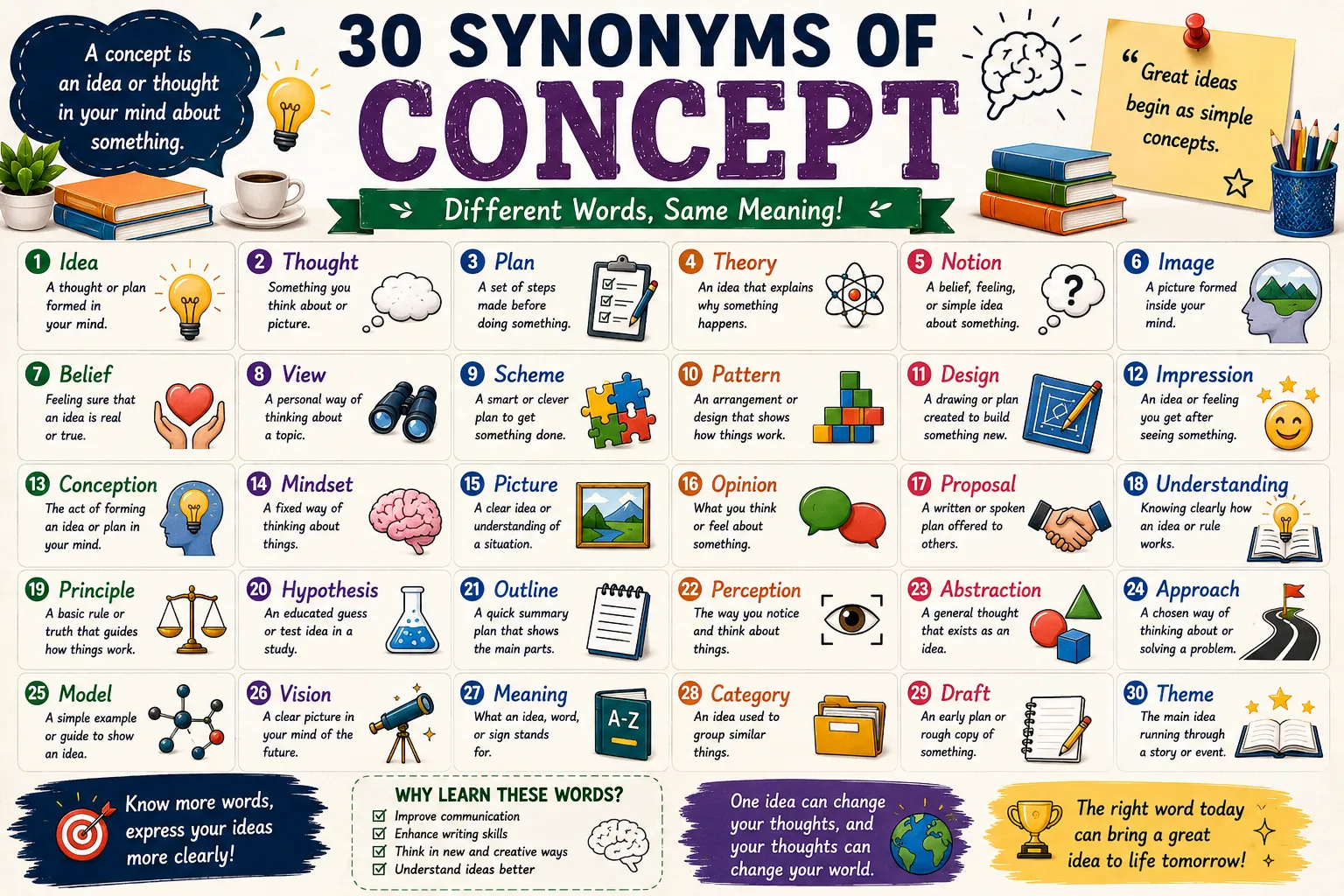
Synonyms of Concept
1. Idea (Noun) — US: /aɪˈdiːə/ | UK: /aɪˈdɪə/
Meaning: A thought or plan formed in your mind.
Examples:
She had a great idea for her science project.
His idea was to build a birdhouse out of wood.
2. Thought (Noun) — US: /θɔːt/ | UK: /θɔːt/
Meaning: Something you think about or picture in your mind.
Examples:
A happy thought popped into his head.
She shared her thought with the reading group.
3. Plan (Noun) — US: /plæn/ | UK: /plæn/
Meaning: A set of steps made before doing something.
Examples:
They made a good plan to clean the classroom.
His plan for recess was to play soccer.
4. Theory (Noun) — US: /ˈθiːəri/ | UK: /ˈθɪəri/
Meaning: An idea that explains why something happens in science or life.
Examples:
The science book explained a theory about gravity.
She tested her theory with a quick experiment.
5. Notion (Noun) — US: /ˈnoʊʃən/ | UK: /ˈnəʊʃn/
Meaning: A belief, feeling, or simple idea about something.
Examples:
He had a funny notion that cats could speak.
She liked the notion of spending summer at the beach.
6. Image (Noun) — US: /ˈɪmɪdʒ/ | UK: /ˈɪmɪdʒ/
Meaning: A picture formed inside your mind.
Examples:
The story created a vivid image of a dark forest.
He kept a mental image of his home park.
7. Belief (Noun) — US: /bɪˈliːf/ | UK: /bɪˈliːf/
Meaning: Feeling sure that an idea is real or true.
Examples:
Her belief was that honesty is always best.
He held a strong belief in team practice.
8. View (Noun) — US: /vjuː/ | UK: /vjuː/
Meaning: A personal way of thinking about a topic.
Examples:
His view on the rule was fair to everyone.
She shared her view during class talk time.
9. Scheme (Noun) — US: /skiːm/ | UK: /skiːm/
Meaning: A smart or clever plan to get something done.
Examples:
They formed a secret scheme to surprise their friend.
His color scheme made the art painting look bright.
10. Pattern (Noun) — US: /ˈpætərn/ | UK: /ˈpætn/
Meaning: An arrangement or design that helps explain how things work.
Examples:
The teacher showed us a number pattern in math.
He noticed a pattern in how the leaves change color.
11. Design (Noun) — US: /dɪˈzaɪn/ | UK: /dɪˈzaɪn/
Meaning: A drawing or plan created to build something new.
Examples:
Her design for the toy boat worked well in water.
He drew a neat design for a poster.
12. Impression (Noun) — US: /ɪmˈprɛʃən/ | UK: /ɪmˈpreʃn/
Meaning: An idea or feeling you get after looking at something.
Examples:
The new student gave a polite impression.
I got the impression that it would snow today.
13. Conception (Noun) — US: /kənˈsɛpʃən/ | UK: /kənˈsepʃn/
Meaning: The act of forming an idea or plan in your mind.
Examples:
Her conception of the story was very creative.
He had no conception of how big the ocean was.
14. Mindset (Noun) — US: /ˈmaɪndsɛt/ | UK: /ˈmaɪndset/
Meaning: A fixed way of thinking about things.
Examples:
A growth mindset helps you learn from mistakes.
She tackled the game with a winning mindset.
15. Picture (Noun) — US: /ˈpɪktʃər/ | UK: /ˈpɪktʃə/
Meaning: A clear idea or understanding of a full situation.
Examples:
The guide gave us a full picture of farm life.
He drew a mental picture of his trip.
16. Opinion (Noun) — US: /əˈpɪnjən/ | UK: /əˈpɪnjən/
Meaning: What you think or feel about a person or item.
Examples:
In my opinion, apples taste better than grapes.
She asked her friend for an opinion on her dress.
17. Proposal (Noun) — US: /prəˈpoʊzəl/ | UK: /prəˈpəʊzl/
Meaning: A written or spoken plan offered to others for review.
Examples:
The principal liked our proposal for a garden.
He presented his proposal to the team.
18. Understanding (Noun) — US: /ˌʌndərˈstændɪŋ/ | UK: /ˌʌndəˈstændɪŋ/
Meaning: Knowing clearly how an idea or rule works.
Examples:
She has a good understanding of plant growth.
They came to a mutual understanding about taking turns.
19. Principle (Noun) — US: /ˈprɪnsəpəl/ | UK: /ˈprɪnsəpl/
Meaning: A basic rule or truth that guides how things work.
Examples:
Helping others is a good basic principle.
We studied the principle of magnetic force today.
20. Hypothesis (Noun) — US: /haɪˈpɑːθəsɪs/ | UK: /haɪˈpɒθəsɪs/
Meaning: An educated guess or test idea in a science study.
Examples:
His hypothesis was that warm water dissolves sugar faster.
The team wrote their hypothesis on the chart.
21. Outline (Noun) — US: /ˈaʊtlaɪn/ | UK: /ˈaʊtlaɪn/
Meaning: A quick summary plan that shows the main parts.
Examples:
She wrote an outline before drafting her paper.
The board showed an outline of our day.
22. Perception (Noun) — US: /pərˈsɛpʃən/ | UK: /pəˈsepʃn/
Meaning: The way you notice and think about things through your senses.
Examples:
Her perception of the noise was that a storm was near.
Good lighting changed his perception of the room.
23. Abstraction (Noun) — US: /æbˈstrækʃən/ | UK: /æbˈstrækʃn/
Meaning: A general thought that exists as an idea rather than a real object.
Examples:
Love is an abstraction that we show through care.
Math numbers are an abstraction used for counting.
24. Approach (Noun) — US: /əˈproʊtʃ/ | UK: /əˈprəʊtʃ/
Meaning: A chosen way of thinking about or solving a problem.
Examples:
A calm approach helped solve the argument.
She tried a new approach to answer the puzzle.
25. Model (Noun) — US: /ˈmɑːdəl/ | UK: /ˈmɒdl/
Meaning: A simple example or guide made to show an idea.
Examples:
The plastic model showed how the heart pumps blood.
He built a scale model of a space rocket.
26. Vision (Noun) — US: /ˈvɪʒən/ | UK: /ˈvɪʒn/
Meaning: A clear picture in your mind of what the future could be.
Examples:
She had a clear vision for her new storybook.
His vision was a park full of bright flowers.
27. Meaning (Noun) — US: /ˈmiːnɪŋ/ | UK: /ˈmiːnɪŋ/
Meaning: What an idea, word, or sign stands for.
Examples:
The dictionary shows the meaning of hard words.
A red light carries the meaning to stop safely.
28. Category (Noun) — US: /ˈkætəɡɔːri/ | UK: /ˈkætəɡəri/
Meaning: An idea used to group similar things together.
Examples:
Dogs and cats belong in the animal category.
She placed the books in the science category.
29. Draft (Noun) — US: /dræft/ | UK: /drɑːft/
Meaning: An early plan or rough copy of a drawing or paper.
Examples:
He made a rough draft of his essay first.
She showed her initial draft to her dad.
30. Theme (Noun) — US: /θiːm/ | UK: /θiːm/
Meaning: The main idea running through a story, song, or party.
Examples:
The theme of the story was true friendship.
Our party had a fun beach theme.
Prototype Meaning
When children hear the word concept, they usually picture a student forming a new project plan in their mind. Also sketching a blueprint, or grasping a new topic introduced during a science or math class.
Prototype Categorization
- Basic Thoughts & Ideas: Idea, Thought, Notion, Impression, Conception, Opinion, View.
- Plans & Drawings: Plan, Scheme, Design, Proposal, Outline, Draft, Model, Approach.
- Science & Lessons: Theory, Pattern, Hypothesis, Principle, Understanding, Abstraction, Category.
- Mind Pictures & Future Goals: Image, Picture, Vision, Mindset, Perception, Belief, Theme, Meaning.
Antonyms of Concept
- Fact
- Reality
- Object
- Physical Thing
- Truth
- Concrete Item
Short Questions and Answers
- What does concept mean?
- Concept means an idea, plan, or thought in your mind about how something works.
- When should concept be used?
- Use concept when talking about math lessons, science plans, story themes, or inventions.
- Is concept positive or negative?
- Concept is usually neutral and positive because it leads to learning, inventing, and planning.
- How is it different from similar words?
- Concept means an overall big idea, while plan lists step-by-step actions, and theory is a testable science guess.
CONCLUSION
Synonyms for concept strengthens your overall English vocabulary. Relying on the same basic word every day can make your class stories sound plain. Using synonyms of concept like idea for quick thoughts, hypothesis for science, or design for drawings makes your sentences clear. Synonyms of concept expand your vocabulary sharpens your writing, builds speaking confidence. Start practicing two or three of these easy synonyms in your daily reading and writing today.

I’m Zahid Abbas, an educator, researcher, and digital publishing strategist with a passion for linguistics, grammar, and clear communication. As a content creator and SEO specialist, I craft research-driven, reader-focused content that empowers learners and makes knowledge accessible worldwide.