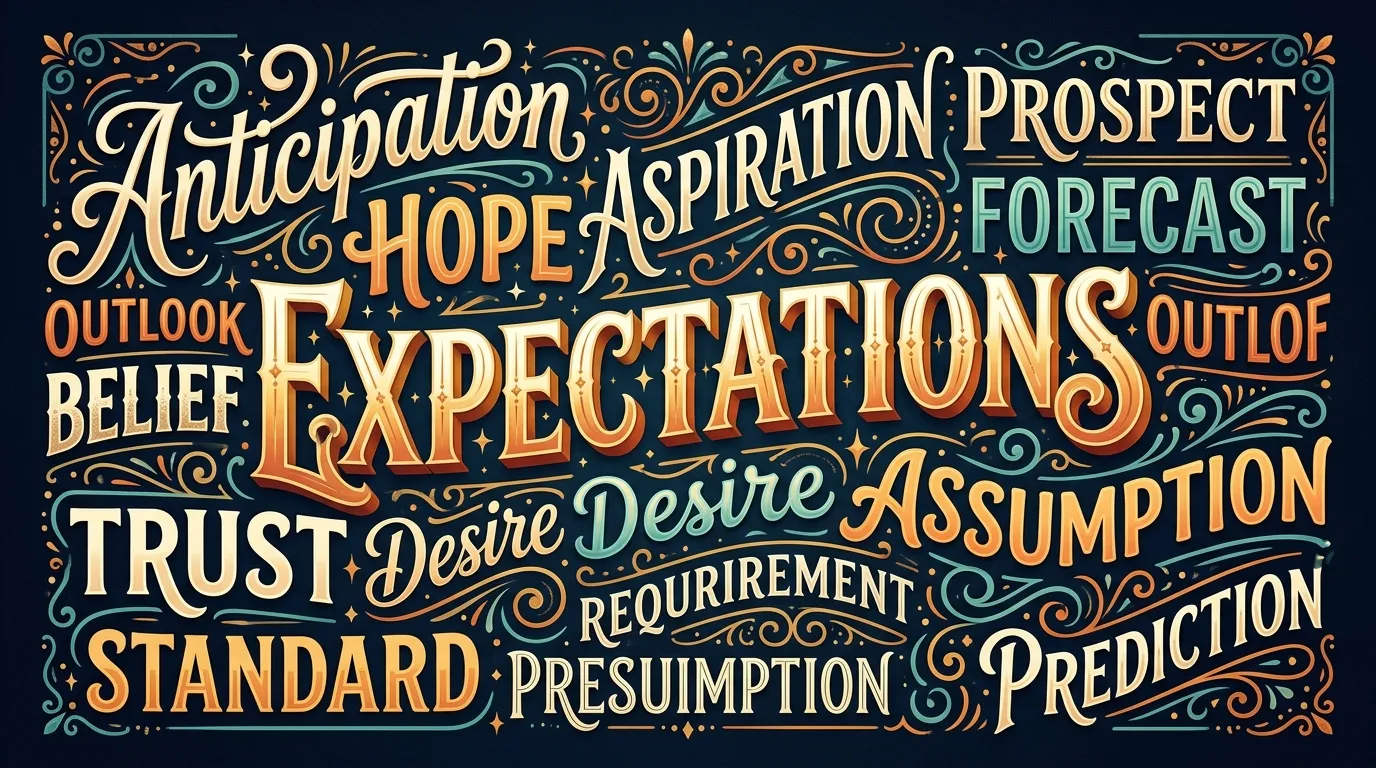
Expectations are things we think will happen or want to happen. For example, a student may have high expectations before an exam. The student hopes to get good marks and make their parents proud.
We use the word expectations in daily life. It helps us talk about our hopes, plans, needs, and beliefs about the future. We have expectations at school, at work, and in our family life.
Learning synonyms of expectations helps English learners use new words with ease. It also helps writers make their work clear and interesting. Using the same word again and again can make writing dull. The right synonym can make each sentence better.
Meaning of Expectations
Definition
Expectations (noun): Beliefs about what will happen or hopes about what someone will do.
Examples
- My expectations are high for the school team.
- She has clear expectations for her new job.
Read more about:https://synonymhunting.com/synonyms-of-structure/
Connotative Meaning
Connotation is the feeling or idea a word gives beyond its basic meaning.
- Positive tone: Expectations can show hope, trust, and belief in success.
- Negative tone: Expectations can feel like pressure when they are too high.
- Neutral tone: Expectations can simply mean what someone thinks will happen.
Etymology of Expectations
The word expectations comes from the Latin word expectare, which means “to wait for” or “to look for.”
- Source language: Latin, through French and English.
- Original meaning: To wait for something or look forward to it.
- Word history: The word expectation grew from the verb expect.
Short History
Old English (450–1100)
Old English had other words for waiting, hoping, and looking ahead. The modern word expectation was not yet in common use.
Middle English (1100–1500)
After the Norman Conquest, French and Latin words became more common in English. Words linked to expecting and waiting grew in use.
Modern English (1500–Present)
The word expectation became common in daily speech and writing. Today, people use expectations to talk about hopes, plans, duties, and likely events.
Pronunciation
- US: /ˌɛk.spɛkˈteɪ.ʃənz/
- UK: /ˌɛk.spekˈteɪ.ʃənz/
Syllables
ex-pec-ta-tions
The word has four syllables.
Affixation Pattern of Expectations
- Root: Expect
- Prefix: None in the base word expect
- Suffix: -action forms the noun expectation; -s makes it plural.
Synonyms of Expectations
These 30 words are useful alternatives to expectations. Some are close in meaning, but they do not fit every sentence.
1. Hopes (Noun)
US: /hoʊps/ · UK: /həʊps/
Meaning: Things you want to happen.
Examples:
- My hopes are high for the new school year.
- Her hopes of winning the race came true.
2. Beliefs (Noun)
US: /bɪˈliːfs/ · UK: /bɪˈliːfs/
Meaning: Ideas that you think are true.
Examples:
- His beliefs about success are strong.
- Our beliefs can shape our expectations.
3. Assumptions (Noun)
US: /əˈsʌmp.ʃənz/ · UK: /əˈsʌmp.ʃənz/
Meaning: Ideas you accept as true without proof.
Examples:
- Do not make assumptions about others.
- Her assumptions about the test were wrong.
4. Anticipations (Noun)
US: /ænˌtɪs.əˈpeɪ.ʃənz/ · UK: /ænˌtɪs.ɪˈpeɪ.ʃənz/
Meaning: Thoughts about what may happen soon.
Examples:
- Our anticipations grew before the big match.
- The trip brought joy and happy anticipations.
5. Predictions (Noun)
US: /prɪˈdɪk.ʃənz/ · UK: /prɪˈdɪk.ʃənz/
Meaning: Statements about what may happen in the future.
Examples:
- His predictions about the game were right.
- Weather predictions help us plan our day.
6. Prospects (Noun)
US: /ˈprɑː.spekts/ · UK: /ˈprɒs.pekts/
Meaning: Chances of something good or bad happening.
Examples:
- She has good prospects for the new job.
- The team has bright prospects this year.
7. Standards (Noun)
US: /ˈstæn.dɚdz/ · UK: /ˈstæn.dədz/
Meaning: Levels of quality or behavior that people expect.
Examples:
- Our school has high standards.
- The shop must meet safety standards.
8. Requirements (Noun)
US: /rɪˈkwaɪr.mənts/ · UK: /rɪˈkwaɪə.mənts/
Meaning: Things that are needed or must be done.
Examples:
- Read the job requirements before you apply.
- The course has three main requirements.
9. Demands (Noun)
US: /dɪˈmændz/ · UK: /dɪˈmɑːndz/
Meaning: Things someone says must be done or given.
Examples:
- The job has many demands.
- The coach’s demands were hard to meet.
10. Wishes (Noun)
US: /ˈwɪʃ.ɪz/ · UK: /ˈwɪʃ.ɪz/
Meaning: Things you want to happen.
Examples:
- My wishes for the future are simple.
- Her wishes came true on her birthday.
11. Desires (Noun)
US: /dɪˈzaɪɚz/ · UK: /dɪˈzaɪəz/
Meaning: Strong wants for something.
Examples:
- His desires helped him work hard.
- She shared her desires with her family.
12. Goals (Noun)
US: /ɡoʊlz/ · UK: /ɡəʊlz/
Meaning: Things you want to achieve.
Examples:
- My goals include learning English.
- She set clear goals for the year.
13. Objectives (Noun)
US: /əbˈdʒek.tɪvz/ · UK: /əbˈdʒek.tɪvz/
Meaning: Clear aims that you plan to reach.
Examples:
- Our main objective is to help students.
- The team met its goals and objectives.
14. Outlooks (Noun)
US: /ˈaʊt.lʊks/ · UK: /ˈaʊt.lʊks/
Meaning: Ways of thinking about what may happen.
Examples:
- The business outlook is good.
- Her outlook on life is hopeful.
15. Forecasts (Noun)
US: /ˈfɔːr.kæsts/ · UK: /ˈfɔː.kɑːsts/
Meaning: Statements about what is likely to happen.
Examples:
- The sales forecasts look strong.
- The weather forecast says rain is coming.
16. Beliefs about the Future (Noun Phrase)
US: /bɪˈliːfs əˌbaʊt ðə ˈfjuː.tʃɚ/ · UK: /bɪˈliːfs əˌbaʊt ðə ˈfjuː.tʃə/
Meaning: Ideas about what may happen later.
Examples:
- Our beliefs about the future can change.
- His beliefs about the future are hopeful.
17. Assurances (Noun)
US: /əˈʃʊr.ən.sɪz/ · UK: /əˈʃɔː.rən.sɪz/
Meaning: Statements meant to make someone feel sure.
Examples:
- She gave us assurances of her support.
- His assurances helped calm the team.
18. Likelihoods (Noun)
US: /ˈlaɪk.li.hʊdz/ · UK: /ˈlaɪk.li.hʊdz/
Meaning: Chances that something will happen.
Examples:
- We discussed the likelihoods of success.
- The likelihood of rain is high.
19. Possibilities (Noun)
US: /ˌpɑː.səˈbɪl.ə.tiz/ · UK: /ˌpɒs.əˈbɪl.ə.tiz/
Meaning: Things that may happen or be true.
Examples:
- There are many possibilities for the future.
- We talked about the possibilities of change.
20. Visions (Noun)
US: /ˈvɪʒ.ənz/ · UK: /ˈvɪʒ.ənz/
Meaning: Ideas or pictures of what you want the future to be.
Examples:
- The leader shared her vision for the school.
- His vision of success inspired his team.
21. Plans (Noun)
US: /plænz/ · UK: /plænz/
Meaning: Ideas about what you will do.
Examples:
- Our plans for the trip are ready.
- She has big plans for her future.
22. Intentions (Noun)
US: /ɪnˈten.ʃənz/ · UK: /ɪnˈten.ʃənz/
Meaning: Things you plan or mean to do.
Examples:
- My intentions are honest.
- He shared his intentions with the group.
23. Aspirations (Noun)
US: /ˌæs.pəˈreɪ.ʃənz/ · UK: /ˌæs.pɪˈreɪ.ʃənz/
Meaning: Strong hopes to achieve something important.
Examples:
- Her aspirations include becoming a teacher.
- Young people often have big aspirations.
24. Standards of Performance (Noun Phrase)
US: /ˈstæn.dɚdz əv pɚˈfɔːr.məns/ · UK: /ˈstæn.dədz əv pəˈfɔː.məns/
Meaning: Levels of work or action that people expect.
Examples:
- The school has high standards of performance.
- Workers must meet the standards of performance.
25. Obligations (Noun)
US: /ˌɑː.bləˈɡeɪ.ʃənz/ · UK: /ˌɒb.lɪˈɡeɪ.ʃənz/
Meaning: Duties that you must carry out.
Examples:
- Parents have obligations to their children.
- He met his work obligations on time.
26. Hunches (Noun)
US: /ˈhʌn.tʃɪz/ · UK: /ˈhʌn.tʃɪz/
Meaning: Feelings that something may be true without proof.
Examples:
- I had a hunch that we would win.
- Her hunch about the answer was right.
27. Estimates (Noun)
US: /ˈes.tə.məts/ · UK: /ˈes.tɪ.məts/
Meaning: Rough ideas about an amount, size, or result.
Examples:
- Our cost estimates were close to the final price.
- The builders gave us estimates for the work.
28. Standards of Conduct (Noun Phrase)
US: /ˈstæn.dɚdz əv ˈkɑːn.dʌkt/ · UK: /ˈstæn.dədz əv ˈkɒn.dʌkt/
Meaning: Rules for how people should act.
Examples:
- The school has clear standards of conduct.
- Workers must follow the standards of conduct.
29. Predictions of Success (Noun Phrase)
US: /prɪˈdɪk.ʃənz əv səkˈses/ · UK: /prɪˈdɪk.ʃənz əv səkˈses/
Meaning: Statements that someone or something will do well.
Examples:
- The coach made predictions of success for the team.
- Her predictions of success came true.
30. Hopes and Dreams (Noun Phrase)
US: /hoʊps ænd driːmz/ · UK: /həʊps ænd driːmz/
Meaning: Things you deeply want to happen in life.
Examples:
- His hopes and dreams include helping others.
- She worked hard to reach her hopes and dreams.
Prototype Meaning of Expectations
The most common meaning of expectations is what people think will happen or what they want to happen. For example, a teacher may expect students to do their homework. Parents may expect their children to work hard. A student may expect good marks after studying. The word can describe hopes, duties, or ideas about the future. Its exact meaning depends on the situation.
Prototype Categorization
Synonyms can be grouped by meaning. This helps you pick the right word for each sentence.
- Hopes and wishes: hopes, wishes, desires, aspirations, hopes and dreams. Use these words for things people want.
- Beliefs and guesses: beliefs, assumptions, hunches, outlooks. Use these when talking about what people think.
- Future events: predictions, forecasts, anticipations, likelihoods, possibilities. Use these for things that may happen.
- Goals and plans: goals, objectives, plans, intentions, visions. Use these for aims and future actions.
- Rules and duties: standards, requirements, demands, obligations, standards of conduct. Use these for things people must do.
- Results and chances: prospects, estimates, predictions of success, standards of performance. Use these when talking about results, chances, or levels of work.
- Trust and certainty: assurances. Use this word when someone tries to make others feel sure.
Choosing the right category helps writers avoid mistakes. For example, hopes is about what you want, while requirements are things you must do. They are not always interchangeable.
Antonyms of Expectations
Antonyms are words with opposite or very different meanings. There is no single perfect opposite for expectations, but these words can work in some contexts.
- Surprise: something you did not expect.
- Uncertainty: not knowing what will happen.
- Doubt: a feeling that something may not be true.
- Disbelief: not accepting something as true.
- Unlikelihood: a low chance of something happening.
- Unpreparedness: not being ready for something.
- Reality: what is actually true or happening, rather than what was expected.
Short Questions and Answers
– What does expectations mean?
It means beliefs about what will happen or hopes about what someone will do.
– When should expectations be used?
Use it when talking about hopes, duties, or ideas about the future.
– Is expectations positive or negative?
It can be positive, negative, or neutral. The meaning depends on the situation.
– How is it different from similar words?
Hopes are things you want to happen. Predictions are ideas about what may happen. Requirements are things that must be done.
– Can expectations be used in formal writing?
Yes. It is common in school, business, research, and daily life.
– What is the singular form of expectations?
The singular form is expectation.
– What is a simple synonym for expectations?
Hopes is a simple choice when you mean things you want to happen.
Conclusion
Learning the meaning of expectations and its synonyms can help you improve your English. Words like hopes, goals, plans, and predictions let you share your ideas in clear ways. Each word has a slightly different meaning, so it is important to choose the one that fits your sentence.
Using different words also helps you avoid repetition in essays, stories, and blog posts. It can make your speech more natural and your writing more interesting. Learning pronunciation and word history can also help you understand English better.
Try to learn two or three new words each day. Write a short sentence with each word and use it in a real talk or a school task. With daily practice, you can build a stronger vocabulary and feel more confident when speaking and writing English.

I’m Zahid Abbas, an educator, researcher, and digital publishing strategist with a passion for linguistics, grammar, and clear communication. As a content creator and SEO specialist, I craft research-driven, reader-focused content that empowers learners and makes knowledge accessible worldwide.










