Forced means made to happen through pressure or effort, or not natural or freely chosen. Think about a boy who is asked to smile for a family photo, even though he is upset about losing his soccer game. His smile looks forced because it does not come from real joy. People use synonyms for forced a lot to describe actions, feelings, or situations that happen. because of pressure rather than free choice. For English learners and content writers, learning synonyms for forced words like forced is important. It helps you avoid repeating the same word again and again. Also makes your writing sound more natural and precise. This article explains the meaning of forced. Along synonyms, examples, grammar, history, pronunciation, and word categories.
Meaning of Forced
Definition
Forced (Adjective):
Made to happen through pressure, effort, or lack of choice; not natural or free.
Examples
- His forced laugh did not fool anyone.
- The company made a forced decision due to low funds.
Connotative Meaning
- Positive tone: It is rarely positive, but it can sound clear when describing a difficult but necessary choice.
- Negative tone: Often feels uncomfortable, showing something unnatural, unwanted, or done under pressure.
- Neutral tone: In legal or technical writing, it can describe a required action in a plain, factual way.
Etymology
- Comes from the word “force,” from Old French “force,” meaning “strength” or “power.”
- That word came from Vulgar Latin “fortia,” based on Latin “fortis,” meaning “strong.”
- The adjective “forced” formed by adding “-ed” to the verb “force.”
Short History
- Old English (450–1100):
- This word did not exist yet. People used other native words to describe strength or pressure.
- Middle English (1100–1500):
- The word “force” entered English from Old French and meant “strength” or “power.” The adjective “forced” later developed from it.
- Modern English (1500–Present):
- The word came to describe both physical pressure, such as forced labor, and unnatural behavior, such as a forced smile.
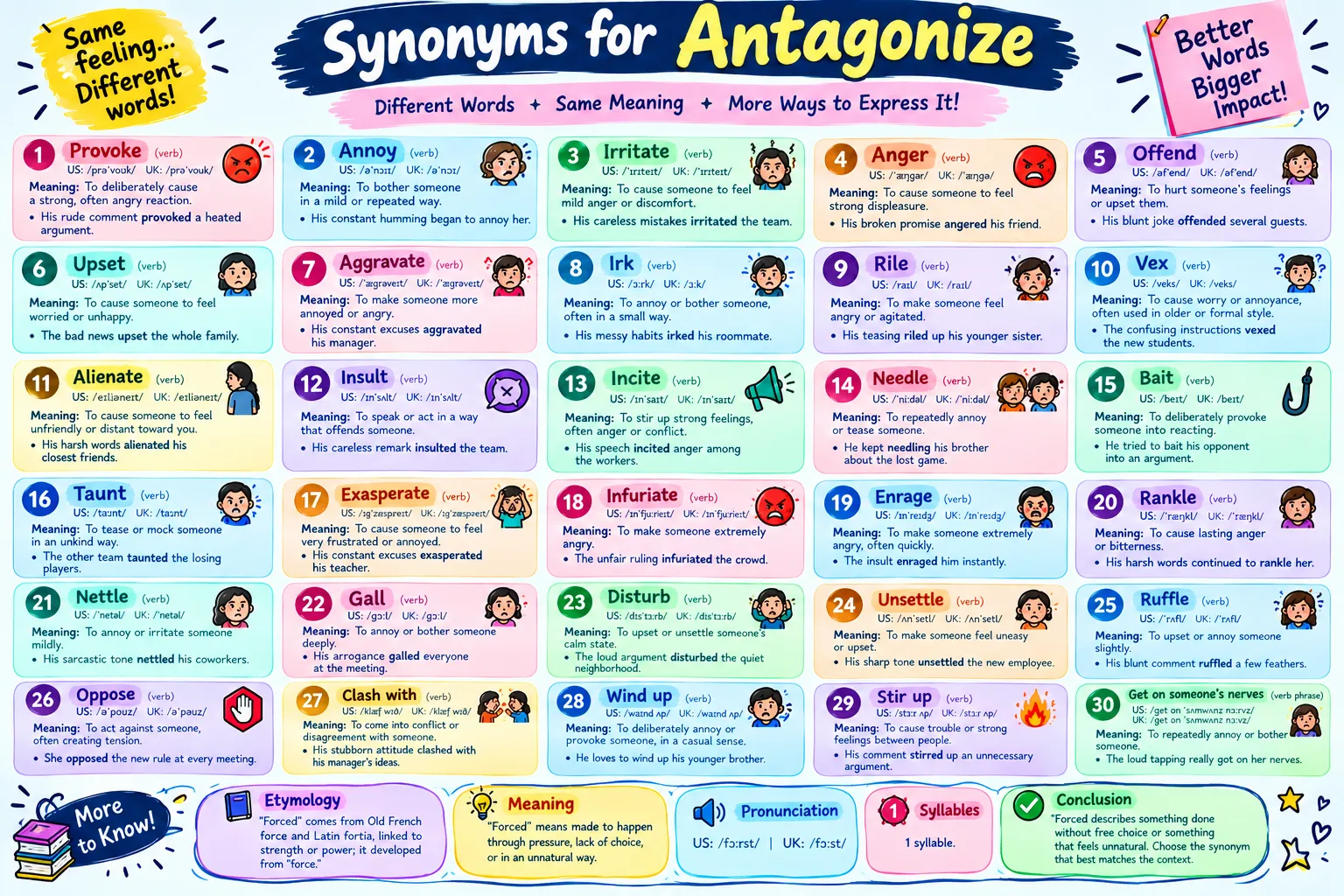
Pronunciation (US & UK – IPA)
- US: /fɔːrst/
- UK: /fɔːst/
Syllables
forced (1 syllable)
Affixation Pattern of Forced
- Root: force (from Latin “fortis,” meaning “strong”)
- Prefix: none
- Suffix: -ed (turns the word into an adjective)
Word Formation:
Force (noun/verb), forced (adjective), forceful (adjective), and forcefully (adverb) all share this root.
Also explore related topics https://synonymhunting.com/synonyms-for-according/
Synonyms for Forced
1. Compelled (Adjective) — US: /kəmˈpɛld/ | UK: /kəmˈpɛld/
Meaning: Made to do something through strong pressure.
Examples:
- She felt compelled to apologize.
- He was compelled to sell the old car.
2. Coerced (Adjective) — US: /koʊˈɜːrst/ | UK: /kəʊˈɜːst/
Meaning: Made to act through threats or strong pressure.
Examples:
- He was coerced into signing the paper.
- She felt coerced into agreeing with the plan.
3. Obligatory (Adjective) — US: /əˈblɪɡəˌtɔːri/ | UK: /əˈblɪɡətəri/
Meaning: Required, with no real choice involved.
Examples:
- Wearing a helmet is obligatory here.
- The meeting is obligatory for all staff.
4. Involuntary (Adjective) — US: /ɪnˈvɑːləntɛri/ | UK: /ɪnˈvɒləntəri/
Meaning: Happening without a person’s free choice.
Examples:
- His involuntary shiver showed how cold he was.
- The move was involuntary due to new company rules.
5. Mandatory (Adjective) — US: /ˈmændəˌtɔːri/ | UK: /ˈmændətəri/
Meaning: Required by a rule, with no exceptions.
Examples:
- Attendance is mandatory for the training.
- Seat belts are mandatory in most countries.
6. Imposed (Adjective) — US: /ɪmˈpoʊzd/ | UK: /ɪmˈpəʊzd/
Meaning: Made to happen by an outside authority or force.
Examples:
- The new rules were imposed by the government.
- A curfew was imposed after the storm.
7. Strained (Adjective) — US: /streɪnd/ | UK: /streɪnd/
Meaning: Showing effort that feels unnatural or uncomfortable.
Examples:
- Her strained smile hid her sadness.
- His strained laugh sounded fake.
8. Unnatural (Adjective) — US: /ʌnˈnætʃərəl/ | UK: /ʌnˈnætʃrəl/
Meaning: Not natural, appearing forced or artificial.
Examples:
- His unnatural pause made everyone uneasy.
- The unnatural silence felt strange.
9. Artificial (Adjective) — US: /ˌɑːrtɪˈfɪʃəl/ | UK: /ˌɑːtɪˈfɪʃəl/
Meaning: Not genuine, made to seem real without being so.
Examples:
- His artificial cheerfulness fooled no one.
- The artificial politeness felt cold.
10. Fake (Adjective) — US: /feɪk/ | UK: /feɪk/
Meaning: Not real or genuine.
Examples:
- Her fake smile was easy to spot.
- His fake laugh made everyone uncomfortable.
11. Contrived (Adjective) — US: /kənˈtraɪvd/ | UK: /kənˈtraɪvd/
Meaning: Planned or forced in an unnatural way.
Examples:
- The contrived ending felt unrealistic.
- Her contrived excuse convinced no one.
12. Unwilling (Adjective) — US: /ʌnˈwɪlɪŋ/ | UK: /ʌnˈwɪlɪŋ/
Meaning: Not wanting to do something, but doing it anyway.
Examples:
- He gave an unwilling apology.
- She was unwilling but agreed to help.
13. Reluctant (Adjective) — US: /rɪˈlʌktənt/ | UK: /rɪˈlʌktənt/
Meaning: Hesitant or unwilling to do something.
Examples:
- She gave a reluctant nod.
- He was reluctant to change his plans.
14. Pressured (Adjective) — US: /ˈprɛʃərd/ | UK: /ˈprɛʃəd/
Meaning: Made to feel forced through outside pressure.
Examples:
- She felt pressured to accept the offer.
- He was pressured into staying late.
15. Compulsory (Adjective) — US: /kəmˈpʌlsəri/ | UK: /kəmˈpʌlsəri/
Meaning: Required with no choice, especially by law or rule.
Examples:
- School is compulsory for children.
- The test is compulsory for graduation.
16. Required (Adjective) — US: /rɪˈkwaɪərd/ | UK: /rɪˈkwaɪəd/
Meaning: Needed or demanded, with no real choice.
Examples:
- A signature is required to proceed.
- Uniforms are required at this school.
17. Obliged (Adjective) — US: /əˈblaɪdʒd/ | UK: /əˈblaɪdʒd/
Meaning: Made to feel a duty or pressure to act.
Examples:
- He felt obliged to attend the funeral.
- She was obliged to explain her absence.
18. Coercive (Adjective) — US: /koʊˈɜːrsɪv/ | UK: /kəʊˈɜːsɪv/
Meaning: Using pressure or threats to force action.
Examples:
- The coercive tactics angered the workers.
- His coercive tone made her uncomfortable.
19. Mandated (Adjective) — US: /ˈmændeɪtɪd/ | UK: /ˈmændeɪtɪd/
Meaning: Officially required by authority.
Examples:
- Masks were mandated during the outbreak.
- The new policy is mandated by the board.
20. Dictated (Adjective) — US: /ˈdɪkˌteɪtɪd/ | UK: /ˈdɪkteɪtɪd/
Meaning: Decided or forced by an outside authority.
Examples:
- The rules were dictated by the head office.
- Her schedule was dictated by the new manager.
21. Feigned (Adjective) — US: /feɪnd/ | UK: /feɪnd/
Meaning: Pretended, not showing real feeling.
Examples:
- Her feigned interest was easy to notice.
- He gave a feigned smile during the meeting.
22. Put-on (Adjective) — US: /ˈpʊt ɒn/ | UK: /ˈpʊt ɒn/
Meaning: Pretended, not showing a real reaction.
Examples:
- His put-on accent surprised his friends.
- Her put-on confidence hid her nerves.
23. Affected (Adjective) — US: /əˈfɛktɪd/ | UK: /əˈfɛktɪd/
Meaning: Showing an unnatural or exaggerated manner.
Examples:
- His affected politeness felt strange.
- Her affected laugh annoyed her friends.
24. Labored (Adjective) — US: /ˈleɪbərd/ | UK: /ˈleɪbəd/
Meaning: Done with visible, unnatural effort.
Examples:
- His labored breathing worried the doctor.
- Her labored explanation confused the class.
25. False (Adjective) — US: /fɔːls/ | UK: /fɔːls/
Meaning: Not true or genuine.
Examples:
- His false cheerfulness fooled no one.
- She gave a false impression of calm.
26. Insincere (Adjective) — US: /ˌɪnsɪnˈsɪr/ | UK: /ˌɪnsɪnˈsɪə/
Meaning: Not showing true or honest feelings.
Examples:
- His insincere apology upset her more.
- Her insincere compliment felt hollow.
27. Hollow (Adjective) — US: /ˈhɑːloʊ/ | UK: /ˈhɒləʊ/
Meaning: Lacking real feeling behind the words or actions.
Examples:
- His hollow promise meant nothing to her.
- Her hollow laugh hid her sadness.
28. Staged (Adjective) — US: /steɪdʒd/ | UK: /steɪdʒd/
Meaning: Arranged to look real, but planned beforehand.
Examples:
- The photo looked completely staged.
- His staged reaction fooled the cameras.
29. Phony (Adjective) — US: /ˈfoʊni/ | UK: /ˈfəʊni/
Meaning: Fake or not genuine, used casually.
Examples:
- His phony smile didn’t fool anyone.
- Her phony excuse fell apart quickly.
30. Constrained (Adjective) — US: /kənˈstreɪnd/ | UK: /kənˈstreɪnd/
Meaning: Limited or pressured into a certain action.
Examples:
- He felt constrained by the strict rules.
- Her choices were constrained by lack of money.
Prototype Meaning
When people hear the word forced, they often think of something that is not natural or freely chosen. It may be a fake smile, a strict rule, or an action done under pressure. The word often suggests discomfort and a lack of true choice.
Prototype Categorization
- Made by rules or law: mandatory, compulsory, required, obligatory, mandated
- Pressured or threatened: compelled, coerced, coercive, pressured, imposed, dictated
- Fake or unnatural expressions: fake, feigned, put-on, phony, affected, insincere, hollow, staged
- Unwilling or reluctant actions: unwilling, reluctant, obliged, constrained
- Strained or effortful: strained, unnatural, labored, contrived
- Not genuine: artificial, false, involuntary
Antonyms of Forced
- Natural
- Voluntary
- Genuine
- Spontaneous
- Willing
Short Questions and Answers
- What does forced mean? It means made to happen through pressure, effort, or lack of choice.
- When should forced be used? Use it when describing actions, feelings, or rules that lack real freedom or natural choice.
- Is forced positive or negative? It is usually negative, showing discomfort or a lack of genuine willingness.
- How is it different from similar words? “Required” often describes a simple rule to follow. “Forced” usually carries a stronger feeling of pressure or unwillingness behind the action.
Conclusion
Synonyms for forced helps you build a stronger, more precise vocabulary. It strengthens your writing and speaking by giving you many ways to describe pressure, fake behavior, and lack of choice. Synonyms for forced helps you avoid repeating the same word again and again. It keeps your writing clearer and more expressive. Most importantly, it builds your confidence as an English speaker and writer. Try learning one new synonyms for forced from this list each day, and watch your vocabulary grow steadily over time.

I’m Zahid Abbas, an educator, researcher, and digital publishing strategist with a passion for linguistics, grammar, and clear communication. As a content creator and SEO specialist, I craft research-driven, reader-focused content that empowers learners and makes knowledge accessible worldwide.