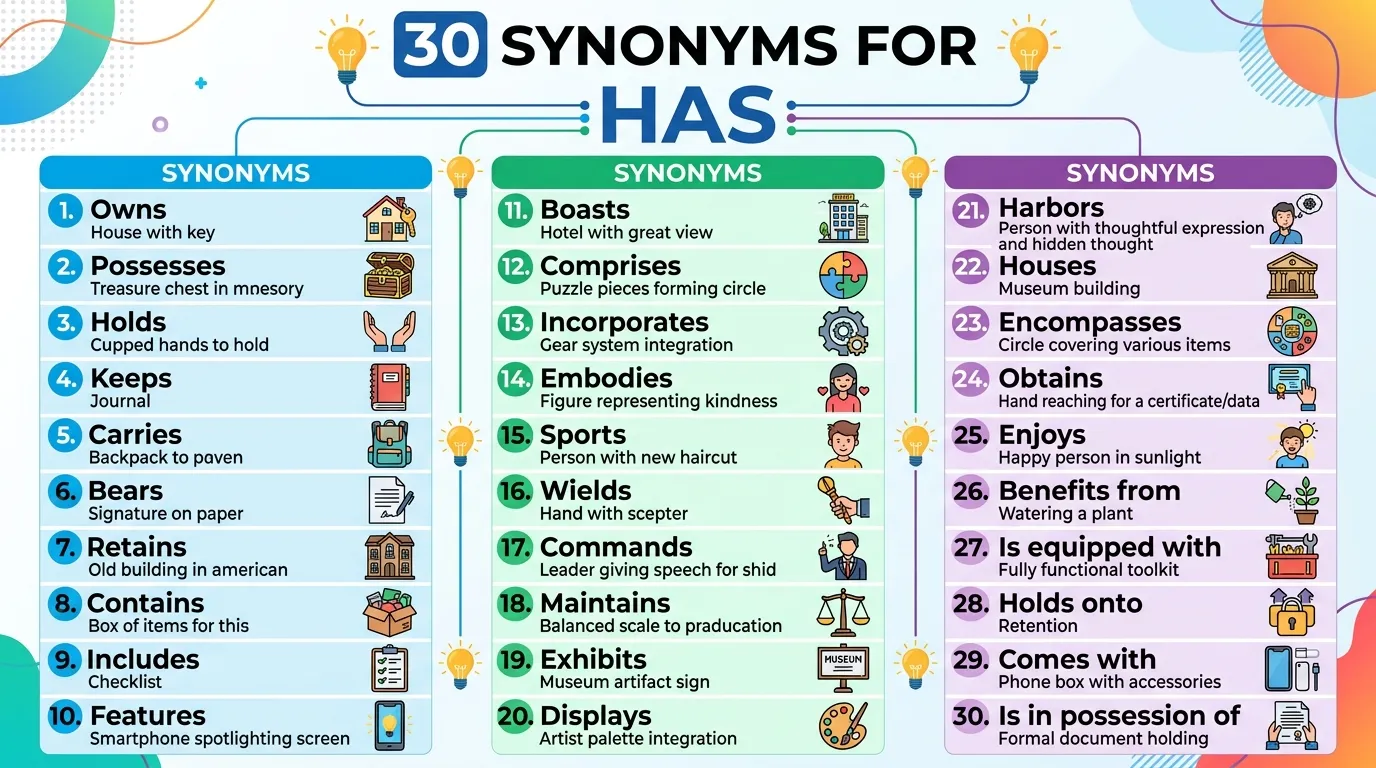
Has means possesses, owns, or contains something. Think about a girl introducing her new puppy to her friends. She says, “He has soft brown fur and big floppy ears.” That word “has” tells her friends exactly what the puppy owns or carries as part of itself. People use synonyms for has constantly in daily speech and writing to describe ownership, features, and qualities. Because “has” is mostly a small grammar word, its synonyms only work when it means “possesses” something, not when it helps form other verb tenses. Learning new synonyms for has helps English learners speak and write with more variety. Synonyms for has also helps writers avoid using the same word again and again. This article explains the meaning of has, its history, and how to say it. It also shares 30 words that mean almost the same thing.
Meaning of Has
Definition
Has (Verb): Possesses, owns, or contains something; the third-person singular form of “have.”
Examples
- She has a beautiful garden behind her house.
- The book has over three hundred pages.
Connotative Meaning
- Positive tone: This word can feel warm when describing something valued, like “she has a kind heart.”
- Negative tone: This word rarely feels negative on its own, though it can describe a problem, like “he has a bad habit.”
- Neutral tone:
- In most everyday use, this word is simply factual, showing ownership or a feature without any strong feeling.
Etymology
- This word comes from the Old English word “habban,” meaning “to have” or “to hold.”
- “Habban” is related to old Germanic words that also meant “to hold” or “to possess.”
- Over time, the form “has” developed as the third-person singular form used with “he,” “she,” and “it.”
Short History
- Old English (450–1100):
- The word “habban” was already used to show possession, much like “have” and “has” are used today.
- Middle English (1100–1500):
- The verb forms shifted slightly in spelling, moving closer to the modern words “have” and “has.”
- Modern English (1500–Present):
- “Has” became fixed as the standard form used with “he,” “she,” and “it,” both for showing possession and for building other verb tenses.
Pronunciation (US & UK – IPA)
- US: /hæz/
- UK: /hæz/
Syllables
has (1 syllable)
Affixation Pattern of Has
- Root: hab (from Old English “habban,” meaning “to have”)
- Prefix: none
- Suffix: -s (marks the third-person singular form)
Word Formation:
Have (base verb), has (third-person singular form), had (past tense), and having (present participle) are all related forms.
Explore related topics https://synonymhunting.com/synonyms-for-that/
Synonyms for Has
1. Owns (Verb) — US: /oʊnz/ | UK: /əʊnz/
Meaning: Possesses something as personal property.
Examples:
- She owns a small bakery downtown.
- The family owns two cars.
2. Possesses (Verb) — US: /pəˈzɛsɪz/ | UK: /pəˈzɛsɪz/
Meaning: Holds or owns something, often formally stated.
Examples:
- He possesses a rare collection of coins.
- The team possesses great skill this season.
3. Holds (Verb) — US: /hoʊldz/ | UK: /həʊldz/
Meaning: Contains or keeps something, often a position or quality.
Examples:
- She holds a strong opinion on the matter.
- The company holds a large share of the market.
4. Keeps (Verb) — US: /kiːps/ | UK: /kiːps/
Meaning: Retains or maintains something over time.
Examples:
- He keeps a journal of his daily thoughts.
- She keeps several plants on her balcony.
5. Carries (Verb) — US: /ˈkæriz/ | UK: /ˈkæriz/
Meaning: Has or bears a certain quality or item.
Examples:
- His voice carries a hint of sadness.
- The bag carries all her school supplies.
6. Bears (Verb) — US: /bɛrz/ | UK: /beəz/
Meaning: Carries or shows a certain feature or mark.
Examples:
- The document bears his signature.
- Her face bears a strong resemblance to her mother.
7. Retains (Verb) — US: /rɪˈteɪnz/ | UK: /rɪˈteɪnz/
Meaning: Continues to have or keep something.
Examples:
- The old house retains its original charm.
- She retains a clear memory of that day.
8. Contains (Verb) — US: /kənˈteɪnz/ | UK: /kənˈteɪnz/
Meaning: Has something inside or as a part of it.
Examples:
- The box contains old family photos.
- This drink contains a lot of sugar.
9. Includes (Verb) — US: /ɪnˈkluːdz/ | UK: /ɪnˈkluːdz/
Meaning: Has something as one of its parts.
Examples:
- The price includes breakfast and dinner.
- Her plan includes a visit to three cities.
10. Features (Verb) — US: /ˈfiːtʃərz/ | UK: /ˈfiːtʃəz/
Meaning: Has a certain quality or part as an important detail.
Examples:
- The phone features a large, bright screen.
- Her painting features bright shades of blue.
11. Boasts (Verb) — US: /boʊsts/ | UK: /bəʊsts/
Meaning: Has something impressive or worth mentioning.
Examples:
- The hotel boasts a beautiful ocean view.
- Her resume boasts years of solid experience.
12. Comprises (Verb) — US: /kəmˈpraɪzɪz/ | UK: /kəmˈpraɪzɪz/
Meaning: Has or is made up of certain parts.
Examples:
- The team comprises ten skilled players.
- The book comprises twelve short chapters.
13. Incorporates (Verb) — US: /ɪnˈkɔːrpəˌreɪts/ | UK: /ɪnˈkɔːpəreɪts/
Meaning: Has something included as part of a larger whole.
Examples:
- The design incorporates several safety features.
- Her recipe incorporates fresh herbs from the garden.
14. Embodies (Verb) — US: /ɪmˈbɑːdiz/ | UK: /ɪmˈbɒdiz/
Meaning: Has or represents a quality in a clear way.
Examples:
- She embodies the spirit of kindness.
- The building embodies modern design.
15. Sports (Verb) — US: /spɔːrts/ | UK: /spɔːts/
Meaning: Has and shows something proudly, often used casually.
Examples:
- He sports a new haircut today.
- The car sports a shiny red finish.
16. Wields (Verb) — US: /wiːldz/ | UK: /wiːldz/
Meaning: Has and uses a certain power or tool.
Examples:
- The manager wields great influence over the team.
- She wields a sharp wit in every conversation.
17. Commands (Verb) — US: /kəˈmændz/ | UK: /kəˈmɑːndz/
Meaning: Has a strong level of respect, power, or attention.
Examples:
- Her calm voice commands attention in meetings.
- The old castle commands a view of the whole valley.
18. Maintains (Verb) — US: /meɪnˈteɪnz/ | UK: /meɪnˈteɪnz/
Meaning: Keeps or has something steady over time.
Examples:
- She maintains a positive attitude even under stress.
- The company maintains high safety standards.
19. Exhibits (Verb) — US: /ɪɡˈzɪbɪts/ | UK: /ɪɡˈzɪbɪts/
Meaning: Shows or has a certain quality clearly.
Examples:
- He exhibits great patience with young children.
- The patient exhibits signs of quick recovery.
20. Displays (Verb) — US: /dɪˈspleɪz/ | UK: /dɪˈspleɪz/
Meaning: Shows or has a visible quality or feature.
Examples:
- She displays real talent for painting.
- The dancer displays years of hard practice.
21. Harbors (Verb) — US: /ˈhɑːrbərz/ | UK: /ˈhɑːbəz/
Meaning: Holds a certain feeling or thought inside.
Examples:
- He harbors no hard feelings about the loss.
- She harbors a secret wish to travel the world.
22. Houses (Verb) — US: /ˈhaʊzɪz/ | UK: /ˈhaʊzɪz/
Meaning: Contains or holds something within a certain space.
Examples:
- The museum houses many ancient artifacts.
- The building houses over two hundred offices.
23. Encompasses (Verb) — US: /ɪnˈkʌmpəsɪz/ | UK: /ɪnˈkʌmpəsɪz/
Meaning: Has or covers a wide range of things.
Examples:
- The course encompasses many different topics.
- Her job encompasses both writing and design.
24. Obtains (Verb) — US: /əbˈteɪnz/ | UK: /əbˈteɪnz/
Meaning: Gains or comes to have something.
Examples:
- He obtains valuable data from the survey.
- She obtains permission before starting the project.
25. Enjoys (Verb) — US: /ɪnˈdʒɔɪz/ | UK: /ɪnˈdʒɔɪz/
Meaning: Has and benefits from something positive.
Examples:
- The company enjoys a strong reputation.
- She enjoys good health thanks to daily exercise.
26. Benefits from (Verb phrase) — US: /ˈbɛnɪfɪts frʌm/ | UK: /ˈbɛnɪfɪts frɒm/
Meaning: Has or gains something helpful.
Examples:
- The team benefits from strong leadership.
- She benefits from years of hard training.
27. Is equipped with (Verb phrase) — US: /ɪz ɪˈkwɪpt wɪð/ | UK: /ɪz ɪˈkwɪpt wɪð/
Meaning: Has certain tools or features included.
Examples:
- The car is equipped with the latest safety features.
- The kitchen is equipped with modern appliances.
28. Holds onto (Verb phrase) — US: /hoʊldz ˈɒntuː/ | UK: /həʊldz ˈɒntə/
Meaning: Keeps or continues to have something.
Examples:
- She holds onto hope despite the setback.
- He holds onto old letters from his grandmother.
29. Comes with (Verb phrase) — US: /kʌmz wɪð/ | UK: /kʌmz wɪð/
Meaning: Includes or has something as part of a package.
Examples:
- The phone comes with a free case.
- The job comes with great benefits.
30. Is in possession of (Verb phrase) — US: /ɪz ɪn pəˈzɛʃən əv/ | UK: /ɪz ɪn pəˈzɛʃən əv/
Meaning: Formally has or holds something.
Examples:
- She is in possession of the original document.
- The museum is in possession of a rare artifact.
Prototype Meaning
When people hear the word has, they picture ownership, quality that belongs to someone or something. It brings to mind simple facts, like what a person owns, carries, or includes as part of who they are.
Prototype Categorization
- Simple ownership: owns, possesses, holds, keeps, is in possession of
- Containing or including: contains, includes, comprises, houses, encompasses
- Showing a feature: features, boasts, exhibits, displays, sports
- Carrying or bearing something: carries, bears, wields, harbors
- Gaining or benefiting: obtains, enjoys, benefits from, comes with, is equipped with
- Keeping steady: maintains, retains, holds onto, embodies, commands, incorporates
Antonyms of Has
- lacks
- misses
- needs
- wants
- is without
Short Questions and Answers
- What does has mean? It means possesses, owns, or contains something.
- When should has be used? Use it when describing what someone or something owns, includes, or shows as a feature.
- Is has positive or negative? It is usually neutral, though it can feel positive or negative depending on what follows it.
- How is it different from similar words? “Owns” often points to clear legal or personal ownership. “Has” is broader and can describe features, feelings, or simple facts, not just ownership.
Conclusion
Synonyms for has helps you build a stronger, more expressive vocabulary. It strengthens your writing and speaking by giving you many ways to describe ownership, features, and qualities. Synonyms for has also helps you avoid repeating the same word again and again. Synonyms for has keeps your writing clearer and more interesting. Most importantly, learning new words like this builds your confidence as an English speaker and writer. Try learning one new synonyms for has from this list each day, and watch your vocabulary grow steadily over time.

I’m Zahid Abbas, an educator, researcher, and digital publishing strategist with a passion for linguistics, grammar, and clear communication. As a content creator and SEO specialist, I craft research-driven, reader-focused content that empowers learners and makes knowledge accessible worldwide.










