The word true means correct, honest, real, or factual. Imagine a child telling the truth after breaking a glass at home. The parents may feel upset, but they still appreciate that the child was true and honest. People use this word every day in conversations, books, schools, news, and online communication.
Because synonyms of true is very common, writers and English learners often need other words with similar meanings. Learning synonyms helps improve vocabulary, avoids repetition, and makes speaking and writing more natural. Different synonyms also express different shades of meaning, such as honesty, accuracy, loyalty, or reality.
In this article, you will learn the meaning of true, its pronunciation, history, grammar, emotional tone, and 30 useful synonyms with examples. You will also explore semantic categories, antonyms, and short questions to strengthen your English communication skills.
Meaning of True
Definition
True (adjective): correct, honest, real, or based on facts.
Examples
- Her story was completely true.
- A true friend always supports you.
Connotative Meaning
(Connotation means the feeling or emotion a word suggests beyond its basic meaning.)
- Positive tone: honest, loyal, accurate
- Negative tone: sometimes harsh or painful reality
- Neutral tone: factually correct or real
Etymology
- From Old English triewe meaning “faithful” or “trustworthy”
- Related to Germanic roots connected with honesty and loyalty
Short History:
- Old English (450–1100): used for loyalty and faithfulness
- Middle English (1100–1500): expanded to mean factual and genuine
- Modern English (1500–Present): widely used for honesty, truth, and accuracy
Pronunciation (US & UK – IPA)
- US: /truː/
- UK: /truː/
Syllables
- true
Affixation Pattern of True
- Root: true
- Prefix: none
- Suffix: none
Word Formation:
- true (adjective)
- truly (adverb)
- truth (noun)
- truthful (adjective)
- truthfully (adverb)
- untrue (adjective)
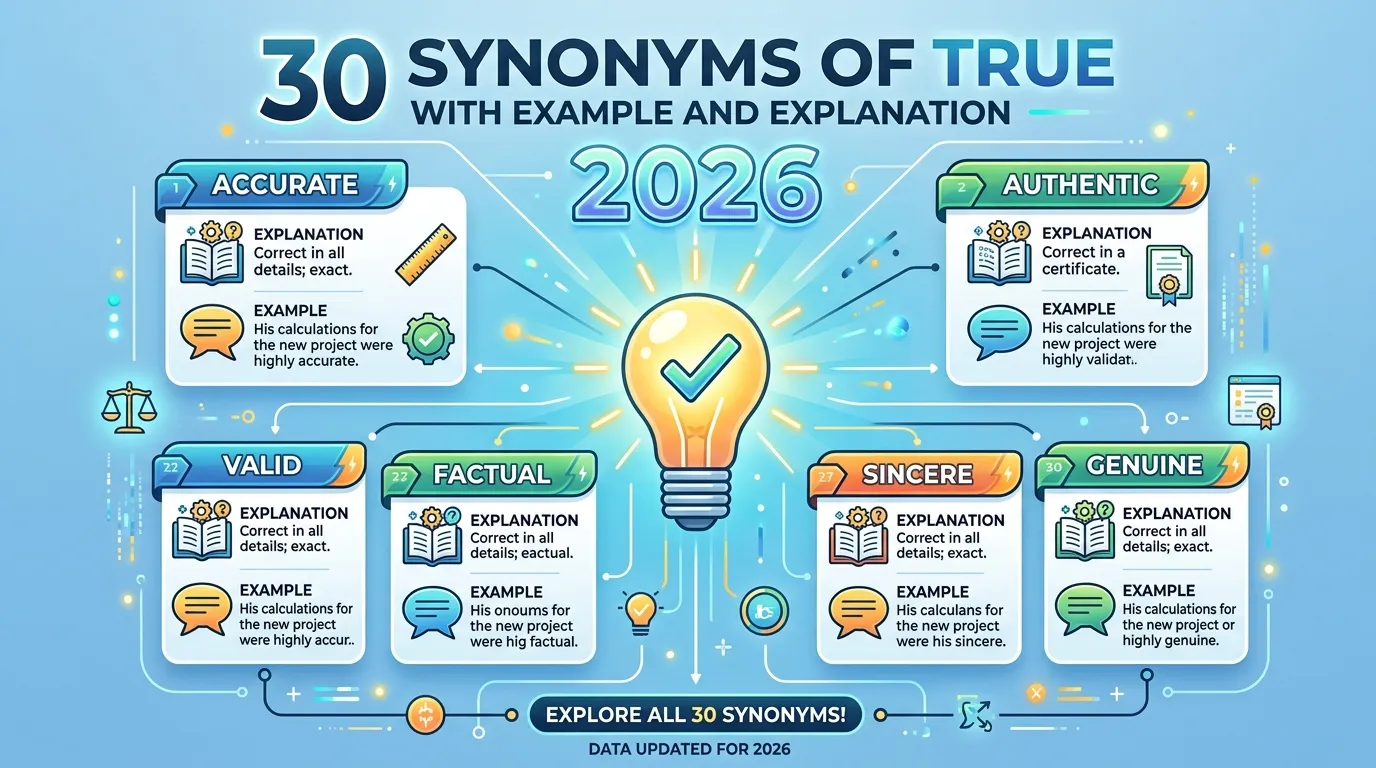
30 Synonyms of True
1. Accurate (adjective)
US: /ˈækjərət/ | UK: /ˈækjərət/
Meaning: correct and exact
Examples:
- The report is accurate.
- She gave an accurate answer.
2. Correct (adjective)
US: /kəˈrɛkt/ | UK: /kəˈrekt/
Meaning: free from mistakes
Examples:
- Your answer is correct.
- He gave the correct information.
3. Honest (adjective)
US: /ˈɑːnɪst/ | UK: /ˈɒnɪst/
Meaning: truthful and sincere
Examples:
- She is an honest person.
- Please give an honest opinion.
4. Genuine (adjective)
US: /ˈdʒɛnjuɪn/ | UK: /ˈdʒenjuɪn/
Meaning: real and authentic
Examples:
- His smile was genuine.
- This is a genuine product.
5. Real (adjective)
US: /riːl/ | UK: /rɪəl/
Meaning: actually existing
Examples:
- The danger was real.
- She showed real emotion.
6. Authentic (adjective)
US: /ɔːˈθɛntɪk/ | UK: /ɔːˈθentɪk/
Meaning: original and trustworthy
Examples:
- The painting is authentic.
- We need authentic documents.
7. Faithful (adjective)
US: /ˈfeɪθfəl/ | UK: /ˈfeɪθfəl/
Meaning: loyal and dependable
Examples:
- He remained faithful to his friends.
- A dog is a faithful animal.
8. Trustworthy (adjective)
US: /ˈtrʌstˌwɜːrði/ | UK: /ˈtrʌstwɜːði/
Meaning: deserving trust
Examples:
- She is very trustworthy.
- We need a trustworthy leader.
9. Reliable (adjective)
US: /rɪˈlaɪəbəl/ | UK: /rɪˈlaɪəbl/
Meaning: dependable and consistent
Examples:
- He is a reliable worker.
- This car is very reliable.
10. Valid (adjective)
US: /ˈvælɪd/ | UK: /ˈvælɪd/
Meaning: legally or logically acceptable
Examples:
- Your argument is valid.
- The ticket is still valid.
11. Factual (adjective)
US: /ˈfæktʃuəl/ | UK: /ˈfæktʃuəl/
Meaning: based on facts
Examples:
- The article is factual.
- Please provide factual details.
12. Exact (adjective)
US: /ɪɡˈzækt/ | UK: /ɪɡˈzækt/
Meaning: completely correct
Examples:
- Give the exact number.
- Her memory was exact.
13. Precise (adjective)
US: /prɪˈsaɪs/ | UK: /prɪˈsaɪs/
Meaning: very accurate and detailed
Examples:
- The directions were precise.
- He used precise language.
14. Legitimate (adjective)
US: /ləˈdʒɪtəmət/ | UK: /lɪˈdʒɪtɪmət/
Meaning: lawful or genuine
Examples:
- It is a legitimate business.
- Her concern was legitimate.
15. Sincere (adjective)
US: /sɪnˈsɪr/ | UK: /sɪnˈsɪə/
Meaning: honest in feelings and actions
Examples:
- He gave a sincere apology.
- Her words sounded sincere.
16. Frank (adjective)
US: /fræŋk/ | UK: /fræŋk/
Meaning: direct and truthful
Examples:
- She was frank with me.
- He gave a frank answer.
17. Straightforward (adjective)
US: /ˌstreɪtˈfɔːrwərd/ | UK: /ˌstreɪtˈfɔːwəd/
Meaning: simple and honest
Examples:
- The explanation was straightforward.
- He is a straightforward person.
18. Credible (adjective)
US: /ˈkrɛdəbəl/ | UK: /ˈkredəbl/
Meaning: believable and convincing
Examples:
- She gave a credible explanation.
- The witness seemed credible.
19. Sound (adjective)
US: /saʊnd/ | UK: /saʊnd/
Meaning: logical and reliable
Examples:
- That is sound advice.
- The plan looks sound.
20. Verifiable (adjective)
US: /ˈvɛrəˌfaɪəbəl/ | UK: /ˈverɪfaɪəbl/
Meaning: able to be proven true
Examples:
- The claim is verifiable.
- We need verifiable evidence.
21. Dependable (adjective)
US: /dɪˈpɛndəbəl/ | UK: /dɪˈpendəbl/
Meaning: reliable and trustworthy
Examples:
- She is very dependable.
- We need a dependable partner.
22. Loyal (adjective)
US: /ˈlɔɪəl/ | UK: /ˈlɔɪəl/
Meaning: faithful and supportive
Examples:
- He stayed loyal to his team.
- A loyal friend is valuable.
23. Truthful (adjective)
US: /ˈtruːθfəl/ | UK: /ˈtruːθfəl/
Meaning: telling the truth
Examples:
- The child was truthful.
- Please give a truthful statement.
24. Right (adjective)
US: /raɪt/ | UK: /raɪt/
Meaning: correct or morally good
Examples:
- Your answer is right.
- She made the right choice.
25. Accurate-to-life (adjective)
US: /ˈækjərət tə laɪf/ | UK: /ˈækjərət tə laɪf/
Meaning: very realistic or true
Examples:
- The drawing was accurate-to-life.
- The movie felt accurate-to-life.
26. Honest-to-goodness (adjective)
US: /ˈɑːnɪst tə ˈɡʊdnəs/ | UK: /ˈɒnɪst tə ˈɡʊdnəs/
Meaning: completely genuine
Examples:
- It was an honest-to-goodness mistake.
- She felt honest-to-goodness joy.
27. Undeniable (adjective)
US: /ˌʌndɪˈnaɪəbəl/ | UK: /ˌʌndɪˈnaɪəbl/
Meaning: impossible to deny
Examples:
- The evidence was undeniable.
- His talent is undeniable.
28. Certain (adjective)
US: /ˈsɜːrtn/ | UK: /ˈsɜːtn/
Meaning: known for sure
Examples:
- I am certain about this.
- The result seems certain.
29. Honesthearted (adjective)
US: /ˈɑːnɪstˌhɑːrtɪd/ | UK: /ˈɒnɪstˌhɑːtɪd/
Meaning: kind and truthful in nature
Examples:
- She is an honesthearted person.
- His actions were honesthearted.
30. Unfake (adjective)
US: /ʌnˈfeɪk/ | UK: /ʌnˈfeɪk/
Meaning: not fake or artificial
Examples:
- Her reaction felt unfake.
- The emotion was completely unfake.
Prototype Meaning
The most common meaning of true is something honest, correct, real, or factual. People usually imagine truthful statements, loyal friendships, or accurate information when they hear this word.
Prototype Categorization
- Honesty and sincerity: honest, truthful, sincere, frank
- Accuracy and correctness: accurate, exact, precise, factual
- Reality and authenticity: real, genuine, authentic, legitimate
- Trust and loyalty: faithful, loyal, dependable, trustworthy
Categorization helps writers choose the best synonym depending on context, tone, and meaning.
Antonyms of True
- False (adjective): not correct or truthful
- Fake (adjective): not genuine or real
- Dishonest (adjective): not truthful
- Incorrect (adjective): wrong or inaccurate
- Unreliable (adjective): not dependable
Short Questions and Answers
What does true mean?
- It means correct, honest, real, or factual.
When should true be used?
- Use it when describing facts, honesty, loyalty, or accuracy.
Is true positive or negative?
- It is usually positive because it suggests honesty and correctness.
How is it different from similar words?
- “True” is broad and general, while words like “accurate” focus on correctness and “honest” focuses on sincerity.
Conclusion
Learning synonyms of true and synonyms of true improves vocabulary and communication skills. It helps English learners express honesty, accuracy, reality, and loyalty more clearly in speaking and writing. Using different synonyms also avoids repetition and makes language more natural and professional. Understanding these words strengthens writing, storytelling, and everyday conversations. It also builds confidence by helping learners choose the right word for each situation. Practice using new vocabulary daily in sentences, conversations, and reading activities. Small vocabulary habits can greatly improve English fluency and communication over time.

I’m Zahid Abbas, an educator, researcher, and digital publishing strategist with a passion for linguistics, grammar, and clear communication. As a content creator and SEO specialist, I craft research-driven, reader-focused content that empowers learners and makes knowledge accessible worldwide.