The word king means a male ruler who controls a country or kingdom. Imagine a large palace, a golden crown, and people respecting a powerful leader. That leader is called a king. In stories, history, movies, and even daily speech, people often use this word to describe power, leadership, honor, or greatness.
The word king is very common in English because it appears in history books, fantasy stories, politics, games, and cultural expressions. Learning synonyms of king helps English learners improve vocabulary and express ideas more clearly. It also helps writers avoid repetition and choose the right tone for different situations. In this article, you will learn the meaning of king, its pronunciation, history, grammar, and 30 useful synonyms with meanings and examples. You will also explore categories, antonyms, and common questions to improve your English communication skills.
Meaning of King
Definition
King (noun): a male ruler of a country, kingdom, or group of people.
Examples
- The king ruled the nation wisely.
- The young king wore a golden crown.
Connotative Meaning
(Connotation means the feeling or emotion a word suggests beyond its basic meaning.)
- Positive tone: power, leadership, honor, greatness
- Negative tone: control, dictatorship, pride
- Neutral tone: a male ruler or monarch
Etymology
- From Old English cyning meaning “tribal leader” or “ruler”
- Related to Germanic language roots connected to family and leadership
Short History:
- Old English (450–1100): “cyning” meant ruler or tribal leader
- Middle English (1100–1500): changed into “king” in royal and political use
- Modern English (1500–Present): widely used for rulers, leaders, and symbolic greatness
Pronunciation (US & UK – IPA)
- US: /kɪŋ/
- UK: /kɪŋ/
Syllables
- king
Affixation Pattern of King
- Root: king
- Prefix: none
- Suffix: none
Word Formation:
- kingdom (noun)
- kingly (adjective)
- kingship (noun)
- kingmaker (noun)
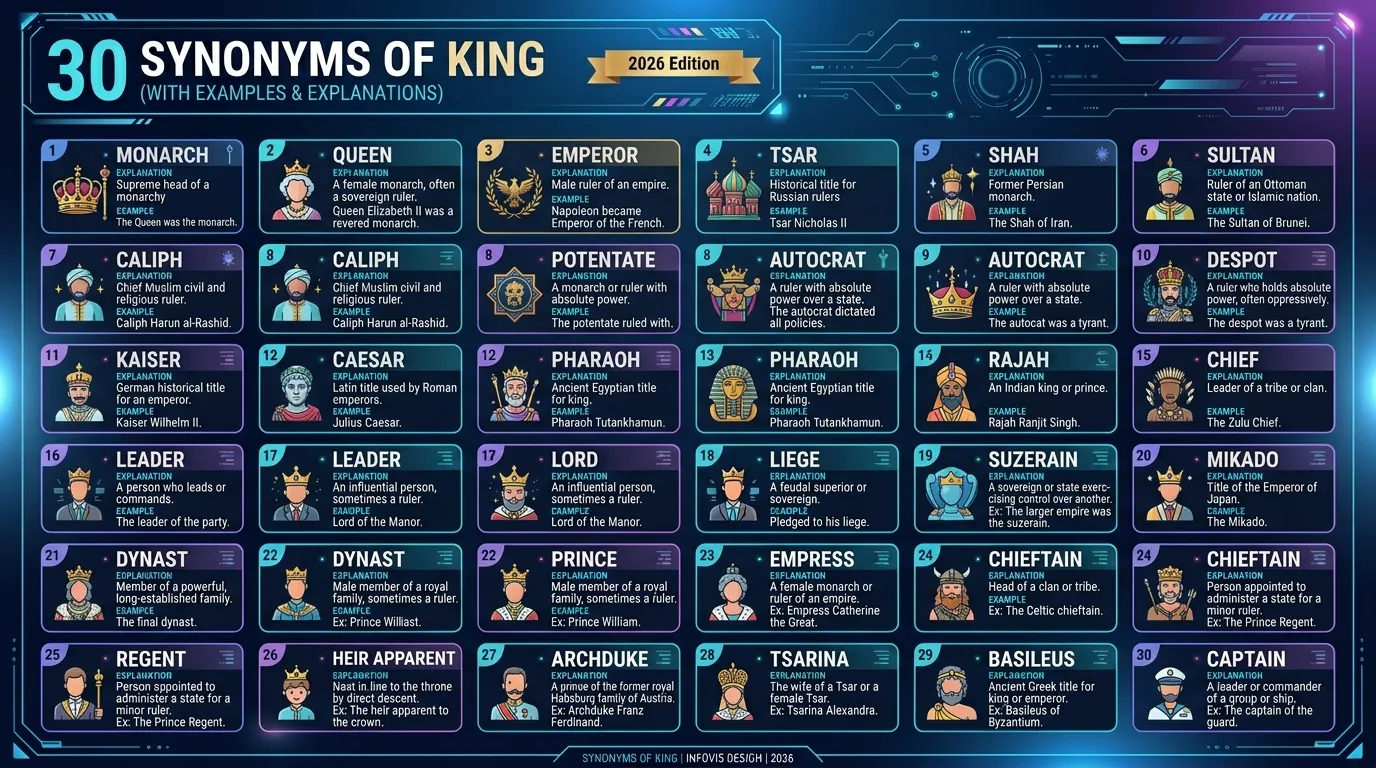
30 Synonyms of King
1. Monarch (noun)
US: /ˈmɑːnərk/ | UK: /ˈmɒnək/
Meaning: a ruler such as a king or queen
Examples:
- The monarch addressed the people.
- The country respected its monarch.
2. Emperor (noun)
US: /ˈempərər/ | UK: /ˈempərə/
Meaning: a ruler of an empire
Examples:
- The emperor controlled vast lands.
- The Roman emperor was powerful.
3. Sovereign (noun)
US: /ˈsɑːvrɪn/ | UK: /ˈsɒvrɪn/
Meaning: a supreme ruler
Examples:
- The sovereign led the kingdom.
- Citizens honored the sovereign.
4. Ruler (noun)
US: /ˈruːlər/ | UK: /ˈruːlə/
Meaning: a person who governs a country
Examples:
- The wise ruler helped the people of low income.
- Every ruler faces challenges.
5. Leader (noun)
US: /ˈliːdər/ | UK: /ˈliːdə/
Meaning: a person who guides others
Examples:
- The leader inspired the army.
- He became a respected leader.
6. Chief (noun)
US: /tʃiːf/ | UK: /tʃiːf/
Meaning: the head of a tribe or group
Examples:
- The tribal chief welcomed visitors.
- The chief made important decisions.
7. Sultan (noun)
US: /ˈsʌltən/ | UK: /ˈsʌltən/
Meaning: a Muslim king or ruler
Examples:
- The sultan ruled the empire.
- The palace belonged to the sultan.
8. Prince (noun)
US: /prɪns/ | UK: /prɪns/
Meaning: a male royal family member
Examples:
- The prince became king later.
- People cheered for the young prince.
9. Lord (noun)
US: /lɔːrd/ | UK: /lɔːd/
Meaning: a nobleman with authority
Examples:
- The lord owned large lands.
- Villagers respected the lord.
10. Duke (noun)
US: /duːk/ | UK: /djuːk/
Meaning: a high-ranking nobleman
Examples:
- The duke attended the ceremony.
- The duke governed the region.
11. Tyrant (noun)
US: /ˈtaɪrənt/ | UK: /ˈtaɪərənt/
Meaning: a cruel and unfair ruler
Examples:
- The tyrant treated people badly.
- Citizens feared the tyrant.
12. Dictator (noun)
US: /dɪkˈteɪtər/ | UK: /dɪkˈteɪtə/
Meaning: a ruler with complete power
Examples:
- The dictator controlled the country.
- Many opposed the dictator.
13. Commander (noun)
US: /kəˈmændər/ | UK: /kəˈmɑːndə/
Meaning: a person leading troops or groups
Examples:
- The commander led the soldiers.
- Everyone obeyed the commander.
14. Governor (noun)
US: /ˈɡʌvərnər/ | UK: /ˈɡʌvənə/
Meaning: an official leader of a region
Examples:
- The governor visited the town.
- Citizens elected the governor.
15. Pharaoh (noun)
US: /ˈferoʊ/ | UK: /ˈfeərəʊ/
Meaning: an ancient Egyptian king
Examples:
- The pharaoh built pyramids.
- Ancient people worshiped the pharaoh.
16. Caesar (noun)
US: /ˈsiːzər/ | UK: /ˈsiːzə/
Meaning: a title for Roman emperors
Examples:
- The Caesar ruled Rome.
- Soldiers protected the Caesar.
17. Monarchist (noun)
US: /ˈmɑːnərkɪst/ | UK: /ˈmɒnəkɪst/
Meaning: a supporter of kings or monarchy
Examples:
- The monarchist defended the crown.
- Many monarchists supported the king.
18. Potentate (noun)
US: /ˈpoʊtnteɪt/ | UK: /ˈpəʊtənteɪt/
Meaning: a powerful ruler
Examples:
- The potentate controlled the region.
- People feared the potentate.
19. Overlord (noun)
US: /ˈoʊvərlɔːrd/ | UK: /ˈəʊvəlɔːd/
Meaning: a ruler with great authority
Examples:
- The overlord demanded taxes.
- Villages obeyed the overlord.
20. Regent (noun)
US: /ˈriːdʒənt/ | UK: /ˈriːdʒənt/
Meaning: a person ruling for a king temporarily
Examples:
- The regent ruled during the king’s absence.
- The queen appointed a regent.
21. Nobleman (noun)
US: /ˈnoʊbəlmən/ | UK: /ˈnəʊbəlmən/
Meaning: a man from a high social class
Examples:
- The nobleman owned castles.
- A wealthy nobleman hosted the event.
22. Chieftain (noun)
US: /ˈtʃiːftən/ | UK: /ˈtʃiːftən/
Meaning: a tribal or clan leader
Examples:
- The chieftain guided the tribe.
- Warriors respected the chieftain.
23. Majesty (noun)
US: /ˈmædʒəsti/ | UK: /ˈmædʒəsti/
Meaning: a royal title for a king or queen
Examples:
- “Your Majesty,” said the guard.
- The crowd greeted His Majesty.
24. Crowned Head (noun)
US: /kraʊnd hɛd/ | UK: /kraʊnd hed/
Meaning: a king or queen wearing a crown
Examples:
- The crowned head entered the hall.
- The people honored the crowned head.
25. Autocrat (noun)
US: /ˈɔːtəkræt/ | UK: /ˈɔːtəkræt/
Meaning: a ruler with unlimited authority
Examples:
- The autocrat controlled every law.
- Citizens protested against the autocrat.
26. Khan (noun)
US: /kɑːn/ | UK: /kɑːn/
Meaning: a ruler in Central Asian cultures
Examples:
- The khan led his army bravely.
- Traders respected the khan.
27. Maharaja (noun)
US: /ˌmɑːhəˈrɑːdʒə/ | UK: /ˌmɑːhəˈrɑːdʒə/
Meaning: a Hindu king or prince
Examples:
- The maharaja lived in a grand palace.
- The maharaja hosted a festival.
28. Tsar (noun)
US: /zɑːr/ | UK: /zɑː/
Meaning: a Russian emperor or ruler
Examples:
- The tsar ruled Russia.
- Soldiers protected the tsar.
29. Headman (noun)
US: /ˈhedmən/ | UK: /ˈhedmən/
Meaning: the leader of a village or group
Examples:
- The headman solved disputes.
- Villagers trusted the headman.
30. Kingpin (noun)
US: /ˈkɪŋpɪn/ | UK: /ˈkɪŋpɪn/
Meaning: the most important person in a group
Examples:
- He became the kingpin of the company.
- Police arrested the criminal kingpin.
Prototype Meaning
The most typical meaning of king is a powerful male ruler wearing a crown and leading a kingdom. People usually imagine a royal palace, soldiers, authority, and leadership when they hear this word.
Prototype Categorization
- Royal rulers: monarch, emperor, sovereign, tsar
- Military or political leaders: commander, governor, dictator
- Traditional tribal rulers: chief, chieftain, khan
- Powerful authority figures: autocrat, tyrant, overlord
Categorization helps writers choose the best synonym depending on tone, culture, and context.
Antonyms of King
Antonyms
- Servant (noun): a person who serves others
- Follower (noun): someone who follows a leader
- Subject (noun): a citizen ruled by a king
- Peasant (noun): a poor farmer or worker
- Commoner (noun): a person without royal status
Short Questions and Answers
What does king mean?
- A king is a male ruler of a country or kingdom.
When should king be used?
- Use it when talking about rulers, leadership, royalty, or symbolic power.
Is king positive or negative?
- It is usually positive, but it can become negative when connected to cruelty or dictatorship.
How is it different from similar words?
- “King” specifically refers to a male royal ruler, while “leader” is a more general term.
Conclusion
Learning synonyms of king and synonyms of king improves vocabulary and communication skills. These words help English learners describe leadership, royalty, authority, and power more clearly in speaking and writing. Using different synonyms also avoids repetition and makes language richer and more expressive.Understanding royal and leadership vocabulary is useful in history, literature, storytelling, politics, and daily conversation. It builds stronger writing skills and improves confidence in English communication. Practice using new words regularly in sentences and conversations. Small vocabulary habits each day can greatly improve fluency, creativity, and overall English knowledge over time.

I’m Zahid Abbas, an educator, researcher, and digital publishing strategist with a passion for linguistics, grammar, and clear communication. As a content creator and SEO specialist, I craft research-driven, reader-focused content that empowers learners and makes knowledge accessible worldwide.