Adapt means to change or adjust so that something fits a new situation or environment. Imagine a student moving to a new school. At first, everything feels different. After a few weeks, the student learns the rules, makes friends, and becomes comfortable. This is a simple example of how people adapt to change.
The word adapt is common in everyday English. People use it when talking about work, school, technology, nature, business, and personal life. Since change is a part of life, this word appears in conversations, books, news articles, and online content.
Learning synonyms of adapt helps English learners, students, teachers, and content writers avoid repeating the same word. It also makes speaking and writing more natural and interesting. In this article, you will learn the meaning of adapt, its pronunciation, grammar, history, semantic categories, and 30 useful synonyms with simple meanings and examples.
Meaning of Adapt
Definition
Adapt (Verb): To change yourself or something so it works better in a new situation, environment, or purpose.
Examples
- She adapted quickly to her new job.
- Animals adapt to changes in the weather.
Connotative Meaning
- Positive tone: Shows flexibility, growth, learning, and success.
- Negative tone: May suggest being forced to change because of difficult conditions.
- Neutral tone: Simply means adjusting to a different situation.
Etymology
- Source language: Latin
- Original word: adaptare
- Original meaning: “To fit,” “to adjust,” or “to make suitable.”
Short History of the Keyword
- Old English (450–1100): The word did not exist in Old English. Similar ideas were expressed with words meaning “fit” or “change.”
- Middle English (1100–1500): The Latin influence increased after the Norman Conquest, preparing the way for the word.
- Modern English (1500–Present): Adapt entered English in the early 1600s and became common in science, education, business, and everyday language.
Pronunciation (US & UK – IPA)
US: /əˈdæpt/
UK: /əˈdæpt/
Syllables
a-dapt
Affixation Pattern of Adapt
Root: adapt
Prefix: None
Suffix: None
Word Formation of Adapt
- Adapt (verb)
- Adapted (verb/adjective)
- Adapting (verb)
- Adaptation (noun)
- Adapter (noun)
- Adaptable (adjective)
- Adaptability (noun)
- Adaptively (adverb)
- Adaptive (adjective)
- Maladapt (verb)
- Maladaptation (noun)
- Unadapted (adjective)
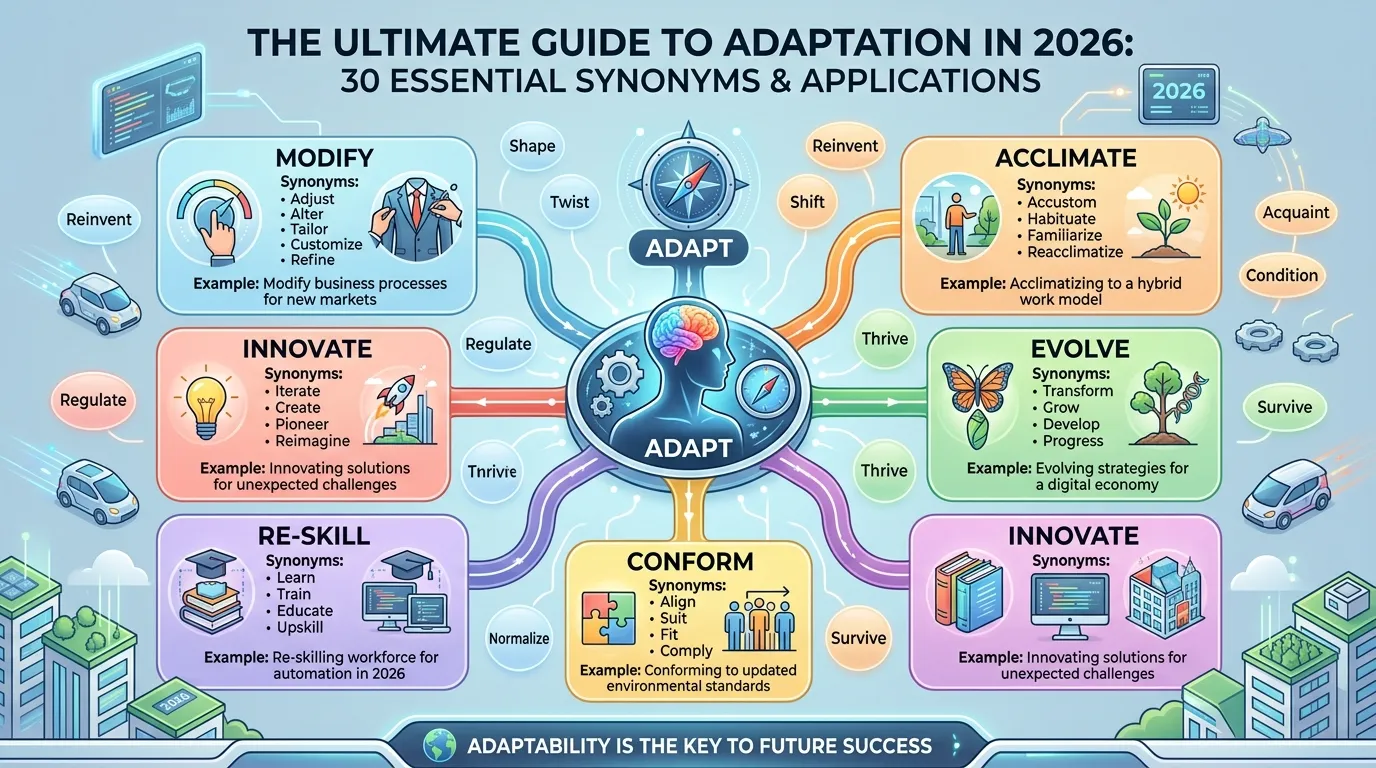
30 Synonyms of Adapt
1. Adjust (Verb)
US: /əˈdʒʌst/ | UK: /əˈdʒʌst/
Meaning: To change something slightly so it works better.
Examples
- She adjusted her chair before sitting down.
- It took him a week to adjust to city life.
2. Modify (Verb)
US: /ˈmɑːdəˌfaɪ/ | UK: /ˈmɒdɪfaɪ/
Meaning: To make small changes to improve something.
Examples
- We modified the plan after the meeting.
- The teacher modified the lesson for beginners.
3. Alter (Verb)
US: /ˈɔːltər/ | UK: /ˈɔːltə/
Meaning: To change something.
Examples
- They altered the schedule.
- She altered her dress before the event.
4. Change (Verb)
US: /tʃeɪndʒ/ | UK: /tʃeɪndʒ/
Meaning: To become different or make something different.
Examples
- Weather changes quickly here.
- He changed his plans.
5. Revise (Verb)
US: /rɪˈvaɪz/ | UK: /rɪˈvaɪz/
Meaning: To improve by correcting or updating.
Examples
- She revised the report.
- The company revised its policy.
6. Amend (Verb)
US: /əˈmɛnd/ | UK: /əˈmɛnd/
Meaning: To make improvements or corrections.
Examples
- They amended the agreement.
- Please amend the document.
7. Transform (Verb)
US: /trænsˈfɔːrm/ | UK: /trænsˈfɔːm/
Meaning: To change completely.
Examples
- Exercise transformed his health.
- Technology transformed communication.
8. Convert (Verb)
US: /kənˈvɜːrt/ | UK: /kənˈvɜːt/
Meaning: To change into another form.
Examples
- They converted the garage into a room.
- Water converts to ice in cold weather.
9. Acclimate (Verb)
US: /ˈækləˌmeɪt/ | UK: /əˈklaɪmeɪt/
Meaning: To become used to a new climate or environment.
Examples
- The hikers acclimated to the mountains.
- It takes time to acclimate to hot weather.
10. Acclimatize (Verb)
US: /əˈklaɪməˌtaɪz/ | UK: /əˈklaɪmətaɪz/
Meaning: To adjust to a new environment.
Examples
- She acclimatized after moving abroad.
- Plants need time to acclimatize.
11. Accommodate (Verb)
US: /əˈkɑːməˌdeɪt/ | UK: /əˈkɒmədeɪt/
Meaning: To change so that different needs are met.
Examples
- The school accommodated students with disabilities.
- We accommodated the new schedule.
12. Conform (Verb)
US: /kənˈfɔːrm/ | UK: /kənˈfɔːm/
Meaning: To behave according to rules or standards.
Examples
- Employees must conform to company rules.
- The product conforms to safety standards.
13. Comply (Verb)
US: /kəmˈplaɪ/ | UK: /kəmˈplaɪ/
Meaning: To obey rules or requests.
Examples
- Everyone complied with the law.
- The company complied with regulations.
14. Fit (Verb)
US: /fɪt/ | UK: /fɪt/
Meaning: To be suitable for a purpose.
Examples
- This key fits the lock.
- The plan fits our budget.
15. Suit (Verb)
US: /suːt/ | UK: /suːt/
Meaning: To be right for someone or something.
Examples
- Blue suits you.
- The schedule suits everyone.
16. Tailor (Verb)
US: /ˈteɪlər/ | UK: /ˈteɪlə/
Meaning: To make something for a particular need.
Examples
- The course was tailored for beginners.
- They tailored the program to customers.
17. Customize (Verb)
US: /ˈkʌstəˌmaɪz/ | UK: /ˈkʌstəmaɪz/
Meaning: To change something for personal needs.
Examples
- You can customize your profile.
- We customized the software.
18. Personalize (Verb)
US: /ˈpɜːrsənəˌlaɪz/ | UK: /ˈpɜːsənəlaɪz/
Meaning: To make something personal.
Examples
- She personalized the gift.
- Customers can personalize the design.
19. Evolve (Verb)
US: /ɪˈvɑːlv/ | UK: /ɪˈvɒlv/
Meaning: To develop gradually.
Examples
- Languages evolve over time.
- Ideas evolve through discussion.
20. Develop (Verb)
US: /dɪˈvɛləp/ | UK: /dɪˈveləp/
Meaning: To grow or improve.
Examples
- Children develop new skills.
- The company developed a new system.
21. Progress (Verb)
US: /prəˈɡrɛs/ | UK: /prəˈɡres/
Meaning: To move forward.
Examples
- The project progressed well.
- She progressed quickly.
22. Advance (Verb)
US: /ədˈvæns/ | UK: /ədˈvɑːns/
Meaning: To move ahead or improve.
Examples
- Technology advances rapidly.
- She advanced her career.
23. Rework (Verb)
US: /riːˈwɜːrk/ | UK: /riːˈwɜːk/
Meaning: To improve by working again.
Examples
- He reworked the design.
- The report was reworked.
24. Remodel (Verb)
US: /riːˈmɑːdəl/ | UK: /riːˈmɒdəl/
Meaning: To change the structure or appearance.
Examples
- They remodeled the kitchen.
- The office was remodeled.
25. Reorganize (Verb)
US: /riːˈɔːrɡənaɪz/ | UK: /riːˈɔːɡənaɪz/
Meaning: To arrange again.
Examples
- She reorganized her files.
- The company reorganized its teams.
26. Reshape (Verb)
US: /riːˈʃeɪp/ | UK: /riːˈʃeɪp/
Meaning: To give a new form.
Examples
- The experience reshaped his thinking.
- They reshaped the policy.
27. Reconstruct (Verb)
US: /ˌriːkənˈstrʌkt/ | UK: /ˌriːkənˈstrʌkt/
Meaning: To build again.
Examples
- Workers reconstructed the bridge.
- Historians reconstructed the event.
28. Innovate (Verb)
US: /ˈɪnəˌveɪt/ | UK: /ˈɪnəveɪt/
Meaning: To introduce new ideas.
Examples
- Great companies innovate often.
- Scientists innovate every year.
29. Readjust (Verb)
US: /ˌriːəˈdʒʌst/ | UK: /ˌriːəˈdʒʌst/
Meaning: To adjust again.
Examples
- She readjusted her schedule.
- The camera was readjusted.
30. Flex (Verb)
US: /flɛks/ | UK: /fleks/
Meaning: To change easily when needed.
Examples
- Good leaders flex their plans.
- Businesses flex during market changes.
Prototype Meaning
People usually think of adapt as changing to fit a new situation. Whether someone starts a new job, learns new technology, or moves to another country, adapting means making the right changes so life becomes easier and more successful.
Prototype Categorization
- General change: change, alter, modify, revise, amend
- Personal adjustment: adjust, acclimate, acclimatize, comply, conform
- Customization: tailor, customize, personalize, suit, fit
- Growth and development: evolve, develop, progress, advance
- Major transformation: transform, convert, remodel, reshape, reconstruct
- Improvement and innovation: innovate, rework, reorganize, readjust, flex
Antonyms of Adapt
- Resist (Verb): To refuse to change.
- Remain (Verb): To stay the same.
- Preserve (Verb): To keep unchanged.
- Maintain (Verb): To continue without changing.
- Reject (Verb): To refuse to accept change.
- Oppose (Verb): To act against change.
- Stagnate (Verb): To stop developing.
- Ignore (Verb): To pay no attention to change.
Short Questions and Answers
- What does adapt mean?
It means to change so you fit a new situation or environment. - When should adapt be used?
Use it when someone or something changes to become more suitable or successful. - Is adapt positive or negative?
It is usually positive because it suggests flexibility and growth, but it can be neutral depending on the context. - How is it different from similar words?
Adapt focuses on becoming suitable for a new situation, while words like change or modify simply mean making something different.
Conclusion
Learning the Synonyms of Adapt and Synonyms of Adapt helps you communicate more clearly and naturally. Instead of repeating the same word, you can choose a synonym that best matches your meaning. This improves your vocabulary, strengthens your writing and speaking skills, and makes your English sound more fluent. Understanding pronunciation, history, grammar, and different categories of synonyms also helps you use each word correctly. Practice using one or two new synonyms every day in conversations, emails, essays, or stories. Over time, your confidence in English will continue to grow, and you will become a stronger speaker and writer using Synonyms of Adapt.

I’m Zahid Abbas, an educator, researcher, and digital publishing strategist with a passion for linguistics, grammar, and clear communication. As a content creator and SEO specialist, I craft research-driven, reader-focused content that empowers learners and makes knowledge accessible worldwide.