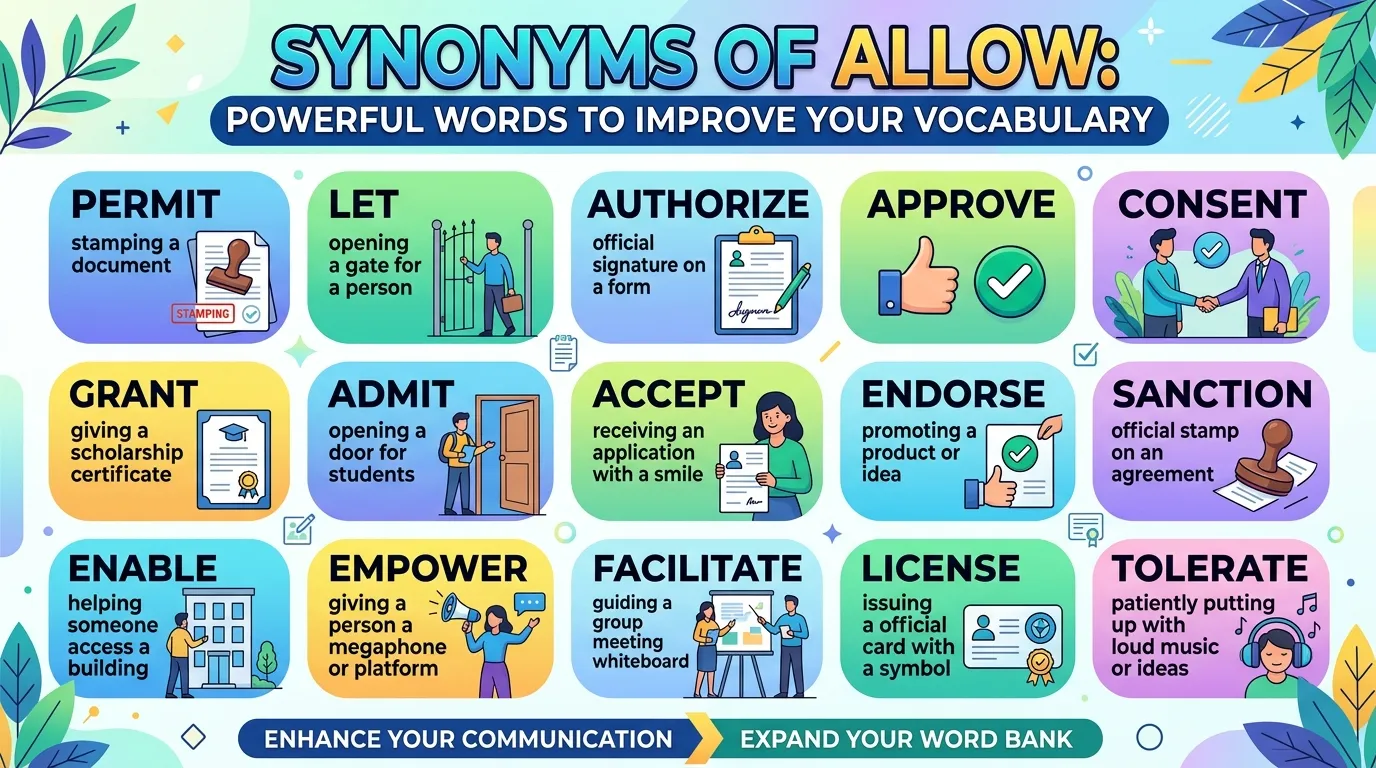
The word allow means to give permission, let something happen, or make something possible. It is one of the most common words in English. For example, a teacher may allow students to use a dictionary during a test, or parents may allow their children to stay up late on a holiday. We use this word every day in conversations, writing, school, work, and online communication.
Learning synonyms of allow helps English learners, students, writers, and professionals express ideas more clearly. Instead of repeating the same word, you can choose a synonym that better fits your meaning and tone. This article explains the meaning of allow, its pronunciation, grammar, history, connotation, and word formation. You will also learn 30 useful synonyms with meanings, pronunciations, and example sentences to improve your vocabulary and writing skills.
Meaning of Allow
Definition
Allow (Verb): To give permission for something to happen or to let someone do something.
Examples
- My parents allow me to ride my bicycle after school.
- The library does not allow food or drinks inside.
Connotative Meaning
- Positive tone: Shows kindness, freedom, trust, support, or permission.
- Negative tone: Can suggest unwilling acceptance or limited permission in some situations.
- Neutral tone: Simply means giving permission or making something possible without emotion.
Etymology
- Source language: Old French and Latin.
- Original meaning: From Old French alouer (“to approve or praise”), influenced by Latin allaudare, meaning “to praise.”
Short History of the Keyword
- Old English (450–1100): The modern word allow was not commonly used. English speakers often used words like let or grant.
- Middle English (1100–1500): The word entered English from Old French and mainly meant “to approve” or “to accept.”
- Modern English (1500–Present): Its meaning expanded to include giving permission, permitting actions, or making something possible. Today, it is one of the most frequently used English verbs.
Pronunciation (US & UK – IPA)
US: /əˈlaʊ/
UK: /əˈlaʊ/
Syllables
al-low
Affixation Pattern of Allow
Root: allow
Prefix: None
Suffix: None
Word Formation of the Keyword
- Allow (verb) – to give permission.
- Allowed (verb, adjective) – gave permission; permitted.
- Allowing (verb, gerund, present participle) – giving permission.
- Allows (verb) – third-person singular form.
- Allowance (noun) – an amount given regularly or something permitted.
- Allowable (adjective) – permitted according to rules.
- Allowably (adverb) – in a permitted way.
- Disallow (verb) – to refuse permission or reject.
- Disallowed (verb, adjective) – refused or rejected.
- Disallowance (noun) – refusal or rejection of permission.
Synonyms of Allow
1. Permit (Verb)
US: /pərˈmɪt/ | UK: /pəˈmɪt/
Meaning: To officially give permission for someone to do something.
Examples:
- The school permits students to use calculators during exams.
- Visitors are not permitted to enter after closing time.
2. Let (Verb)
US: /let/ | UK: /let/
Meaning: To allow someone to do something.
Examples:
- My father let me drive his car.
- Please let the children play outside.
3. Authorize (Verb)
US: /ˈɔːθəraɪz/ | UK: /ˈɔːθəraɪz/
Meaning: To give official permission or legal approval.
Examples:
- The manager authorized the payment.
- Only the director can authorize this request.
4. Approve (Verb)
US: /əˈpruːv/ | UK: /əˈpruːv/
Meaning: To officially accept or agree to something.
Examples:
- The committee approved the new plan.
- Her vacation request was approved yesterday.
5. Consent (Verb)
US: /kənˈsent/ | UK: /kənˈsent/
Meaning: To agree or give permission willingly.
Examples:
- She consented to the interview.
- His parents consented to the trip.
6. Grant (Verb)
US: /ɡrænt/ | UK: /ɡrɑːnt/
Meaning: To give or allow something that has been requested.
Examples:
- The judge granted bail.
- They granted him permission to leave early.
7. Admit (Verb)
US: /ədˈmɪt/ | UK: /ədˈmɪt/
Meaning: To allow someone to enter a place or join a group.
Examples:
- The hospital admitted the patient immediately.
- Only members are admitted to the club.
8. Accept (Verb)
US: /əkˈsept/ | UK: /əkˈsept/
Meaning: To receive or agree to something willingly.
Examples:
- She accepted the invitation.
- The college accepted his application.
9. Endorse (Verb)
US: /ɪnˈdɔːrs/ | UK: /ɪnˈdɔːs/
Meaning: To publicly support or approve something.
Examples:
- Experts endorsed the new safety rules.
- The organization endorsed the campaign.
10. Sanction (Verb)
US: /ˈsæŋkʃən/ | UK: /ˈsæŋkʃən/
Meaning: To officially approve or permit an action.
Examples:
- The committee sanctioned the project.
- The government sanctioned the construction work.
11. Enable (Verb)
US: /ɪˈneɪbəl/ | UK: /ɪˈneɪbəl/
Meaning: To make it possible for someone to do something.
Examples:
- The new software enables users to work faster.
- Good education enables children to reach their goals.
12. Empower (Verb)
US: /ɪmˈpaʊər/ | UK: /ɪmˈpaʊə/
Meaning: To give someone the authority, confidence, or ability to act.
Examples:
- The program empowers women to start businesses.
- Good teachers empower students to think independently.
13. Facilitate (Verb)
US: /fəˈsɪləteɪt/ | UK: /fəˈsɪlɪteɪt/
Meaning: To make a process or action easier.
Examples:
- The bridge facilitates travel between the two cities.
- Technology facilitates communication around the world.
14. License (Verb)
US: /ˈlaɪsəns/ | UK: /ˈlaɪsəns/
Meaning: To give official permission to do a particular activity.
Examples:
- The city licensed the new restaurant.
- Only trained drivers are licensed to operate buses.
15. Tolerate (Verb)
US: /ˈtɑːləreɪt/ | UK: /ˈtɒləreɪt/
Meaning: To allow something to exist even if you do not like it.
Examples:
- The teacher will not tolerate cheating.
- We should tolerate different opinions.
16. Accommodate (Verb)
US: /əˈkɑːmədeɪt/ | UK: /əˈkɒmədeɪt/
Meaning: To provide enough space or make room for someone or something.
Examples:
- The hotel can accommodate 300 guests.
- The schedule was changed to accommodate everyone.
17. Give the Green Light (Verb Phrase)
US: /ɡɪv ðə ɡriːn laɪt/ | UK: /ɡɪv ðə ɡriːn laɪt/
Meaning: To officially approve or allow something to begin.
Examples:
- The board gave the green light to the project.
- The company gave the green light for construction.
18. Clear (Verb)
US: /klɪr/ | UK: /klɪə/
Meaning: To officially approve or allow something after checking it.
Examples:
- The doctor cleared him to return to work.
- Airport security cleared the passengers.
19. Give Permission (Verb Phrase)
US: /ɡɪv pərˈmɪʃən/ | UK: /ɡɪv pəˈmɪʃən/
Meaning: To allow someone to do something.
Examples:
- Her parents gave permission for the trip.
- The manager gave permission to leave early.
20. Give Consent (Verb Phrase)
US: /ɡɪv kənˈsent/ | UK: /ɡɪv kənˈsent/
Meaning: To willingly agree or authorize an action.
Examples:
- The patient gave consent before the surgery.
- Both partners gave consent to the agreement.
21. Approve of (Verb Phrase)
US: /əˈpruːv əv/ | UK: /əˈpruːv əv/
Meaning: To think that something is good or acceptable.
Examples:
- My parents approve of my career choice.
- Most people approve of the new policy.
22. Give Access (Verb Phrase)
US: /ɡɪv ˈæk.ses/ | UK: /ɡɪv ˈæk.ses/
Meaning: To let someone enter a place or use something.
Examples:
- The administrator gave access to the new employee.
- Members are given access to premium content.
23. Open the Door To (Verb Phrase)
US: /ˈoʊpən ðə dɔːr tuː/ | UK: /ˈəʊpən ðə dɔː tuː/
Meaning: To make an opportunity possible.
Examples:
- The scholarship opened the door to higher education.
- Hard work opens the door to success.
24. Make Possible (Verb Phrase)
US: /meɪk ˈpɑːsəbəl/ | UK: /meɪk ˈpɒsəbəl/
Meaning: To create the conditions needed for something to happen.
Examples:
- Modern medicine makes longer lives possible.
- Teamwork made the project possible.
25. Give Approval (Verb Phrase)
US: /ɡɪv əˈpruːvəl/ | UK: /ɡɪv əˈpruːvəl/
Meaning: To officially agree to or accept something.
Examples:
- The director gave approval for the budget.
- The committee gave approval to the proposal.
26. Ratify (Verb)
US: /ˈrætəfaɪ/ | UK: /ˈrætɪfaɪ/
Meaning: To officially confirm or approve a decision or agreement.
Examples:
- The members ratified the new rules.
- Parliament ratified the treaty.
27. Confirm (Verb)
US: /kənˈfɜːrm/ | UK: /kənˈfɜːm/
Meaning: To state that something is approved, true, or final.
Examples:
- The office confirmed the appointment.
- She confirmed her attendance.
28. Validate (Verb)
US: /ˈvælədeɪt/ | UK: /ˈvælɪdeɪt/
Meaning: To prove that something is acceptable, correct, or officially recognized.
Examples:
- The system validated the user’s identity.
- The research validated the results.
29. Recognize (Verb)
US: /ˈrekəɡnaɪz/ | UK: /ˈrekəɡnaɪz/
Meaning: To officially accept or acknowledge someone or something.
Examples:
- The government recognized the new organization.
- The award recognized her achievements.
30. Support (Verb)
US: /səˈpɔːrt/ | UK: /səˈpɔːt/
Meaning: To help, encourage, or approve of an idea or action.
Examples:
- Many people support the new law.
- Her family supported her decision.
Prototype Meaning
When people hear the word allow, they usually think about giving permission. One person has the authority or choice to let another person do something. For example, a teacher allows students to ask questions, a parent allows a child to play outside, or a website allows users to create an account. This idea of permission is the most common and typical meaning of the word.
Prototype Categorization
- Giving permission: permit, let, allow, give permission, consent.
- Official approval: authorize, approve, sanction, ratify, license.
- Making something possible: enable, facilitate, empower, make possible, open the door to.
- Accepting or recognizing: accept, validate, confirm, recognize, endorse.
- Providing opportunity or access: admit, accommodate, give access, clear, support.
Antonyms of Allow
- Forbid (Verb): To order someone not to do something.
- Prohibit (Verb): To officially stop or ban an action.
- Ban (Verb): To completely forbid something.
- Prevent (Verb): To stop something from happening.
- Deny (Verb): To refuse permission or access.
- Reject (Verb): To refuse to accept or approve.
- Block (Verb): To stop movement, progress, or access.
- Disallow (Verb): To refuse permission officially.
- Restrict (Verb): To limit freedom or activity.
- Oppose (Verb): To disagree with or resist something.
Short Questions and Answers
- What does allow mean? It means to give permission, let something happen, or make something possible.
- When should allow be used? Use it when talking about permission, acceptance, or enabling an action.
- Is allow positive or negative? It is usually neutral or positive. The tone depends on the situation and context.
- How is it different from similar words? Allow is a general word for permission. Permit and authorize are more formal, let is informal, and enable means making something possible rather than simply giving permission.
Conclusion
Learning the Synonyms of Allow and Synonyms of Allow is an excellent way to expand your English vocabulary. Each synonym has its own meaning, tone, and level of formality, allowing you to choose the most suitable word for every situation. Using different words instead of repeating allow makes your writing more interesting and your speaking more natural. Understanding pronunciation, history, grammar, and connotation also helps you use these words correctly and confidently. Keep practicing these synonyms in daily conversations, reading, and writing. The more often you use them, the stronger your vocabulary will become, and the more confident you will feel communicating in English.

I’m Zahid Abbas, an educator, researcher, and digital publishing strategist with a passion for linguistics, grammar, and clear communication. As a content creator and SEO specialist, I craft research-driven, reader-focused content that empowers learners and makes knowledge accessible worldwide.