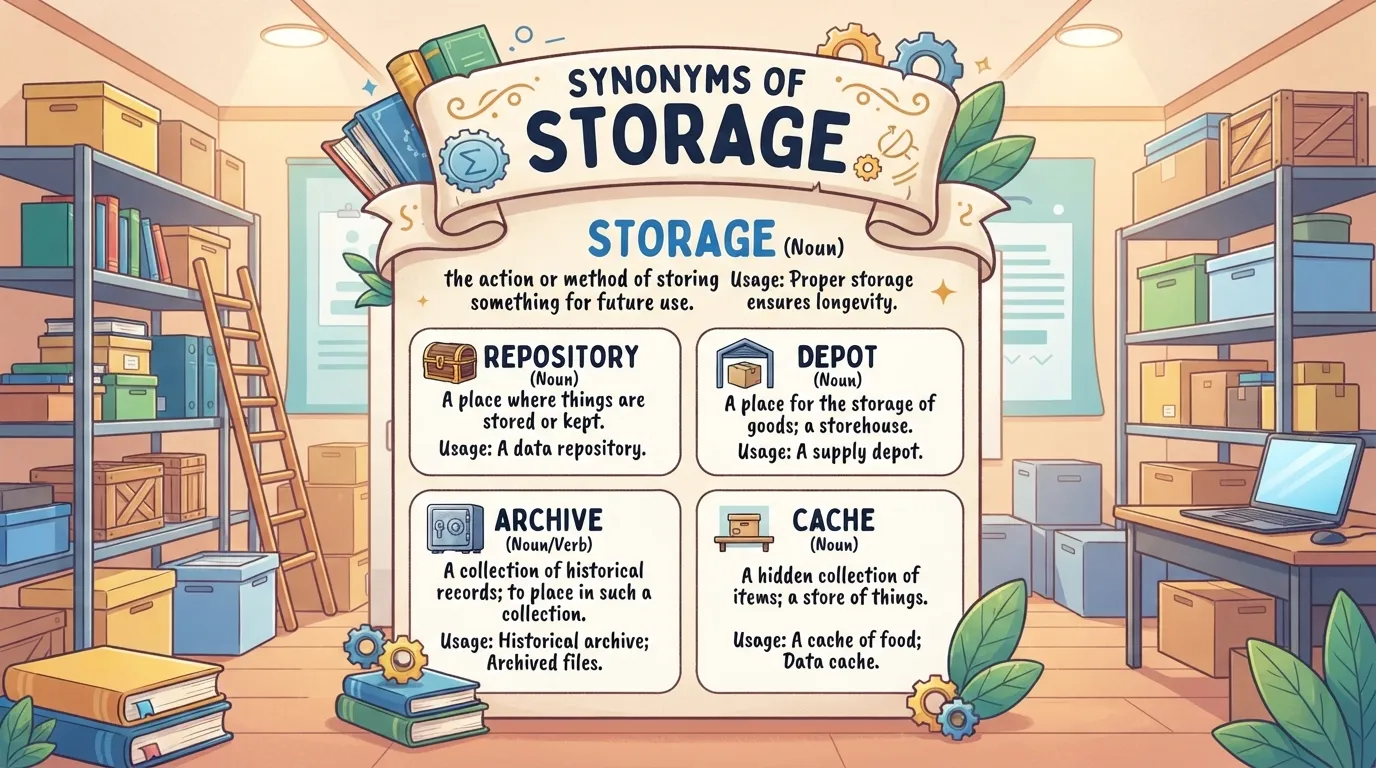
Storage means keeping something in a safe or suitable place for future use. Imagine cleaning your bedroom and putting winter clothes, books, and extra shoes into boxes. You are using storage to keep your things organized until you need them again. The word is common in everyday English because people talk about storing clothes, food, files, furniture, and digital data.
Learning synonyms for storage is useful because using the same word again and again can make speaking and writing sound repetitive. English learners can use related words to express small differences in meaning, while content writers can make their articles more natural and varied.
In this article, we will explore the meaning of storage and 30 useful synonyms. We will also look at examples, grammar, pronunciation, connotation, etymology, word formation, history, semantic categories, and antonyms. These details will help you choose the right word for each situation.
Read more about:https://synonymhunting.com/synonyms-for-advanced/
Meaning of Storage
Definition
Storage (noun): the act, process, or place of keeping something for future use.
Examples
- The kitchen has enough storage for all our dishes and utensils.
- Cloud storage allows users to save files online.
Connotative Meaning
Connotation (the feeling or idea that a word suggests beyond its basic meaning) can change slightly depending on the context.
- Positive tone: Storage can suggest organization, safety, preparation, and good use of space.
- Negative tone: In some contexts, storage can suggest clutter, unnecessary possessions, or a lack of space.
- Neutral tone: It can simply describe the act or place of keeping something for later use.
Etymology
- Storage comes from the verb store with the suffix -age.
- The idea later developed toward keeping goods or supplies for future use.
- The suffix -age is used in English to form nouns related to an action, process, result, or collection.
Short History of Storage
- Old English (450–1100): The modern word storage was not yet established. English used other words and expressions for keeping, saving, or preserving goods.
- Middle English (1100–1500): Words related to store entered and developed through French influence. Store increasingly referred to supplies or goods kept for future use.
- Modern English (1500–Present): Storage became established as a noun for the act, condition, or place of keeping things. Today, it is used for physical goods as well as digital information.
Pronunciation (US & UK – IPA)
US: /ˈstɔːrɪdʒ/ UK: /ˈstɔːrɪdʒ/
Syllables
stor-age
Affixation Pattern of Storage
- Root: store
- Prefix: None
- Suffix: -age
- Word formation: storage is a noun formed from the verb store + the suffix -age.
Related Word Forms
- store — verb/noun
- stored — verb/adjective
- storing — verb
- storage — noun
- storehouse — noun
- storer — noun, a person or thing that stores something
Synonyms of Storage
1. Keeping (Noun) — US /ˈkiːpɪŋ/ | UK /ˈkiːpɪŋ/
Meaning: The act of holding or maintaining something for a period of time.
Examples:
- The keeping of important documents requires a safe place.
- Proper food keeping helps prevent waste.
2. Warehousing (Noun) — US /ˈwerhaʊzɪŋ/ | UK /ˈweəhaʊzɪŋ/
Meaning: The practice of keeping goods in a warehouse.
Examples:
- The company spends a lot on warehousing.
- Modern warehousing helps businesses manage large amounts of stock.
3. Stockpiling (Noun) — US /ˈstɑːkpaɪlɪŋ/ | UK /ˈstɒkpaɪlɪŋ/
Meaning: The act of collecting and storing a large amount of something for future use.
Examples:
- The family started stockpiling bottled water before the storm.
- Stockpiling food can be useful during an emergency.
4. Preservation (Noun) — US /ˌprezərˈveɪʃən/ | UK /ˌprezəˈveɪʃən/
Meaning: The act of keeping something safe from damage, decay, or loss.
Examples:
- Cold preservation keeps some foods fresh.
- Digital preservation protects old photographs and records.
5. Retention (Noun) — US /rɪˈtenʃən/ | UK /rɪˈtenʃən/
Meaning: The act of keeping or holding something instead of removing it.
Examples:
- Data retention is important for some businesses.
- Water retention can affect the condition of soil.
6. Safekeeping (Noun) — US /ˈseɪfˌkiːpɪŋ/ | UK /ˈseɪfˌkiːpɪŋ/
Meaning: The act of keeping something safe and protected.
Examples:
- I left my passport with the hotel for safekeeping.
- The documents were placed in a box for safekeeping.
7. Custody (Noun) — US /ˈkʌstədi/ | UK /ˈkʌstədi/
Meaning: Care or control of something that is being kept safe.
Examples:
- The museum has custody of several valuable paintings.
- The documents remained in his custody.
8. Deposit (Noun) — US /dɪˈpɑːzɪt/ | UK /dɪˈpɒzɪt/
Meaning: Something placed somewhere for keeping or safekeeping.
Examples:
- The bank accepted the deposit safely.
- The hotel offers a secure deposit service for valuables.
9. Reserve (Noun) — US /rɪˈzɝːv/ | UK /rɪˈzɜːv/
Meaning: An amount of something kept for future use.
Examples:
- We keep a water reserve for emergencies.
- The company has a fuel reserve for difficult times.
10. Stock (Noun) — US /stɑːk/ | UK /stɒk/
Meaning: A supply of goods kept for sale or future use.
Examples:
- The shop has a large stock of shoes.
- We need to check our food stock before the weekend.
11. Supply (Noun) — US /səˈplaɪ/ | UK /səˈplaɪ/
Meaning: An amount of something available for use when needed.
Examples:
- We keep a good supply of drinking water at home.
- The hospital has an emergency supply of medicine.
12. Repository (Noun) — US /rɪˈpɑːzətɔːri/ | UK /rɪˈpɒzɪtəri/
Meaning: A place where information, objects, or materials are stored.
Examples:
- The website is a repository of useful documents.
- The library acts as a repository for historical records.
13. Cache (Noun) — US /kæʃ/ | UK /kæʃ/
Meaning: A hidden or reserved collection of things kept for later use.
Examples:
- The explorers discovered a cache of food.
- The computer keeps a cache of temporary data.
14. Archive (Noun) — US /ˈɑːrkaɪv/ | UK /ˈɑːkaɪv/
Meaning: A collection or place where important records are kept for long-term use.
Examples:
- The newspaper has an online archive of old articles.
- The museum keeps an archive of historical photographs.
15. Storehouse (Noun) — US /ˈstɔːrhaʊs/ | UK /ˈstɔːhaʊs/
Meaning: A building or place used for storing goods or materials.
Examples:
- The grain was moved to a large storehouse.
- The old storehouse is full of farming equipment.
16. Stockroom (Noun) — US /ˈstɑːkruːm/ | UK /ˈstɒkruːm/
Meaning: A room where products or supplies are kept.
Examples:
- Extra clothes are kept in the stockroom.
- The worker checked the stockroom for more boxes.
17. Warehouse (Noun) — US /ˈwerhaʊs/ | UK /ˈweəhaʊs/
Meaning: A large building used to store goods.
Examples:
- The company rents a large warehouse.
- Thousands of products are kept in the warehouse.
18. Accumulation (Noun) — US /əˌkjuːmjəˈleɪʃən/ | UK /əˌkjuːmjəˈleɪʃən/
Meaning: The gradual collection of more and more things.
Examples:
- The accumulation of old files made the office untidy.
- Snow accumulation can block roads.
19. Hoarding (Noun) — US /ˈhɔːrdɪŋ/ | UK /ˈhɔːdɪŋ/
Meaning: The practice of collecting and keeping more of something than is needed.
Examples:
- Hoarding too many unused items can create clutter.
- The unnecessary hoarding of supplies can cause shortages for others.
20. Conservation (Noun) — US /ˌkɑːnsərˈveɪʃən/ | UK /ˌkɒnsəˈveɪʃən/
Meaning: The careful protection and use of something so it lasts.
Examples:
- Water conservation is important in dry areas.
- Proper conservation can protect old books.
21. Containment (Noun) — US /kənˈteɪnmənt/ | UK /kənˈteɪnmənt/
Meaning: The act of keeping something within a particular place or limit.
Examples:
- Safe containment of chemicals is essential.
- The box provides good containment for small parts.
22. Filing (Noun) — US /ˈfaɪlɪŋ/ | UK /ˈfaɪlɪŋ/
Meaning: The act of arranging and keeping documents in an organized system.
Examples:
- Digital filing makes documents easier to find.
- Good filing can save office workers time.
23. Lodging (Noun) — US /ˈlɑːdʒɪŋ/ | UK /ˈlɒdʒɪŋ/
Meaning: The act of placing or keeping something in a particular place.
Examples:
- The lodging of important papers in a secure location is necessary.
- The museum provides careful lodging for valuable objects.
24. Maintenance (Noun) — US /ˈmeɪntənəns/ | UK /ˈmeɪntənəns/
Meaning: The act of keeping something in good condition.
Examples:
- Regular maintenance helps protect stored equipment.
- The building needs regular maintenance.
25. Conservation Storage (Noun) — US /ˌkɑːnsərˈveɪʃən ˈstɔːrɪdʒ/ | UK /ˌkɒnsəˈveɪʃən ˈstɔːrɪdʒ/
Meaning: Special storage designed to protect valuable or sensitive objects.
Examples:
- The museum uses conservation storage for rare paintings.
- Proper conservation storage protects old manuscripts.
26. Holding (Noun) — US /ˈhoʊldɪŋ/ | UK /ˈhəʊldɪŋ/
Meaning: Something that is kept or possessed for a period of time.
Examples:
- The bank has a large holding of important records.
- The company reviewed its property holdings.
27. Reserve Stock (Noun) — US /rɪˈzɝːv stɑːk/ | UK /rɪˈzɜːv stɒk/
Meaning: Extra goods kept for future or emergency use.
Examples:
- The shop keeps reserve stock in the back.
- Emergency reserve stock can help during supply problems.
28. Inventory (Noun) — US /ˈɪnvəntɔːri/ | UK /ˈɪnvəntri/
Meaning: A complete list of goods or materials that are available or stored.
Examples:
- The manager checked the inventory.
- We update our inventory every month.
29. Stowage (Noun) — US /ˈstoʊɪdʒ/ | UK /ˈstəʊɪdʒ/
Meaning: The act or process of putting things away in a particular place.
Examples:
- The boat has limited stowage space.
- Proper stowage keeps luggage secure during travel.
30. Stockpiling (Noun) — US /ˈstɑːkpaɪlɪŋ/ | UK /ˈstɒkpaɪlɪŋ/
Meaning: The deliberate collection and storage of supplies for future needs.
Examples:
- Stockpiling extra food can be useful before a long trip.
- The business began stockpiling materials before production increased.
Prototype Meaning
The most typical meaning of storage is the act or space used to keep things safely until they are needed. The central idea is simple: something is kept in a suitable place instead of being used, thrown away, or removed immediately.
Prototype Categorization
Synonyms can be grouped according to their main use:
- General keeping: keeping, holding, retention, safekeeping — useful when talking about keeping something safe.
- Long-term records: archive, repository, filing — useful for documents, information, and historical materials.
- Future supplies: reserve, supply, stockpiling, cache — useful when something is kept for later use.
Antonyms of Storage
There is no single perfect opposite of storage in every context. Useful antonyms include:
- Removal — taking something away
- Disposal — getting rid of something
- Release — allowing something to leave or become available
- Use — using something rather than keeping it
- Consumption — using something up
- Distribution — giving or sending something to different people or places
- Unpacking — taking stored items out of their containers
- Deletion — removing digital information
Short Questions and Answers
- What does storage mean? Storage means keeping something in a safe or suitable place for future use.
- When should storage be used? Use storage when talking about keeping physical objects, supplies, documents, information, or digital data.
- Is storage positive or negative? Storage is usually neutral. It can have a positive or negative feeling depending on the context. Organized storage sounds useful, while excessive storage can suggest clutter.
Conclusion
Learning the meaning and synonyms of storage can make your English more flexible and precise. Instead of using the same word repeatedly, you can choose terms such as keeping, preservation, warehouse, archive, reserve, or safekeeping according to the situation. These words can improve both writing and speaking because each one highlights a slightly different idea. Understanding pronunciation, connotation, word formation, history, and semantic categories also helps English learners use vocabulary with greater confidence. For content writers, these alternatives can make articles smoother and reduce unnecessary repetition. The best way to remember new vocabulary is to practice it regularly. Try using two or three synonyms in your own sentences each day. With steady practice, your vocabulary will become richer, clearer, and more natural.

I’m Zahid Abbas, an educator, researcher, and digital publishing strategist with a passion for linguistics, grammar, and clear communication. As a content creator and SEO specialist, I craft research-driven, reader-focused content that empowers learners and makes knowledge accessible worldwide.










