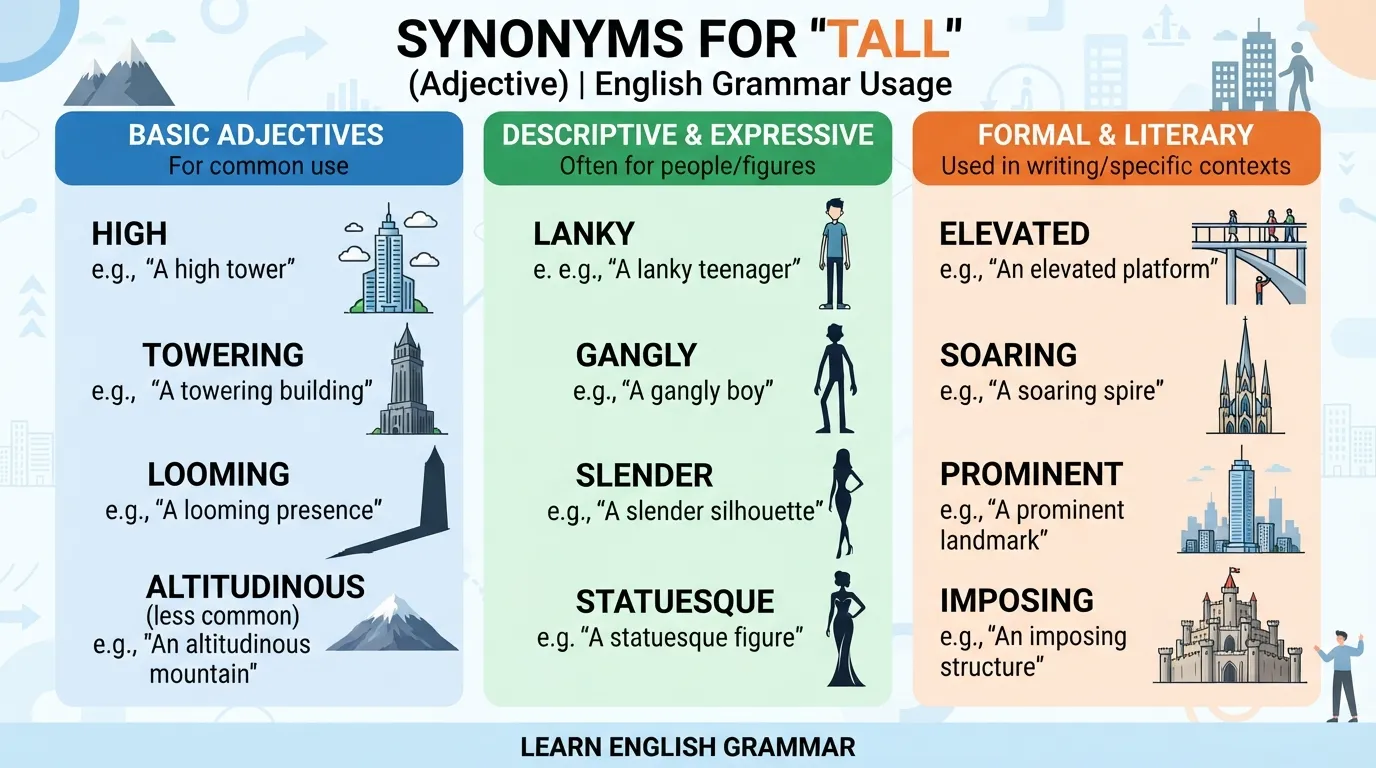
Tall means having greater height than most people or things of the same kind. Imagine a child standing beside his older brother. The child may look short, while his brother looks tall because he is much higher.
Learning synonyms of tall is useful because English learners often use the same word again and again. Content writers, students, and speakers can make their English more natural by choosing words that fit the exact situation. Some synonyms describe great height, while others suggest a slim body, impressive height, or unusual size. These details will help you choose the right word with confidence.
Meaning of Tall
Definition
Tall (adjective): Having greater height than is usual or greater height compared with other people or things of the same type.
Examples
- My brother is very tall for his age.
- We saw a tall building near the city center.
Connotative Meaning
Connotation (the feeling or idea that a word suggests beyond its basic meaning).
- Positive tone: Tall can suggest attractiveness, strength, elegance, confidence, or a strong presence.
- Neutral tone: Tall can simply describe height without showing any positive or negative feeling.
Etymology
- Source: Old English
- Old English form: getæl and related forms are associated with ideas of proper or suitable size, while the modern sense developed later.
- The modern English adjective tall developed through Middle English forms and gradually gained its common meaning of having considerable height.
Read more about:https://synonymhunting.com/synonyms-for-unknown/
Short History of Tall
- Old English (450–1100): English used several words to describe size, height, and physical dimensions. The exact modern meaning of tall was not yet fully established.
- Modern English (1500–Present): Tall became strongly connected with physical height. Today, it is one of the most common English words for describing people and objects that are high in relation to their width or surroundings.
Pronunciation (US & UK – IPA)
US: /tɔːl/ UK: /tɔːl/
Syllables
tall
It has one syllable.
Affixation Pattern of Tall
- Root: tall
- Prefix: None
- Suffix: None
- Base form: tall
- Comparative: taller
- Superlative: tallest
- Adverbial form: tall can sometimes be used adverbially, as in “stand tall.”
- Noun forms: tallness
- Related forms: tallish, tallness
The word tall is mainly an adjective. Its common grammatical forms include taller and tallest for comparison.
Synonyms of Tall
1. High (Adjective) — US /haɪ/ | UK /haɪ/
Meaning: Having a large distance from the bottom to the top.
Examples:
- The mountain is very high.
- They live in a high apartment building.
2. Lofty (Adjective) — US /ˈlɔːfti/ | UK /ˈlɒfti/
Meaning: Very high in physical height or position.
Examples:
- The castle stood on a lofty hill.
- We looked up at the lofty tower.
3. Towering (Adjective) — US /ˈtaʊərɪŋ/ | UK /ˈtaʊərɪŋ/
Meaning: Extremely tall and much higher than things around it.
Examples:
- A towering tree stood outside the house.
- The athlete was a towering figure on the court.
Note: This word strongly emphasizes great height.
4. Elevated (Adjective) — US /ˈɛləveɪtɪd/ | UK /ˈelɪveɪtɪd/
Meaning: Raised to a higher position or level.
Examples:
- The house sits on an elevated area.
- The road passes over an elevated bridge.
Note: Elevated is more formal than tall.
5. High-Rising (Adjective) — US /ˌhaɪ ˈraɪzɪŋ/ | UK /ˌhaɪ ˈraɪzɪŋ/
Meaning: Rising to a great height.
Examples:
- High-rising buildings cover the city skyline.
- They moved into a high-rising residential tower.
6. Towerlike (Adjective) — US /ˈtaʊərlɑɪk/ | UK /ˈtaʊəlɑɪk/
Meaning: Having a shape or appearance similar to a tall tower.
Examples:
- The rock had a towerlike shape.
- A towerlike structure stood near the entrance.
7. Statuesque (Adjective) — US /ˌstætʃuˈesk/ | UK /ˌstætʃuˈesk/
Meaning: Tall and attractively shaped like a statue.
Examples:
- The model had a statuesque appearance.
- She looked statuesque in the long dress.
Note: This word usually has a positive tone.
8. Stately (Adjective) — US /ˈsteɪtli/ | UK /ˈsteɪtli/
Meaning: Impressive, dignified, and often large or tall.
Examples:
- A stately building stood at the end of the street.
- The stately trees lined the road.
9. Rangy (Adjective) — US /ˈreɪndʒi/ | UK /ˈreɪndʒi/
Meaning: Tall, thin, and somewhat loosely built.
Examples:
- The rangy young man played basketball.
- A rangy horse ran across the field.
10. Lanky (Adjective) — US /ˈlæŋki/ | UK /ˈlæŋki/
Meaning: Tall and thin, often in a slightly awkward way.
Examples:
- The lanky boy was the tallest student in class.
- He was a lanky teenager with long arms.
Note: Lanky can have a mildly negative or humorous tone.
11. Long-Legged (Adjective) — US /ˌlɔːŋ ˈleɡd/ | UK /ˌlɒŋ ˈleɡd/
Meaning: Having unusually long legs.
Examples:
- The long-legged athlete ran quickly.
- She is tall and long-legged.
12. Long (Adjective) — US /lɔːŋ/ | UK /lɒŋ/
Meaning: Having greater length from one end to another.
Examples:
- The giraffe has long legs.
- He has long arms and a tall body.
Note: Long is not a direct synonym in every situation. It describes length, while tall mainly describes vertical height.
13. Giant (Adjective) — US /ˈdʒaɪənt/ | UK /ˈdʒaɪənt/
Meaning: Extremely large or tall.
Examples:
- A giant tree grew behind the house.
- We saw a giant statue in the park.
14. Gigantic (Adjective) — US /dʒaɪˈɡæntɪk/ | UK /dʒaɪˈɡæntɪk/
Meaning: Extremely large in size.
Examples:
- The museum has a gigantic entrance.
- A gigantic tower dominated the skyline.
15. Colossal (Adjective) — US /kəˈlɑːsəl/ | UK /kəˈlɒsəl/
Meaning: Extremely large or impressive in size.
Examples:
- The city built a colossal monument.
- A colossal statue stood near the entrance.
16. Huge (Adjective) — US /hjuːdʒ/ | UK /hjuːdʒ/
Meaning: Very large in size or amount.
Examples:
- They built a huge tower.
- A huge tree blocked the window.
Note: Huge means very large, but it does not always mean tall.
17. Enormous (Adjective) — US /ɪˈnɔːrməs/ | UK /ɪˈnɔːməs/
Meaning: Extremely large.
Examples:
- An enormous building stood downtown.
- We saw an enormous tree in the forest.
18. Immense (Adjective) — US /ɪˈmens/ | UK /ɪˈmens/
Meaning: Extremely large or great in size.
Examples:
- The palace has an immense entrance.
- An immense tower could be seen from miles away.
19. Long and Lean (Adjective Phrase) — US /ˌlɔːŋ ən ˈliːn/ | UK /ˌlɒŋ ən ˈliːn/
Meaning: Tall and thin with a slim body shape.
Examples:
- The long and lean athlete moved quickly.
- He has a long and lean body.
20. High-Standing (Adjective) — US /ˌhaɪ ˈstændɪŋ/ | UK /ˌhaɪ ˈstændɪŋ/
Meaning: Standing at a high position or level.
Examples:
- The high-standing structure could be seen from far away.
- The statue was high-standing above the entrance.
21. Upstanding (Adjective) — US /ʌpˈstændɪŋ/ | UK /ʌpˈstændɪŋ/
Meaning: Standing upright; also used to describe a respectable person.
Examples:
- The upstanding tree had survived the storm.
- He was an upstanding member of the community.
Note: Its common modern meaning is “honest and respectable,” so it is not a direct replacement for tall.
22. Vertical (Adjective) — US /ˈvɜːrtɪkəl/ | UK /ˈvɜːtɪkəl/
Meaning: Going straight up and down rather than from side to side.
Examples:
- The wall has a vertical design.
- The building has strong vertical lines.
Note: Vertical describes direction or position, not simply a person’s height.
23. High-Set (Adjective) — US /ˌhaɪ ˈset/ | UK /ˌhaɪ ˈset/
Meaning: Positioned or built at a relatively high level.
Examples:
- The house has high-set windows.
- The animal had high-set ears.
24. Tallish (Adjective) — US /ˈtɔːlɪʃ/ | UK /ˈtɔːlɪʃ/
Meaning: Fairly tall but not extremely tall.
Examples:
- He is tallish for his age.
- The tallish student stood at the back.
Note: The suffix -ish means “somewhat” or “rather.”
25. Leggy (Adjective) — US /ˈleɡi/ | UK /ˈleɡi/
Meaning: Having long legs, often in an attractive or noticeable way.
Examples:
- The leggy teenager was good at basketball.
- The model had a leggy appearance.
26. High-Growing (Adjective) — US /ˌhaɪ ˈɡroʊɪŋ/ | UK /ˌhaɪ ˈɡrəʊɪŋ/
Meaning: Growing to a considerable height.
Examples:
- These are high-growing trees.
- The garden has several high-growing plants.
27. Tree-Tall (Adjective) — US /ˈtriː tɔːl/ | UK /ˈtriː tɔːl/
Meaning: As tall as or similar in height to a tree.
Examples:
- The grass became tree-tall after the rainy season.
- The plants grew almost tree-tall.
Note: This is an expressive phrase rather than a common everyday synonym.
28. Sky-High (Adjective) — US /ˌskaɪ ˈhaɪ/ | UK /ˌskaɪ ˈhaɪ/
Meaning: Extremely high.
Examples:
- The new tower reached sky-high above the city.
- The plane flew sky-high over the clouds.
Note: It is often used figuratively for prices, hopes, or expectations.
29. Towering-High (Adjective Phrase) — US /ˈtaʊərɪŋ haɪ/ | UK /ˈtaʊərɪŋ haɪ/
Meaning: Rising to an unusually great height.
Examples:
- Towering-high trees surrounded the road.
- The building looked towering-high from the street.
30. High-Set and Tall (Adjective Phrase) — US /ˌhaɪ set ən tɔːl/ | UK /ˌhaɪ set ən tɔːl/
Meaning: Describes something that is both tall and positioned at a high level.
Examples:
- The house has a high-set and tall structure.
- The high-set and tall windows gave the room more light.
Note: This is a descriptive phrase rather than a standard dictionary synonym. For natural everyday English, tall, high, towering, or lofty are usually better choices.
Prototype Meaning
The most typical meaning of tall is having more height than is usual or more height than other similar people or things. When people hear the word tall, they usually imagine a person who is noticeably higher than others, such as a tall basketball player. They may also imagine a tall building, tree, tower, or pole. The word mainly focuses on vertical height rather than overall size.
Prototype Categorization
- Direct height words: high, towering, lofty, elevated describe something that rises upward or has considerable height.
- Large-size words: giant, gigantic, colossal, huge, enormous, and immense suggest great size. They are not always exact replacements for tall.
- Formal or descriptive words: stately, elevated, vertical, and lofty can make writing sound more formal or literary.
- Informal or expressive words: tallish and sky-high can add a casual or vivid tone.
- Specialized descriptions: long, high-set, and high-growing describe particular aspects of height or position.
Categorizing synonyms helps writers choose the best word for the situation. A student describing a person may choose lanky or statuesque, while a writer describing a skyscraper may prefer towering or lofty. This makes writing more accurate and prevents unnecessary repetition.
Antonyms of Tall
Common antonyms of tall include:
- Short
- Small
- Low
- Little
- Short-statured
- Tiny
- Low-rise
- Dwarf-sized
- Compact
- Petite
The best antonym depends on the context. For a person, short is usually the natural opposite of tall. For a building, low-rise may be more suitable.
Short Questions and Answers
- What does tall mean? Tall means having greater height than usual or greater height than similar people or objects.
- When should tall be used? Use tall when talking about the vertical height of people, buildings, trees, towers, and similar objects.
- Is tall positive or negative? Tall is usually neutral. Depending on the context, it can have a positive meaning when describing an attractive or impressive person.
- How is tall different from high? Tall is often used for people and upright objects. High is commonly used for levels, positions, mountains, ceilings, prices, and distances above the ground.
- How is tall different from lofty? Lofty often sounds more formal or literary and can also describe ideas, goals, or ambitions.
- Can huge be used instead of tall? Sometimes, but not always. Huge means very large overall, while tall focuses mainly on height.
- What is the comparative form of tall? The comparative form is taller.
- What is the superlative form of tall? The superlative form is tallest.
Conclusion
Learning tall and its synonyms can make your English clearer, richer, and more flexible. The word tall is simple and common, but its alternatives can give your writing more exact meaning. Words such as high, towering, and lofty can describe great height, while lanky, leggy, and statuesque can describe a person’s appearance. Other words, such as gigantic and colossal, focus more on overall size than height.
Knowing these differences helps you avoid repeating the same word in every sentence. It also strengthens both writing and speaking skills. English learners can build confidence by learning a few new synonyms each day and using them in real sentences. Practice these words in conversations, essays, stories, and online writing. With regular practice, your vocabulary will become more natural, varied, and precise.

I’m Zahid Abbas, an educator, researcher, and digital publishing strategist with a passion for linguistics, grammar, and clear communication. As a content creator and SEO specialist, I craft research-driven, reader-focused content that empowers learners and makes knowledge accessible worldwide.










