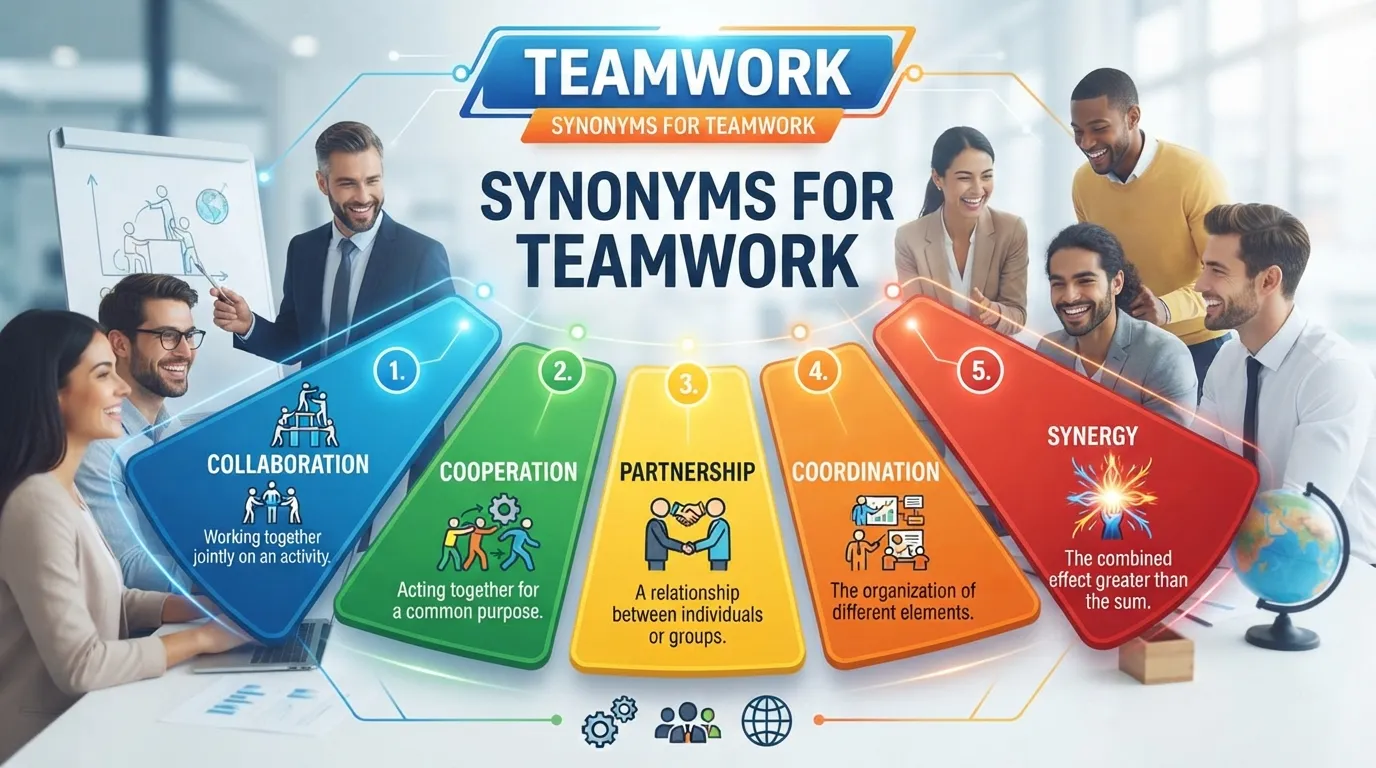
Teamwork means working together with other people to reach a shared goal. Imagine a school project where four students have different jobs. One finds information, one writes, one makes pictures, and another gives the presentation. They help each other and finish the task together. That is teamwork.
The word is commonly used in schools, workplaces, sports, and community activities because many goals are easier to reach when people cooperate. Learning synonyms for teamwork helps English learners express ideas in different ways and helps content writers avoid using the same word again and again.
In this article, you will learn the meaning, synonyms, examples, grammar, history, pronunciation, connotative meaning, and semantic groups of teamwork. These useful words can help you write and speak with greater clarity and confidence.
Meaning of Teamwork
Definition
Teamwork (noun): the act of working together with other people to achieve a common goal.
Examples
- Good teamwork helped the students complete the project on time.
- Our team won the match because of strong teamwork.
Connotative Meaning
Connotation (the feeling or idea that a word suggests beyond its basic meaning):
- Positive tone: cooperation, unity, trust, support, shared success, and friendship.
- Neutral tone: simply describes people working together toward a shared purpose.
Etymology
- Source: The word teamwork is formed from the English words team + work.
- Team: comes from Old English team, meaning a group of animals or people working together, and also related to offspring or family line.
- Work: comes from Old English weorc, meaning labor, action, or activity.
Short History of Teamwork
- Middle English (1100–1500): Team and work continued to develop in English. People often used them to describe groups, labor, and shared activities.
- Modern English (1500–Present): Teamwork became established as a term for people working together. Today, it is common in education, business, sports, technology, and many other fields.
Pronunciation of Teamwork
- US: /ˈtiːm.wɝːk/
- UK: /ˈtiːm.wɜːk/
Syllables
team-work
Affixation Pattern of Teamwork
- Root: team + work
- Prefix: None
- Suffix: None
- Word formation: Teamwork is a compound noun formed by joining two nouns: team + work.
Related grammatical forms include:
- team — noun
- teamwork — noun
- teamwork-oriented — adjective
- team-based — adjective
- teamwork-related — adjective phrase
Read more about:https://synonymhunting.com/synonyms-for-instead/
Synonyms of Teamwork
1. Cooperation (Noun) — US /koʊˌɑː.pəˈreɪ.ʃən/ | UK /kəʊˌɒp.əˈreɪ.ʃən/
Meaning: The act of working together willingly to achieve something.
Examples:
- The project was successful because of everyone’s cooperation.
- Cooperation between the two groups solved the problem.
2. Collaboration (Noun) — US /kəˌlæb.əˈreɪ.ʃən/ | UK /kəˌlæb.əˈreɪ.ʃən/
Meaning: Working with others to create or achieve something together.
Examples:
- The students worked in collaboration on the science project.
- Collaboration between teachers can improve learning.
3. Partnership (Noun) — US /ˈpɑːrt.nɚ.ʃɪp/ | UK /ˈpɑːt.nə.ʃɪp/
Meaning: A relationship in which people or groups work together for a shared purpose.
Examples:
- The two companies formed a strong partnership.
- Our partnership helped us complete the project.
4. Unity (Noun) — US /ˈjuː.nə.t̬i/ | UK /ˈjuː.nɪ.ti/
Meaning: A state of being joined together with a common purpose.
Examples:
- Unity helped the team overcome its problems.
- The group showed great unity during the competition.
5. Alliance (Noun) — US /əˈlaɪ.əns/ | UK /əˈlaɪ.əns/
Meaning: An agreement between people or groups to work together.
Examples:
- The organizations formed an alliance to support students.
- Their alliance helped them reach a common goal.
6. Cooperation (Noun) — US /koʊˌɑː.pəˈreɪ.ʃən/ | UK /kəʊˌɒp.əˈreɪ.ʃən/
Meaning: The process of helping each other and working toward the same result.
Examples:
- Cooperation is important in every successful team.
- We need cooperation from all members.
7. Coordination (Noun) — US /koʊˌɔːr.dəˈneɪ.ʃən/ | UK /kəʊˌɔː.dɪˈneɪ.ʃən/
Meaning: Organizing people’s actions so they work well together.
Examples:
- Good coordination made the event successful.
- The rescue required careful coordination.
8. Solidarity (Noun) — US /ˌsɑː.ləˈdær.ə.t̬i/ | UK /ˌsɒl.ɪˈdær.ə.ti/
Meaning: Unity and support among people who share a purpose or problem.
Examples:
- The workers showed solidarity during the difficult time.
- Their solidarity made the group stronger.
9. Synergy (Noun) — US /ˈsɪn.ɚ.dʒi/ | UK /ˈsɪn.ə.dʒi/
Meaning: The extra power created when people work well together.
Examples:
- The team’s synergy produced excellent results.
- There was strong synergy between the designers and writers.
10. Association (Noun) — US /əˌsoʊ.siˈeɪ.ʃən/ | UK /əˌsəʊ.siˈeɪ.ʃən/
Meaning: A group of people connected by a shared interest or purpose.
Examples:
- The teachers formed an association.
- The association supports local schools.
11. Teaming (Noun) — US /ˈtiː.mɪŋ/ | UK /ˈtiː.mɪŋ/
Meaning: The act of joining with others to work on something.
Examples:
- Teaming between departments improved the service.
- Successful teaming requires trust.
12. Joint Effort (Noun) — US /dʒɔɪnt ˈef.ɚt/ | UK /dʒɔɪnt ˈef.ət/
Meaning: An effort made by two or more people together.
Examples:
- The clean-up was a joint effort by the students.
- The project succeeded through a joint effort.
13. Mutual Support (Noun) — US /ˈmjuː.tʃu.əl səˈpɔːrt/ | UK /ˈmjuː.tʃu.əl səˈpɔːt/
Meaning: Help that people give to each other.
Examples:
- Mutual support helped the players stay confident.
- The group grew stronger through mutual support.
14. Team Spirit (Noun) — US /tiːm ˈspɪr.ɪt/ | UK /tiːm ˈspɪr.ɪt/
Meaning: A feeling of loyalty, friendship, and shared purpose within a team.
Examples:
- The players showed excellent team spirit.
- Team spirit kept everyone motivated.
15. Fellowship (Noun) — US /ˈfel.oʊ.ʃɪp/ | UK /ˈfel.əʊ.ʃɪp/
Meaning: A friendly relationship among people with shared interests or goals.
Examples:
- The club creates a sense of fellowship.
- They enjoyed fellowship while working together.
16. Interaction (Noun) — US /ˌɪn.t̬ɚˈæk.ʃən/ | UK /ˌɪn.tərˈæk.ʃən/
Meaning: Communication or activity between two or more people.
Examples:
- Good interaction helps team members understand each other.
- Classroom interaction can improve teamwork.
17. Engagement (Noun) — US /ɪnˈɡeɪdʒ.mənt/ | UK /ɪnˈɡeɪdʒ.mənt/
Meaning: Active involvement in an activity or group.
Examples:
- Student engagement increased during group work.
- Employee engagement can improve team performance.
18. Involvement (Noun) — US /ɪnˈvɑːlv.mənt/ | UK /ɪnˈvɒlv.mənt/
Meaning: Taking an active part in something.
Examples:
- Her involvement helped the team succeed.
- Everyone’s involvement was important.
19. Participation (Noun) — US /pɑːrˌtɪs.əˈpeɪ.ʃən/ | UK /pɑːˌtɪs.ɪˈpeɪ.ʃən/
Meaning: The act of taking part in an activity.
Examples:
- Active participation made the workshop successful.
- The teacher encouraged participation from every student.
20. Synchronization (Noun) — US /ˌsɪŋ.krə.nəˈzeɪ.ʃən/ | UK /ˌsɪŋ.krə.naɪˈzeɪ.ʃən/
Meaning: The process of making actions happen together at the right time.
Examples:
- The dancers performed with perfect synchronization.
- Good synchronization helped the team finish quickly.
21. Group Effort (Noun) — US /ɡruːp ˈef.ɚt/ | UK /ɡruːp ˈef.ət/
Meaning: Work done by several people together.
Examples:
- Cleaning the park was a group effort.
- The final product was a group effort.
22. Joint Work (Noun) — US /dʒɔɪnt wɝːk/ | UK /dʒɔɪnt wɜːk/
Meaning: Work completed together by two or more people.
Examples:
- The report was the result of joint work.
- Their joint work produced a useful solution.
23. Collective Action (Noun) — US /kəˈlek.tɪv ˈæk.ʃən/ | UK /kəˈlek.tɪv ˈæk.ʃən/
Meaning: Action taken by a group to achieve a shared goal.
Examples:
- Collective action helped protect the local park.
- The problem required collective action.
24. Mutuality (Noun) — US /ˌmjuː.tʃuˈæl.ə.t̬i/ | UK /ˌmjuː.tʃuˈæl.ə.ti/
Meaning: A relationship based on shared actions, benefits, or responsibilities.
Examples:
- Mutuality is important in a healthy working relationship.
- Their agreement was based on mutuality.
25. Cooperationism (Noun) — US /koʊˈɑː.pə.rə.tɪ.zəm/ | UK /kəʊˈɒp.ər.ə.tɪ.zəm/
Meaning: The idea or practice of emphasizing cooperation.
Examples:
- Cooperationism focuses on shared effort.
- The organization promotes cooperationism in community work.
26. Comradeship (Noun) — US /ˈkɑːm.rəd.ʃɪp/ | UK /ˈkɒm.rəd.ʃɪp/
Examples:
- The players developed strong comradeship.
- Comradeship helped the group remain united.
27. Collectiveness (Noun) — US /kəˈlek.tɪv.nəs/ | UK /kəˈlek.tɪv.nəs/
Meaning: The quality of acting as a group rather than as individuals.
Examples:
- The project showed a strong sense of collectiveness.
- Collectiveness can help groups solve problems.
28. Coaction (Noun) — US /koʊˈæk.ʃən/ | UK /kəʊˈæk.ʃən/
Meaning: Joint action by two or more people or groups.
Examples:
- The project required coaction between several departments.
- Their coaction produced a better result.
29. Cooperation-Based Work (Noun) — US /koʊˌɑː.pəˈreɪ.ʃən beɪst wɝːk/ | UK /kəʊˌɒp.əˈreɪ.ʃən beɪst wɜːk/
Meaning: Work that depends on people helping and supporting one another.
Examples:
- Cooperation-based work can improve team relationships.
- The school uses cooperation-based work in group projects.
30. Collaborative Work (Noun) — US /kəˈlæb.ə.rə.t̬ɪv wɝːk/ | UK /kəˈlæb.ər.ətɪv wɜːk/
Meaning: Work completed by people who share ideas and responsibilities.
Examples:
- Collaborative work helped the writers finish the article.
- Students often learn well through collaborative work.
Prototype Meaning
The most typical meaning of teamwork is people working together toward one shared goal. A sports team, school project group, or workplace team can all show teamwork.
Prototype Categorization
Synonyms of teamwork can be grouped by their main meaning:
- Working together: cooperation, collaboration, teaming, joint work, collaborative work.
- Unity and shared purpose: unity, solidarity, alliance, team spirit, fellowship.
- Organization and timing: coordination, synchronization.
- Active involvement: participation, engagement, involvement, interaction.
- Shared effort: joint effort, group effort, collective action.
- Strong relationships: partnership, mutual support, comradeship, mutuality.
- Advanced or formal terms: synergy, coaction, collectiveness.
Antonyms of Teamwork
- Competition
- Conflict
- Disagreement
- Division
- Isolation
- Rivalry
- Opposition
- Noncooperation
- Individualism
- Self-interest
- Separation
- Discord
Short Questions and Answers
- What does teamwork mean? Teamwork means working together with others to achieve a shared goal.
- Is teamwork positive or negative? Teamwork is usually positive because it suggests cooperation, support, and shared success. However, the context can describe poor teamwork as a problem.
- How is teamwork different from similar words? Teamwork is a broad term for working together. Collaboration often focuses on creating something together, while coordination focuses on organizing actions. Partnership highlights an ongoing relationship between people or groups.
Conclusion
Learning teamwork and its synonyms can make your English stronger and more flexible. Teamwork describes people who work together for a shared goal, but words such as cooperation, collaboration, partnership, unity, coordination, solidarity, and synergy can express more specific ideas. Knowing these differences helps you choose the right word for school work, business writing, sports, blogs, and everyday conversation. Synonyms also help you avoid repetition and make your writing more natural. For English learners, studying meaning, pronunciation, tone, grammar, and word history gives each word a deeper connection. Try to learn two or three new words each day and use them in your own sentences. With regular practice, your vocabulary, writing, speaking, and English confidence can all improve.

I’m Zahid Abbas, an educator, researcher, and digital publishing strategist with a passion for linguistics, grammar, and clear communication. As a content creator and SEO specialist, I craft research-driven, reader-focused content that empowers learners and makes knowledge accessible worldwide.










