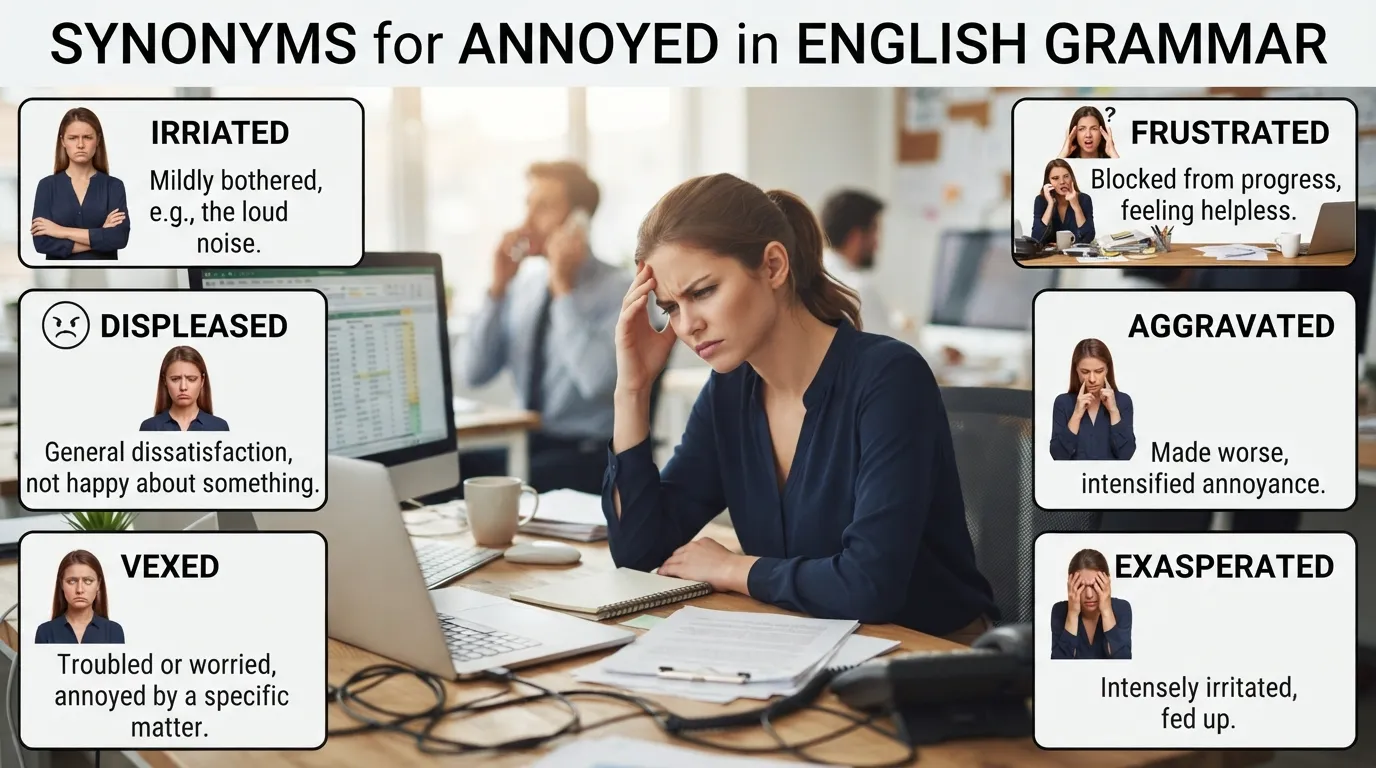
Annoyed means feeling slightly angry or bothered by someone or something. Imagine sitting down to study, but a loud noise keeps coming from the next room. After a few minutes, you may feel annoyed because you cannot focus.
This word is very common in everyday English because people often need to describe small problems, rude actions, delays, or unwanted noise. However, using the same word again and again can make speaking and writing sound dull.
Learning synonyms helps English learners express feelings with greater accuracy and gives content writers more words to choose from. This will help you understand not only what each word means, but also when to use it naturally.
Read more about:https://synonymhunting.com/synonyms-of-storage/
Meaning of Annoyed
Definition
Annoyed (adjective): feeling slightly angry, bothered, or unhappy because of someone or something.
Examples
- I felt annoyed when my friend arrived late.
- She was annoyed by the constant noise outside.
Connotative Meaning
Connotation (the feeling or idea that a word suggests beyond its basic meaning):
- Positive tone: Annoyed is usually not positive, but mild annoyance can sometimes show that a person cares about a situation.
- Negative tone: It commonly suggests irritation, frustration, or mild anger.
- Neutral tone: In a simple description, it can state someone’s emotional reaction without strong judgment.
Etymology
- Source: The word annoy entered English through Anglo-French and Old French.
- Original sense: It was related to causing trouble, harm, or distress.
- Modern form: Annoyed is the past participle and adjective form of annoy.
Short History
- Old English (450–1100): The modern word annoy was not yet used in its present form. English had other words for troubling or disturbing someone.
- Middle English (1100–1500): Forms related to annoy entered English through Anglo-French and developed meanings connected with troubling or harming.
- Modern English (1500–Present): Annoy gradually developed its common modern sense of irritating or bothering someone. Annoyed became widely used to describe a person’s emotional reaction.
Pronunciation (US & UK – IPA)
US: /əˈnɔɪd/ UK: /əˈnɔɪd/
Syllables
an-noyed
Affixation Pattern of Annoyed
- Root: annoy
- Prefix: None
- Suffix: -ed
- Word formation: Annoyed is mainly used as an adjective and as the past participle of the verb annoy. Related forms include annoy, annoying, annoyance, and annoyingly.
Synonyms of Annoyed
1. Irritated (Adjective) — US /ˈɪrɪteɪtɪd/ | UK /ˈɪrɪteɪtɪd/
Meaning: Feeling bothered or slightly angry about something.
Examples:
- I was irritated by the loud music.
- She became irritated when nobody listened.
2. Bothered (Adjective) — US /ˈbɑːðərd/ | UK /ˈbɒðəd/
Meaning: Feeling troubled, worried, or disturbed by something.
Examples:
- He looked bothered by the question.
- I was bothered by the constant noise.
3. Irritatedly (Adverb) — US /ˈɪrɪteɪtɪdli/ | UK /ˈɪrɪteɪtɪdli/
Meaning: In an irritated or annoyed manner.
Examples:
- She replied irritatedly to the repeated question.
- He spoke irritatedly after waiting for an hour.
4. Frustrated (Adjective) — US /ˈfrʌstreɪtɪd/ | UK /frʌˈstreɪtɪd/
Meaning: Feeling upset because something is difficult or does not happen as expected.
Examples:
- I felt frustrated when the computer stopped working.
- The student was frustrated by the difficult task.
5. Exasperated (Adjective) — US /ɪɡˈzæspəreɪtɪd/ | UK /ɪɡˈzɑːspəreɪtɪd/
Meaning: Very annoyed because a problem has continued for too long.
Examples:
- The teacher looked exasperated after repeated interruptions.
- She was exasperated by the constant delays.
6. Aggravated (Adjective) — US /ˈæɡrəveɪtɪd/ | UK /ˈæɡrəveɪtɪd/
Meaning: Very annoyed or frustrated by a situation.
Examples:
- He felt aggravated by the slow service.
- I became aggravated when the same mistake happened again.
7. Vexed (Adjective) — US /vekst/ | UK /vekst/
Meaning: Annoyed or worried by a difficult problem.
Examples:
- She was vexed by the strange behavior.
- He looked vexed after reading the letter.
8. Irked (Adjective) — US /ɜːrkt/ | UK /ɜːkt/
Meaning: Slightly annoyed by something unpleasant.
Examples:
- I was irked by his rude comment.
- She felt irked when the meeting started late.
9. Displeased (Adjective) — US /dɪsˈpliːzd/ | UK /dɪsˈpliːzd/
Meaning: Not happy or satisfied with something.
Examples:
- The customer was displeased with the service.
- My manager looked displeased with the result.
10. Agitated (Adjective) — US /ˈædʒəteɪtɪd/ | UK /ˈædʒɪteɪtɪd/
Meaning: Feeling worried, upset, or unable to stay calm.
Examples:
- He became agitated during the argument.
- She looked agitated after hearing the news.
11. Restless (Adjective) — US /ˈrestləs/ | UK /ˈrestləs/
Meaning: Unable to relax or stay still because of discomfort or worry.
Examples:
- I felt restless during the long meeting.
- The child became restless after waiting for hours.
12. Impatient (Adjective) — US /ɪmˈpeɪʃənt/ | UK /ɪmˈpeɪʃənt/
Meaning: Easily annoyed because something is taking too long.
Examples:
- He became impatient while waiting in line.
- She was impatient with the slow response.
13. Cross (Adjective) — US /krɔːs/ | UK /krɒs/
Meaning: Slightly angry or annoyed.
Examples:
- Dad was cross because we came home late.
- She sounded cross when I asked again.
14. Testy (Adjective) — US /ˈtesti/ | UK /ˈtesti/
Meaning: Easily annoyed and likely to respond angrily.
Examples:
- He became testy after a long day.
- The manager sounded testy during the meeting.
15. Touchy (Adjective) — US /ˈtʌtʃi/ | UK /ˈtʌtʃi/
Meaning: Easily upset or annoyed by things people say or do.
Examples:
- He is touchy about his mistakes.
- She was touchy after the argument.
16. Grumpy (Adjective) — US /ˈɡrʌmpi/ | UK /ˈɡrʌmpi/
Meaning: In a bad mood and easily annoyed.
Examples:
- I feel grumpy when I do not get enough sleep.
- The old man was grumpy in the morning.
17. Moody (Adjective) — US /ˈmuːdi/ | UK /ˈmuːdi/
Meaning: Having changing moods, often including an unhappy or annoyed mood.
Examples:
- He has been moody all morning.
- She seemed moody after the meeting.
18. Angry (Adjective) — US /ˈæŋɡri/ | UK /ˈæŋɡri/
Meaning: Feeling strong displeasure or anger.
Examples:
- She was angry about the unfair decision.
- He became angry when his phone was damaged.
19. Upset (Adjective) — US /ʌpˈset/ | UK /ʌpˈset/
Meaning: Feeling unhappy, worried, or emotionally disturbed.
Examples:
- I was upset by his words.
- She felt upset after the argument.
20. Aggrieved (Adjective) — US /əˈɡriːvd/ | UK /əˈɡriːvd/
Meaning: Feeling that you have been treated unfairly.
Examples:
- The worker felt aggrieved by the decision.
- She sounded aggrieved during the discussion.
21. Resentful (Adjective) — US /rɪˈzentfəl/ | UK /rɪˈzentfəl/
Meaning: Feeling angry because you believe someone treated you unfairly.
Examples:
- He became resentful after being ignored.
- She felt resentful about the unfair treatment.
22. Disgruntled (Adjective) — US /dɪsˈɡrʌntəld/ | UK /dɪsˈɡrʌntəld/
Meaning: Unhappy and annoyed about something.
Examples:
- Several customers were disgruntled by the delay.
- The employee became disgruntled with the new rules.
23. Peeved (Adjective) — US /piːvd/ | UK /piːvd/
Meaning: Slightly annoyed or irritated.
Examples:
- I was peeved when he forgot my birthday.
- She looked peeved after waiting outside.
24. Riled (Adjective) — US /raɪld/ | UK /raɪld/
Meaning: Made angry or annoyed.
Examples:
- His comments riled the audience.
- She was riled by the unfair criticism.
25. Put Out (Adjective Phrase) — US /pʊt aʊt/ | UK /pʊt aʊt/
Meaning: Slightly annoyed because something has caused inconvenience.
Examples:
- She was put out by the sudden change.
- He seemed put out when we changed the plan.
26. Miffed (Adjective) — US /mɪft/ | UK /mɪft/
Meaning: Slightly annoyed or offended.
Examples:
- She was miffed when nobody invited her.
- He looked miffed by the comment.
27. Chafed (Adjective) — US /tʃeɪft/ | UK /tʃeɪft/
Meaning: Feeling annoyed because of an unwanted situation or restriction.
Examples:
- He chafed under the strict rules.
- She felt chafed by the lack of freedom.
28. Fuming (Adjective) — US /ˈfjuːmɪŋ/ | UK /ˈfjuːmɪŋ/
Meaning: Extremely angry.
Examples:
- He was fuming after losing the important file.
- She was fuming when she discovered the mistake.
29. Seething (Adjective) — US /ˈsiːðɪŋ/ | UK /ˈsiːðɪŋ/
Meaning: Feeling extremely angry while trying not to show it.
Examples:
- He was seething after the unfair decision.
- She sat quietly, seething with anger.
30. Incensed (Adjective) — US /ɪnˈsenst/ | UK /ɪnˈsenst/
Meaning: Extremely angry about something considered wrong or unfair.
Examples:
- The residents were incensed by the sudden closure.
- She was incensed by the rude treatment.
Prototype Meaning
The most typical meaning of annoyed is feeling mildly angry or bothered because something is irritating. It usually describes a lower level of anger than words such as furious, enraged, or incensed.
Prototype Categorization
Synonyms of annoyed can be grouped by the strength and type of emotion:
- Mild irritation: irked, peeved, miffed, bothered, put out
- General irritation: irritated, aggravated, vexed, displeased
- Frustration: frustrated, exasperated, impatient
- Bad mood: grumpy, cross, testy, touchy, moody
- Emotional disturbance: agitated, upset, restless
- Strong anger: angry, riled, fuming, seething, incensed
- Unfair treatment: resentful, aggrieved, disgruntled, chafed
This categorization helps writers select a word that matches the exact situation. For example, peeved suggests mild annoyance, while fuming suggests very strong anger.
Antonyms of Annoyed
- Calm
- Pleased
- Happy
- Content
- Satisfied
- Relaxed
- Cheerful
- Patient
- Delighted
- Peaceful
Short Questions and Answers
- What does annoyed mean? Annoyed means feeling bothered, irritated, or slightly angry because of something.
- When should annoyed be used? Use annoyed when someone is bothered or mildly angry about a person, action, event, or situation.
- Is annoyed positive or negative? It usually has a negative tone because it describes irritation or displeasure.
- How is annoyed different from similar words? Annoyed usually describes mild anger. Frustrated focuses on difficulty, while angry can describe stronger emotion. Fuming and incensed suggest much stronger anger.
Conclusion
Learning annoyed and its synonyms can make your English more clear, natural, and expressive. The word annoyed is useful for everyday situations, but its synonyms let you show different levels and types of irritation. Words such as irked and peeved describe mild annoyance, while frustrated shows difficulty or failure. Stronger words such as fuming and incensed show intense anger. Understanding their meanings, pronunciation, tone, history, and usage helps English learners choose the right word. It also helps writers avoid repeating the same vocabulary in every sentence. Try learning two or three synonyms each day and use them in your own sentences.

I’m Zahid Abbas, an educator, researcher, and digital publishing strategist with a passion for linguistics, grammar, and clear communication. As a content creator and SEO specialist, I craft research-driven, reader-focused content that empowers learners and makes knowledge accessible worldwide.










