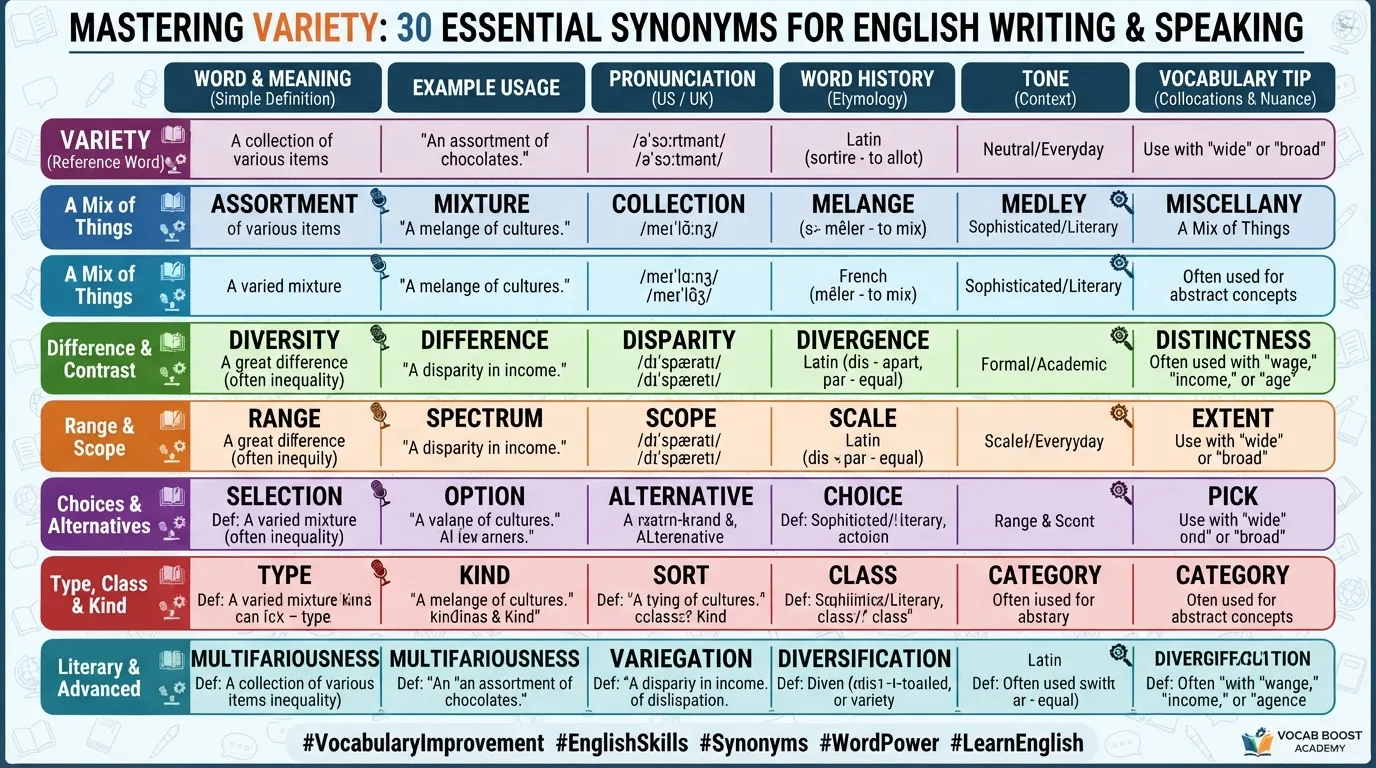
Variety means having different types of things or a range of choices. Imagine visiting a fruit shop. You see apples, bananas, oranges, and grapes. The shop offers a variety of fruits. This word is common in daily English. People use it when talking about food, choices, activities, ideas, and experiences.
Learning synonyms of variety can help English learners and content writers improve their vocabulary. It also helps them avoid using the same word again and again. However, not all synonyms have the same meaning. Some describe different types of things, while others focus on choices, changes, or differences.
In this article, you will learn the meaning of variety, its pronunciation, history, grammar, and 30 useful synonyms. You will also see simple examples, word categories, antonyms, and tips for choosing the right word.
Meaning of Variety
Definition
Variety (noun): The state of having different types of things, or a number of different choices.
Examples
- The restaurant offers a variety of fresh meals.
- Reading a variety of books helps children learn new things.
Connotative Meaning
Connotation is the feeling or idea that a word suggests beyond its basic meaning.
- Positive tone: Variety can suggest fun, choice, freshness, and excitement. For example, a variety of activities can make a school day more enjoyable.
- Negative tone: Variety can suggest too many choices or a lack of focus. For example, a wide variety of tasks may make it hard to finish one job.
- Neutral tone: Variety can simply describe different types of things. For example, the store sells a variety of shoes.
Etymology of Variety
- Source language: Variety comes from Old French varieté and Latin varietas.
- Original meaning: The Latin word referred to difference, diversity, or change.
- Root word: It comes from Latin varius, meaning different or varied.
Short History of Variety
Old English (450–1100)
The modern word variety was not used in Old English in its current form. English speakers used other words to express ideas of difference and change.
Middle English (1100–1500)
After the Norman Conquest, French and Latin words became more common in English. The word variety entered English through Old French and was used to describe difference or diversity.
Modern English (1500–Present)
Variety became a common noun in English. Today, people use it for different types of things, choices, experiences, and changes. It is also used in science, food, education, entertainment, and everyday conversation.
Pronunciation (US & UK – IPA)
- US: /vəˈraɪəti/
- UK: /vəˈraɪəti/
Syllables
va-ri-e-ty
Affixation Pattern of Variety
- Root: vary
- Prefix: None
- Suffix: -ity
- Word formation: Variety is formed from the adjective various or the verb vary, with the noun-forming suffix -ity historically related to Latin -itas.
Words Formed from Variety
| Word | Grammatical Category | Meaning |
|---|---|---|
| Variety | Noun | Different types or choices |
| Varieties | Plural noun | Different kinds |
| Varied | Adjective | Having different types |
| Various | Adjective | Several different |
| Vary | Verb | To change or differ |
| Variously | Adverb | In different ways |
| Variation | Noun | A change or difference |
| Variable | Noun/Adjective | Something that can change |
| Variability | Noun | The ability to change |
| Variegated | Adjective | Having different colors or patterns |
Synonyms of Variety
The following 30 words are related to variety. Some are close synonyms, while others fit only certain contexts. Choose the word that matches your exact meaning.
1. Diversity (Noun) — US IPA /daɪˈvɝːsəti/ | UK IPA /daɪˈvɜːsəti/
Meaning: The presence of many different types of people or things.
Examples:
- The school celebrates diversity.
- The garden has a diversity of plants.
2. Assortment (Noun) — US IPA /əˈsɔːrtmənt/ | UK IPA /əˈsɔːtmənt/
Meaning: A collection of different types of things.
Examples:
- She bought an assortment of chocolates.
- The shop sells an assortment of toys.
3. Selection (Noun) — US IPA /sɪˈlekʃən/ | UK IPA /sɪˈlekʃən/
Meaning: A group of things chosen from a larger number.
Examples:
- The store has a large selection of books.
- We enjoyed the selection of desserts.
4. Range (Noun) — US IPA /reɪndʒ/ | UK IPA /reɪndʒ/
Meaning: A number of different things within a group.
Examples:
- The shop offers a wide range of clothes.
- The course covers a range of topics.
5. Array (Noun) — US IPA /əˈreɪ/ | UK IPA /əˈreɪ/
Meaning: An impressive or large group of different things.
Examples:
- The table had an array of fresh fruits.
- The museum displays an array of paintings.
Also Read More About: https://synonymhunting.com/synonyms-for-focused/
6. Mixture (Noun) — US IPA /ˈmɪkstʃər/ | UK IPA /ˈmɪkstʃə/
Meaning: A combination of different things.
Examples:
- The salad is a mixture of vegetables.
- The class has a mixture of ages.
7. Assorted (Adjective) — US IPA /əˈsɔːrtɪd/ | UK IPA /əˈsɔːtɪd/
Meaning: Made up of different types of things.
Examples:
- The box contains assorted sweets.
- She bought assorted flowers for the party.
8. Multitude (Noun) — US IPA /ˈmʌltəˌtuːd/ | UK IPA /ˈmʌltɪtjuːd/
Meaning: A very large number of people or things.
Examples:
- The market offers a multitude of choices.
- A multitude of stars filled the sky.
9. Variety Pack (Noun) — US IPA /vəˈraɪəti pæk/ | UK IPA /vəˈraɪəti pæk/
Meaning: A package containing different types of the same product.
Examples:
- I bought a variety pack of snacks.
- The store sells a variety pack of drinks.
10. Diversity of Choice (Noun Phrase) — US IPA /daɪˈvɝːsəti əv tʃɔɪs/ | UK IPA /daɪˈvɜːsəti əv tʃɔɪs/
Meaning: The availability of many different options.
Examples:
- The school gives students a diversity of choice.
- Customers enjoy the diversity of choice at the store.
11. Variation (Noun) — US IPA /ˌveriˈeɪʃən/ | UK IPA /ˌveəriˈeɪʃən/
Meaning: A difference or change from the usual form.
Examples:
- There is a variation in the colors.
- The recipe allows some variation.
12. Difference (Noun) — US IPA /ˈdɪfərəns/ | UK IPA /ˈdɪfərəns/
Meaning: The way in which things are not the same.
Examples:
- There is a difference between the two designs.
- The teacher explained the difference in meaning.
13. Multiplicity (Noun) — US IPA /ˌmʌltəˈplɪsəti/ | UK IPA /ˌmʌltɪˈplɪsəti/
Meaning: The state of having many different parts or forms.
Examples:
- The project includes a multiplicity of ideas.
- The artist uses a multiplicity of colors.
14. Spectrum (Noun) — US IPA /ˈspektrəm/ | UK IPA /ˈspektrəm/
Meaning: A wide range of different types or qualities.
Examples:
- The course covers a spectrum of subjects.
- The debate included a spectrum of opinions.
15. Diversity of Types (Noun Phrase) — US IPA /daɪˈvɝːsəti əv taɪps/ | UK IPA /daɪˈvɜːsəti əv taɪps/
Meaning: The presence of many different kinds.
Examples:
- The forest has a diversity of types of trees.
- The store offers a diversity of types of products.
16. Heterogeneity (Noun) — US IPA /ˌhetərəˈdʒiːnəti/ | UK IPA /ˌhetərəˈdʒiːnəti/
Meaning: The state of being made up of different kinds of things.
Examples:
- The team showed heterogeneity in skills.
- The soil has heterogeneity in its composition.
17. Medley (Noun) — US IPA /ˈmedli/ | UK IPA /ˈmedli/
Meaning: A mixture of different things, often songs or foods.
Examples:
- The band played a medley of songs.
- We prepared a medley of vegetables.
18. Mélange (Noun) — US IPA /meɪˈlɑːnʒ/ | UK IPA /meɪˈlɑːnʒ/
Meaning: A mixture of different things.
Examples:
- The room had a mélange of colors.
- The book is a mélange of stories and poems.
19. Potpourri (Noun) — US IPA /ˌpoʊpəˈriː/ | UK IPA /ˌpəʊpʊˈriː/
Meaning: A mixture of different things, often with a pleasant or varied effect.
Examples:
- The show was a potpourri of music and dance.
- The magazine contains a potpourri of topics.
20. Assortment of Choices (Noun Phrase) — US IPA /əˈsɔːrtmənt əv ˈtʃɔɪsɪz/ | UK IPA /əˈsɔːtmənt əv ˈtʃɔɪsɪz/
Meaning: A group of different options.
Examples:
- The menu offers an assortment of choices.
- The website has an assortment of choices for readers.
21. Breadth (Noun) — US IPA /bredθ/ | UK IPA /bredθ/
Meaning: The extent or range of something.
Examples:
- The course has breadth in its topics.
- The book shows the breadth of human experience.
22. Scope (Noun) — US IPA /skoʊp/ | UK IPA /skəʊp/
Meaning: The range of subjects or activities included.
Examples:
- The project has a wide scope.
- The course covers a broad scope of ideas.
23. Assortment of Forms (Noun Phrase) — US IPA /əˈsɔːrtmənt əv fɔːrmz/ | UK IPA /əˈsɔːtmənt əv fɔːmz/
Meaning: A group of different shapes, types, or versions.
Examples:
- The artist used an assortment of forms.
- The lesson explains an assortment of word forms.
24. Change (Noun) — US IPA /tʃeɪndʒ/ | UK IPA /tʃeɪndʒ/
Meaning: The act or result of becoming different.
Examples:
- A change in routine can be refreshing.
- The weather showed a sudden change.
25. Alternation (Noun) — US IPA /ˌɔːltərˈneɪʃən/ | UK IPA /ˌɔːltəˈneɪʃən/
Meaning: The act of switching between different things.
Examples:
- The pattern shows an alternation of colors.
- The schedule uses an alternation of work and rest.
26. Inconsistency (Noun) — US IPA /ˌɪnkənˈsɪstənsi/ | UK IPA /ˌɪnkənˈsɪstənsi/
Meaning: A lack of sameness or agreement.
Examples:
- The report contains inconsistency in its figures.
- There is inconsistency in the team’s performance.
27. Variability (Noun) — US IPA /ˌveriəˈbɪləti/ | UK IPA /ˌveəriəˈbɪləti/
Meaning: The ability or tendency to change.
Examples:
- The study measures variability in rainfall.
- The results show variability across groups.
28. Hodgepodge (Noun) — US IPA /ˈhɑːdʒpɑːdʒ/ | UK IPA /ˈhɒdʒpɒdʒ/
Meaning: A mixture of different things, often without order.
Examples:
- The room was a hodgepodge of furniture.
- The article became a hodgepodge of ideas.
29. Assortment of Styles (Noun Phrase) — US IPA /əˈsɔːrtmənt əv staɪlz/ | UK IPA /əˈsɔːtmənt əv staɪlz/
Meaning: A group of different styles.
Examples:
- The shop sells an assortment of styles.
- The designer uses an assortment of styles.
30. Richness (Noun) — US IPA /ˈrɪtʃnəs/ | UK IPA /ˈrɪtʃnəs/
Meaning: The quality of having many interesting or valuable features.
Examples:
- The book shows the richness of the English language.
- The garden has richness in color and texture.
Prototype Meaning
The most typical meaning of variety is having different kinds of something instead of only one kind. When people hear the word, they often imagine a shop with many products, a meal with different foods, or a group of activities. Variety usually suggests that people have choices and can enjoy different experiences. It can also describe differences in people, ideas, colors, or styles.
Prototype Categorization
Synonyms of variety can be grouped by their meaning. This helps writers choose words that fit the topic and avoid changing the meaning of a sentence.
- Different types: Diversity, assortment, variety pack, and assorted describe the presence of different kinds of things.
- Choices and options: Selection, range, array, and assortment of choices focus on the options available.
- Mixtures: Mixture, medley, mélange, potpourri, and hodgepodge describe things combined together.
- Differences and changes: Variation, difference, change, alternation, and variability focus on how things differ or change.
- Wide coverage: Spectrum, breadth, scope, and multiplicity describe a wide range of subjects or qualities.
- Different forms: Assortment of forms and assortment of styles describe different versions, shapes, or designs.
- Positive richness: Richness describes the value or interest created by having many features.
- Technical differences: Heterogeneity and inconsistency are more formal terms. They are useful in science, research, and detailed writing.
Antonyms of Variety
Antonyms are words with opposite meanings. The best opposite of variety depends on the sentence.
| Antonym | Meaning |
|---|---|
| Sameness | The state of being the same |
| Uniformity | The state of being alike |
| Similarity | The quality of being similar |
| Monotony | A lack of change or variety |
| Consistency | The state of remaining the same |
| Homogeneity | The state of being made up of similar parts |
| Repetition | The act of doing or saying something again |
| Regularity | The state of following a fixed pattern |
Short Questions and Answers
– What does variety mean?
Variety means having different types of things or several choices.
– When should variety be used?
Use variety when talking about different kinds of things, choices, or experiences.
– Is variety positive or negative?
Variety is usually neutral or positive. It can be negative when too many choices cause confusion.
– How is variety different from similar words?
Variety focuses on different types or choices. Diversity often highlights differences, selection focuses on chosen options, and mixture describes things combined together.
Conclusion
Learning the meaning of variety and its synonyms can help you become a better English speaker and writer. Words such as diversity, assortment, selection, and range help you express different ideas clearly. Each word has its own meaning and use, so it is important to choose the one that fits your sentence.
Using synonyms also helps you avoid repetition and makes your writing more interesting. For English learners, this practice can build confidence in daily conversations, schoolwork, and professional writing. Start by learning a few words each day. Read their meanings, study their examples, and try using them in your own sentences. With regular practice, you can improve your vocabulary, express your thoughts more clearly, and enjoy learning English.

I’m Zahid Abbas, an educator, researcher, and digital publishing strategist with a passion for linguistics, grammar, and clear communication. As a content creator and SEO specialist, I craft research-driven, reader-focused content that empowers learners and makes knowledge accessible worldwide.










