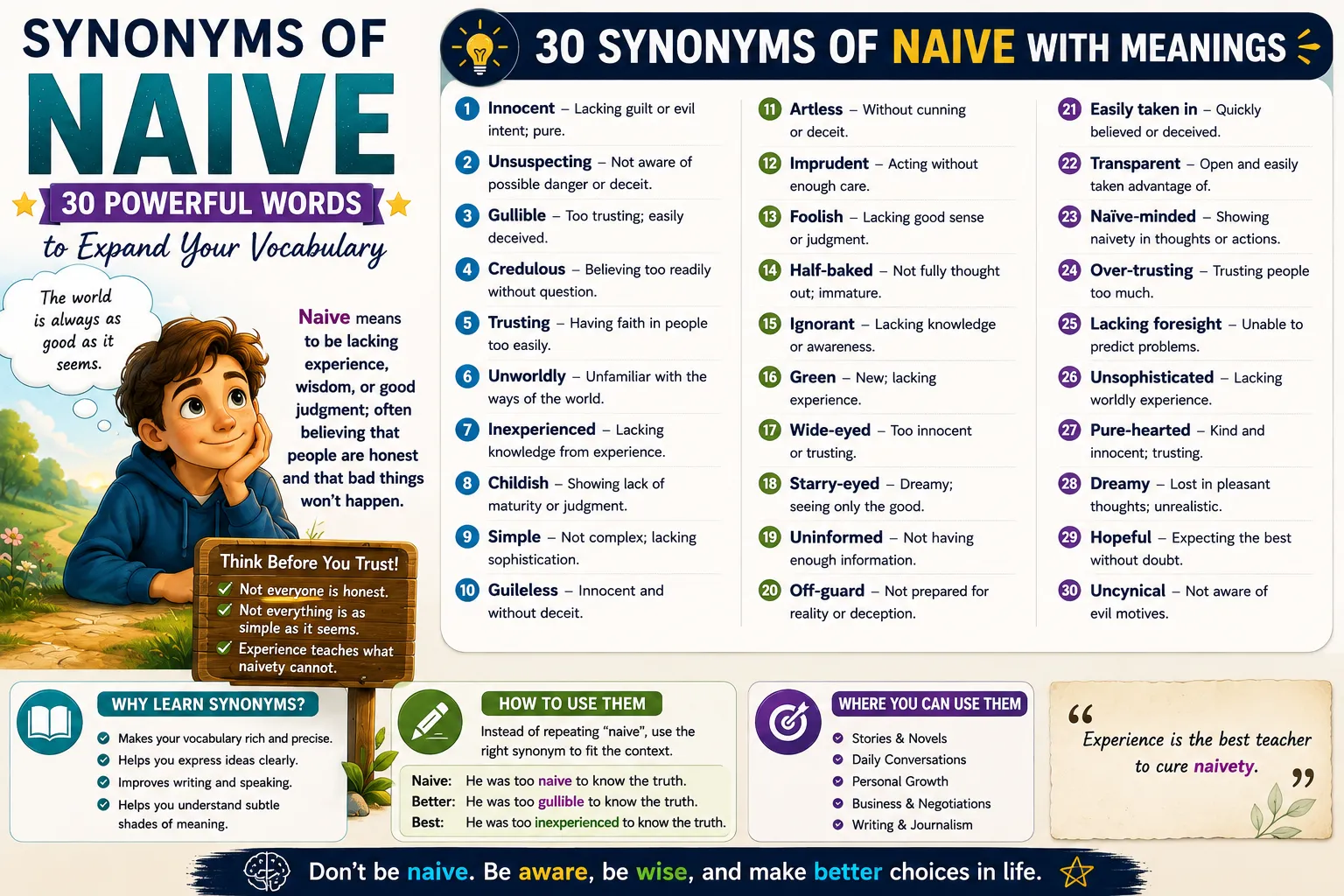
The word naive describes a person who is young, gentle, and easily believes what others say. Because they do not have much experience yet. Imagine a little student who goes to a birthday party. And truly believes that a magician made a red toy coin vanish into thin air. She claps her hands with joy because she does not know how magic tricks work yet. That cute trust and simple wonder show what it means to be naive. Learning synonyms of naive is necessary for English learners and young writers to improve their vocabulary. . Synonyms of naive enables you to describe childlike innocence, simple trust, or being new at a game without repeating the same word every time. This article aims to discuss the meaning of the key word and its 30 synonyms with clear examples, grammar facts, word history, pronunciation guides, and simple categories written in smooth, easy sentences.
Meaning of Naive
Definition
Naive (Adjective): Being very young in experience, trusting others too easily, or having a simple, sweet innocence.
Examples
- The naive puppy thought the rubber ball was a real animal.
- It was naive of Sam to think it would never rain on sports day.
Connotative Meaning
- Positive tone: Expresses sweet innocence, truthfulness, pure heart, and gentle trust.
- Negative tone: Can describe being easily tricked, silly, or not ready for a hard test.
- Neutral tone: Used by teachers and books to describe young animals or new beginners.
Etymology
- Source language: Came from the French word naïf, which came from the Latin word nativus, meaning natural or born simple.
- Old English (450–1100): Early children used words like bilewit (simple and sweet) long ago.
- Middle English (1100–1500): French words started coming into English storybooks and tales.
- Modern English (1500–Present): Became the word naive, used today for young, trusting people!
Pronunciation
- US: /naɪˈiːv/
- UK: /naɪˈiːv/
Syllables
na-ive (2 parts)
Affixation Pattern of Naive
- Root: Naive
- Prefix: None
- Suffix: -ly (Adverb)
- Word Formation:
- Adjective: Naive
- Noun: Naivety
- Adverb: Naively
Synonyms of Naive
1. Innocent (Adjective) — US: /ˈɪnəsənt/ | UK: /ˈɪnəsnt/
Meaning: Pure, sweet, and doing no harm to anyone.
Examples:
The innocent kitten played with a ball of yarn.
She has an innocent smile that makes everyone happy.
2. Trusting (Adjective) — US: /ˈtrʌstɪŋ/ | UK: /ˈtrʌstɪŋ/
Meaning: Believing that all people are good and kind.
Examples:
The trusting boy gave his favorite toy to his friend.
Dogs are very trusting animals.
3. Simple (Adjective) — US: /ˈsɪmpəl/ | UK: /ˈsɪmpl/
Meaning: Easy to understand, plain, and sweet.
Examples:
He is a simple boy who loves playing in the park.
Her simple ideas helped clean the classroom.
4. Young (Adjective) — US: /jʌŋ/ | UK: /jʌŋ/
Meaning: Having lived for only a short time.
Examples:
The young bird learned how to fly today.
Young students like playing outdoor games.
5. Childlike (Adjective) — US: /ˈtʃaɪldlaɪk/ | UK: /ˈtʃaɪldlaɪk/
Meaning: Having happy qualities like a small child.
Examples:
He looked at the colorful balloons with childlike joy.
Grandma has a sweet, childlike laugh.
6. Green (Adjective) — US: /ɡriːn/ | UK: /ɡriːn/
Meaning: Very new to a sport, job, or game.
Examples:
The player was still green and missed the ball.
We were green on our first day at swimming school.
7. Raw (Adjective) — US: /rɔː/ | UK: /rɔː/
Meaning: Untrained and needs more practice to get better.
Examples:
The coach helped the raw runner win the race.
She has raw talent for drawing funny cats.
8. Wide-eyed (Adjective) — US: /ˌwaɪdˈaɪd/ | UK: /ˌwaɪdˈaɪd/
Meaning: Showing big surprise, wonder, and innocence.
Examples:
The children stood wide-eyed near the tall Christmas tree.
The wide-eyed girl looked at the zoo lion.
9. Honest (Adjective) — US: /ˈɑːnɪst/ | UK: /ˈɒnɪst/
Meaning: Always telling the truth and not hiding things.
Examples:
An honest child returns lost money to the teacher.
He gave an honest answer during class.
10. Open (Adjective) — US: /ˈoʊpən/ | UK: /ˈəʊpən/
Meaning: Ready to share feelings and talk kindly.
Examples:
She is very open with her school friends.
An open heart makes new friends quickly.
11. Untested (Adjective) — US: /ʌnˈtɛstɪd/ | UK: /ʌnˈtestɪd/
Meaning: Not tried in a real game or hard test yet.
Examples:
The team played with an untested new bat today.
Our new boat is still untested in deep water.
12. Fresh (Adjective) — US: /frɛʃ/ | UK: /frɛʃ/
Meaning: Newly arrived and full of happy energy.
Examples:
The fresh new student joined our 3rd grade class.
Fresh players ran onto the football field.
13. Unaware (Adjective) — US: /ˌʌnəˈwɛr/ | UK: /ˌʌnəˈweə/
Meaning: Not knowing that something is happening nearby.
Examples:
The unaware cat slept while the mouse ran past.
He was unaware that his shoe was untied.
14. Sweet (Adjective) — US: /swiːt/ | UK: /swiːt/
Meaning: Very kind, gentle, and lovely to everyone.
Examples:
The sweet girl shared her apples with her brother.
We have a sweet little bunny at home.
15. Pure (Adjective) — US: /pjʊr/ | UK: /pjʊə/
Meaning: Clean, good, and without bad thoughts.
Examples:
She spoke with pure love for her family.
The child has a pure heart.
16. Gentle (Adjective) — US: /ˈdʒɛntəl/ | UK: /ˈdʒentl/
Meaning: Soft, careful, and not rough or angry.
Examples:
Be gentle when holding the small chick.
The gentle breeze blew the green leaves.
17. Unused (Adjective) — US: /ˌʌnˈjuːzd/ | UK: /ˌʌnˈjuːzd/
Meaning: Not used to hard work or long journeys yet.
Examples:
His unused shoes looked bright and clean.
The unused bicycle sat in the dry garage.
18. Plain (Adjective) — US: /pleɪn/ | UK: /pleɪn/
Meaning: Simple, honest, and easy to see.
Examples:
He told the story in plain, simple words.
She wore a plain blue dress to school.
19. Friendly (Adjective) — US: /ˈfrɛndli/ | UK: /ˈfrendli/
Meaning: Kind, smiling, and happy to meet people.
Examples:
The friendly dog wagged its tail fast.
A friendly smile makes people feel good.
20. Soft (Adjective) — US: /sɔːft/ | UK: /sɒft/
Meaning: Gentle, quiet, and not harsh or loud.
Examples:
The mother spoke in a soft voice to the baby.
He has a soft heart for hungry birds.
21. Sincere (Adjective) — US: /sɪnˈsɪr/ | UK: /sɪnˈsɪə/
Meaning: Real, true, and feeling what you say.
Examples:
He gave a sincere sorry after bumping into me.
Her sincere card made the teacher smile.
22. Unseen (Adjective) — US: /ˌʌnˈsiːn/ | UK: /ˌʌnˈsiːn/
Meaning: Hidden or not noticed by other people yet.
Examples:
The unseen bird sang sweet songs from the tree.
His talent was unseen until the art competition.
23. Shy (Adjective) — US: /ʃaɪ/ | UK: /ʃaɪ/
Meaning: Quiet and slow to talk in front of new people.
Examples:
The shy boy hid behind his mother.
A shy squirrel ran up the oak tree.
24. New (Adjective) — US: /nuː/ | UK: /njuː/
Meaning: Just starting out and having no old practice.
Examples:
The new girl sat near the front row window.
I got a new storybook from the school library.
25. True (Adjective) — US: /truː/ | UK: /truː/
Meaning: Real, honest, and loyal to friends.
Examples:
A true friend helps you when you fall.
It was a true story about a brave dog.
26. Easy (Adjective) — US: /ˈiːzi/ | UK: /ˈiːzi/
Meaning: Not hard, calm, and easily pleased.
Examples:
He is an easy boy to play games with.
The cat found an easy spot to sleep.
27. Quiet (Adjective) — US: /ˈkwaɪət/ | UK: /ˈkwaɪət/
Meaning: Making little noise and staying calm.
Examples:
The quiet class read their books peacefully.
She gave a quiet answer to the teacher.
28. Mild (Adjective) — US: /maɪld/ | UK: /maɪld/
Meaning: Gentle, soft, and not harsh or strong.
Examples:
We enjoyed a mild sunny day in spring.
He has a mild nature and never fights.
29. Glad (Adjective) — US: /ɡlæd/ | UK: /ɡlæd/
Meaning: Happy, pleased, and full of joy.
Examples:
The glad child skipped down the red path.
We were glad to hear the good school news.
30. Warm (Adjective) — US: /wɔːrm/ | UK: /wɔːm/
Meaning: Kind, welcoming, and full of love.
Examples:
She gave her mother a warm hug.
The room had a warm and happy feel.
Prototype Meaning
When children hear the word naive, they usually picture a young, happy student who trusts everybody, smiles gently, and thinks the world is filled only with fun games, friendly pets, and kind teachers.
Prototype Categorization
- Kindness & Pure Heart: Innocent, Childlike, Pure, Sweet, Gentle, Soft, Sincere, True, Warm.
- Simple Trust & Truth: Trusting, Simple, Honest, Open, Plain, Friendly, Glad.
- Being New & Needing Practice: Young, Green, Raw, Untested, Fresh, New, Unused.
- Quiet & Wide-Eyed Wonder: Wide-eyed, Unaware, Unseen, Shy, Quiet, Mild, Easy.
Antonyms of Naive
- Smart
- Wise
- Clever
- Experienced
- Cautious
- Careful
Short Questions and Answers
- What does “naive” mean?
“Naive” means being young, sweet, and trusting others very easily. - When should “naive” be used?
Use “naive” when writing about young children, new pets, or beginners starting a new game. - Is “naive” positive or negative?
“Naive” can be sweet when talking about innocent children, but tricky if someone gets fooled in a game. - How is it different from similar words?
“Naive” means general youth and simple trust, while “young” just means small age, and “honest” means telling the truth.
CONCLUSION
Synonyms of naive strengthens your overall English vocabulary. Relying on the same basic word every day can make your class stories sound boring. Using exact synonyms of naive like innocent for sweet pets, fresh for new classmates, or wide-eyed for happy surprise makes your sentences fun to read. Expanding your vocabulary sharpens your writing, builds speaking confidence, and helps you get great marks in school English tests. Start practicing two or three of these synonyms of naive in your daily reading, writing, and talking.

I’m Zahid Abbas, an educator, researcher, and digital publishing strategist with a passion for linguistics, grammar, and clear communication. As a content creator and SEO specialist, I craft research-driven, reader-focused content that empowers learners and makes knowledge accessible worldwide.