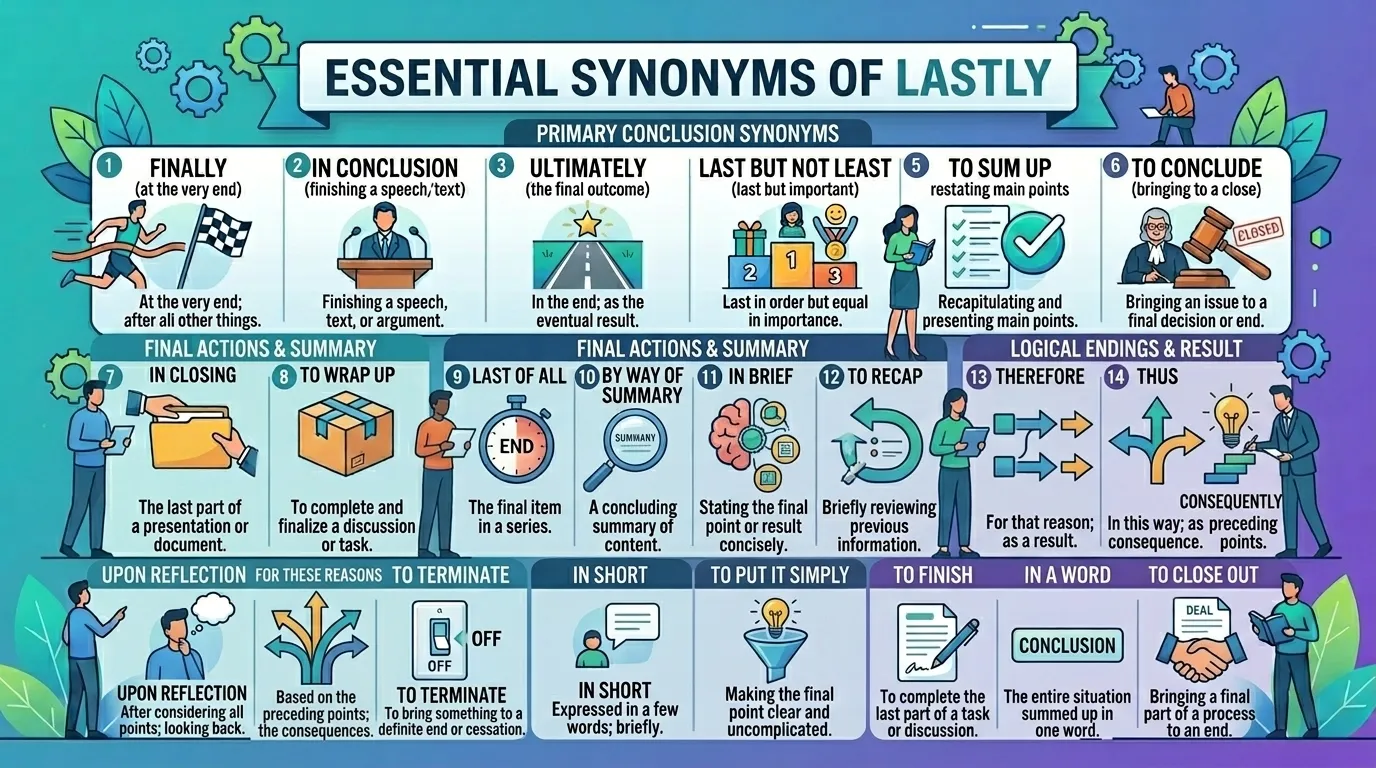
Lastly means “as the final point” or “at the end of a list.” Think about a teacher explaining the steps of a science project. She says, “First, gather your tools. Next, mix the materials. Lastly, record your results.” That last word tells the class the list is finished.
People use synonyms of lastly a lot, in speeches, essays, and instructions. It helps show that the final idea or step has arrived.
But saying “lastly” again and again can make writing feel repeated. English learners and writers need other words too. Synonyms of lastly help show the ending of a list in different ways, some simple, some more formal. Synonyms of lastly also help your writing sound more natural and clear.
This article looks at the word “lastly” in a simple way. You will learn what it means, how to say it, where it came from, and how to use it. Then you will learn 30 other words that mean almost the same thing.
Meaning of Lastly
Definition
Lastly (adverb): Used to introduce the final point, step, or item in a list.
Examples
- Lastly, add a pinch of salt to the soup.
- She thanked her teachers, her parents, and lastly, her friends.
Connotative Meaning
- Positive tone: “Lastly” can feel satisfying, showing that a list or task is coming to a clear end.
- Negative tone: “Lastly” is rarely negative. It can feel a bit stiff if overused in casual speech.
- Neutral tone: In instructions or essays, “lastly” is usually just a simple transition word, without strong feeling.
Etymology
- “Lastly” comes from the word last, which comes from the Old English word latost, the superlative form of “late.”
- “Latost” meant “coming after everything else” or “slowest.”
- The suffix “-ly” was added to “last” to form “lastly,” a word used to introduce the final point in speech or writing.
Short History
- Old English (450–1100): The word “latost” (later “last”) meant coming after all others in time or order. There was no word “lastly” yet.
- Middle English (1100–1500): “Last” shortened from “latost” and kept its meaning of final or ending. The “-ly” form began to develop as a way to introduce a final point.
- Modern English (1500–Present): “Lastly” became a common transition word, especially in essays, speeches, and instructions, used to clearly mark the final idea or step.
Pronunciation (US & UK – IPA)
- US: /ˈlæstli/
- UK: /ˈlɑːstli/
Syllables
last-ly
Affixation Pattern of Lastly
- Root: last (the superlative form of “late,” meaning final or coming after all others)
- Prefix: none
- Suffix: -ly (forms the adverb “lastly”)
Word formation: This root gives us a few related words. “Last” works as an adjective, adverb, and noun. “Lastly” is the adverb form, used to introduce a final point. “Lasting” is a related word, but it means enduring or continuing, which is a different sense of “last.”
Synonyms of Lastly
1. Finally (adverb) — US /ˈfaɪnəli/ | UK /ˈfaɪnəli/
Meaning: At the end, after everything else. Examples:
- Finally, she added the last piece to the puzzle.
- We tried three plans, and finally, one worked.
2. In conclusion (phrase) — US /ɪn kənˈkluːʒən/ | UK /ɪn kənˈkluːʒən/
Meaning: Used to introduce the final part of a speech or essay. Examples:
- In conclusion, the plan will save time and money.
- In conclusion, she thanked everyone for their support.
3. To conclude (phrase) — US /tə kənˈkluːd/ | UK /tə kənˈkluːd/
Meaning: Used to introduce a final summary or point. Examples:
- To conclude, the results show clear improvement.
- To conclude, he shared his final thoughts on the project.
4. In closing (phrase) — US /ɪn ˈkloʊzɪŋ/ | UK /ɪn ˈkləʊzɪŋ/
Meaning: Used to introduce the final words of a speech or letter. Examples:
- In closing, I want to thank the whole team.
- In closing, she wished everyone a safe trip home.
5. Last but not least (phrase) — US /læst bʌt nɑːt liːst/ | UK /lɑːst bʌt nɒt liːst/
Meaning: Used to show the final item is still important. Examples:
- Last but not least, we thank our volunteers.
- Last but not least, check the oven temperature.
6. At last (phrase) — US /æt læst/ | UK /æt lɑːst/
Meaning: After a long wait, finally. Examples:
- At last, the rain stopped and the sun came out.
- At last, they reached the top of the mountain.
7. In the end (phrase) — US /ɪn ðə ɛnd/ | UK /ɪn ði ɛnd/
Meaning: After everything has happened. Examples:
- In the end, they chose the smaller apartment.
- In the end, her hard work paid off.
8. Ultimately (adverb) — US /ˈʌltɪmətli/ | UK /ˈʌltɪmətli/
Meaning: In the end, after all other steps or ideas. Examples:
- Ultimately, the team decided to wait a year.
- Ultimately, her decision changed the whole plan.
9. To finish (phrase) — US /tə ˈfɪnɪʃ/ | UK /tə ˈfɪnɪʃ/
Meaning: Used to introduce the final part of a task or speech. Examples:
- To finish, he showed a short video about the project.
- To finish, she answered a few last questions.
10. To sum up (phrase) — US /tə sʌm ʌp/ | UK /tə sʌm ʌp/
Meaning: To give a short final summary. Examples:
- To sum up, the trip was fun but tiring.
- To sum up, the plan needs more time and money.
11. As a final point (phrase) — US /æz ə ˈfaɪnəl pɔɪnt/ | UK /æz ə ˈfaɪnəl pɔɪnt/
Meaning: Used to introduce the last idea in a list. Examples:
- As a final point, remember to save your work.
- As a final point, she praised the whole team.
12. Eventually (adverb) — US /ɪˈvɛntʃuəli/ | UK /ɪˈvɛntʃuəli/
Meaning: After some time, in the end. Examples:
- Eventually, they found the right house.
- Eventually, the noise stopped and the room went quiet.
13. At the end (phrase) — US /æt ði ɛnd/ | UK /æt ði ɛnd/
Meaning: After everything before it. Examples:
- At the end, everyone clapped for the winners.
- At the end, she thanked her family for their help.
14. In summary (phrase) — US /ɪn ˈsʌməri/ | UK /ɪn ˈsʌməri/
Meaning: Used to give a short final overview. Examples:
- In summary, the report shows steady growth.
- In summary, the trip taught them many new skills.
15. Last of all (phrase) — US /læst əv ɔːl/ | UK /lɑːst əv ɔːl/
Meaning: The very final point or step. Examples:
- Last of all, check that every door is locked.
- Last of all, she signed her name at the bottom.
16. To wrap up (phrase) — US /tə ræp ʌp/ | UK /tə ræp ʌp/
Meaning: To bring something to a close, often casually. Examples:
- To wrap up, let’s review what we learned today.
- To wrap up, he shared one last piece of advice.
17. In the final analysis (phrase) — US /ɪn ðə ˈfaɪnəl əˈnæləsɪs/ | UK /ɪn ðə ˈfaɪnəl əˈnæləsɪs/
Meaning: After thinking everything through, a formal phrase. Examples:
- In the final analysis, the plan was worth the risk.
- In the final analysis, both sides gained something.
18. All in all (phrase) — US /ɔːl ɪn ɔːl/ | UK /ɔːl ɪn ɔːl/
Meaning: Considering everything, as a final thought. Examples:
- All in all, it was a great trip.
- All in all, the changes made the process easier.
19. On a final note (phrase) — US /ɒn ə ˈfaɪnəl noʊt/ | UK /ɒn ə ˈfaɪnəl nəʊt/
Meaning: Used to share one last thought before finishing. Examples:
- On a final note, thank you all for coming.
- On a final note, remember to double-check your work.
20. As a last point (phrase) — US /æz ə læst pɔɪnt/ | UK /æz ə lɑːst pɔɪnt/
Meaning: Used to introduce the last idea shared. Examples:
- As a last point, she reminded them of the deadline.
- As a last point, he explained the new rule.
21. To close (phrase) — US /tə kloʊz/ | UK /tə kləʊz/
Meaning: To bring a speech or writing to its final part. Examples:
- To close, the speaker thanked the audience.
- To close, she shared a short, hopeful message.
22. In the final place (phrase) — US /ɪn ðə ˈfaɪnəl pleɪs/ | UK /ɪn ðə ˈfaɪnəl pleɪs/
Meaning: Used formally to introduce the last point. Examples:
- In the final place, we must consider the cost.
- In the final place, the report lists future plans.
23. At the close (phrase) — US /æt ðə kloʊz/ | UK /æt ðə kləʊz/
Meaning: At the very end of an event or piece of writing. Examples:
- At the close, the singer thanked her fans.
- At the close of the meeting, they set a new date.
24. As the final step (phrase) — US /æz ðə ˈfaɪnəl stɛp/ | UK /æz ðə ˈfaɪnəl stɛp/
Meaning: Used to describe the last action in a process. Examples:
- As the final step, tighten each screw firmly.
- As the final step, she checked the numbers twice.
25. Once and for all (phrase) — US /wʌns ənd fər ɔːl/ | UK /wʌns ənd fə ɔːl/
Meaning: In a final and complete way, ending something for good. Examples:
- They fixed the leak once and for all.
- She wanted to settle the argument once and for all.
26. After all is said and done (phrase) — US /ˈæftər ɔːl ɪz sɛd ənd dʌn/ | UK /ˈɑːftər ɔːl ɪz sɛd ənd dʌn/
Meaning: When everything is finished and considered. Examples:
- After all is said and done, they were proud of their work.
- After all is said and done, the trip was worth it.
27. In the last place (phrase) — US /ɪn ðə læst pleɪs/ | UK /ɪn ðə lɑːst pleɪs/
Meaning: Used formally to introduce the final point. Examples:
- In the last place, the team reviewed the budget.
- In the last place, she checked every detail again.
28. To end with (phrase) — US /tə ɛnd wɪð/ | UK /tə ɛnd wɪð/
Meaning: Used to introduce the closing part of something. Examples:
- To end with, he played one more song for the crowd.
- To end with, she shared a short thank-you note.
29. As a closing point (phrase) — US /æz ə ˈkloʊzɪŋ pɔɪnt/ | UK /æz ə ˈkləʊzɪŋ pɔɪnt/
Meaning: Used to share the final idea of a talk or essay. Examples:
- As a closing point, remember to stay patient.
- As a closing point, the coach praised the team’s effort.
30. Last (adverb) — US /læst/ | UK /lɑːst/
Meaning: At the final position, often used simply in a list. Examples:
- First we cooked, then we cleaned, and last, we relaxed.
- She spoke first, and her brother spoke last.
Prototype Meaning
When people hear the word “lastly,” they usually picture the end of a list or the final step in a set of instructions. It brings to mind a sense of closure, like the final piece falling into place. This simple idea of marking an ending sits at the center of the word. Synonyms of lastly add detail, showing whether the ending feels formal, or casual.
Prototype Categorization
You can group these synonyms by how formal or casual they feel:
- Simple, everyday words: finally, last, at last, eventually
- Common writing transitions: in conclusion, in summary, to sum up, to wrap up
- Formal or academic phrases: in the final analysis, in the final place, in the last place
- Marking the very final item: last of all, last but not least, as a last point
- Reflecting on everything: all in all, after all is said and done, in the end
- Ending with strong finality: once and for all, ultimately, to close, at the close
Antonyms of Lastly
firstly, initially, first, to begin with
Short Questions and Answers
- What does “lastly” mean? It means “as the final point” or “at the end of a list.”
- When should “lastly” be used? Use it to introduce the last step, item, or idea in a list, speech, or piece of writing.
- Is “lastly” positive or negative? It is neutral. It simply shows that something is ending, without strong emotion.
- How is it different from similar words? “Lastly” is common in writing and speeches. “Finally” feels more natural in everyday talk. “In conclusion” fits formal essays. “Last but not least” shows that the final point still holds importance.
Conclusion
Synonyms of lastly will help your English grow strong. Synonyms of lastly help your writing sound clear and organized, not repeated. Synonyms of lastly also help you guide your reader smoothly from one idea to the next. Anyone learning English can use synonyms of lastly to write essays, speeches, and instructions with more skill. Try to learn one new word each day. Use it to end a list or a short story. Over time, synonyms of lastly will make your English much stronger.

I’m Zahid Abbas, an educator, researcher, and digital publishing strategist with a passion for linguistics, grammar, and clear communication. As a content creator and SEO specialist, I craft research-driven, reader-focused content that empowers learners and makes knowledge accessible worldwide.