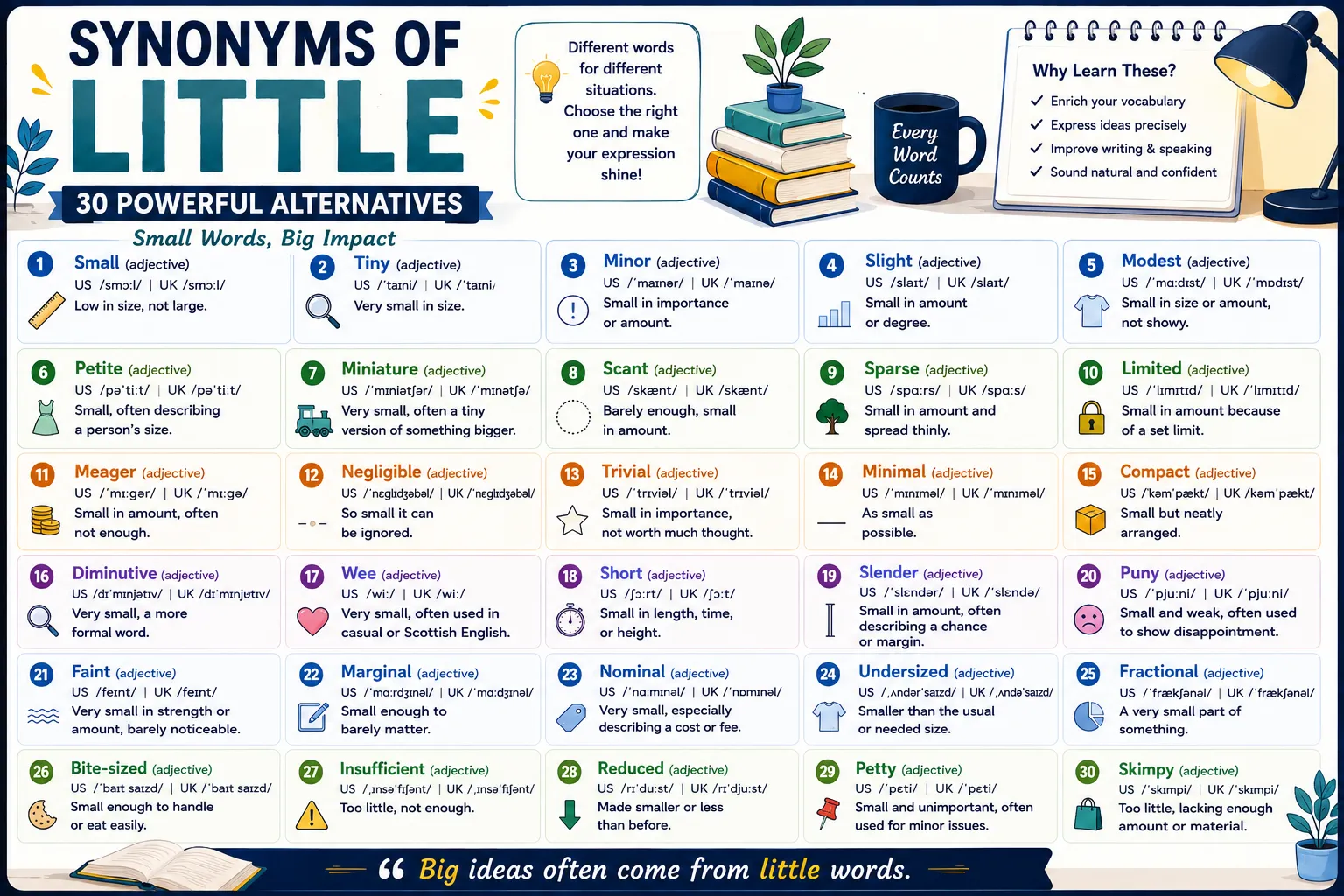
Little means small in size or amount. Think about a young girl holding her new baby brother for the first time. His tiny hands wrap around her finger, and she smiles at how little he is. That gentle idea of smallness is what “little” means.
People use this word every day. Synonyms of little use it for size, amount, age, and even feelings, like “a little worried.” It is one of the first words English learners use, and it carries a warm, simple feeling.
But saying “little” again and again can make writing feel plain. English learners and writers need synonyms of little too. New words help show different kinds of smallness, from a light amount to a tiny size. Synonyms of little also help your writing sound more clear and full of detail.
This article looks at the word “little” in a simple way. You will learn what it means, how to say it, where it came from, and how to use it. Then you will learn 30 other words that mean almost the same thing.
Meaning of Little
Definition
Little (adjective): Small in size, amount, or degree.
Examples
- She has a little garden behind her house.
- He only had a little time before the meeting.
Connotative Meaning
- Positive tone: “Little” often feels warm and gentle, like a little smile or a little gift.
- Negative tone: “Little” can feel disappointing when there is not enough, like a little food after a long day.
- Neutral tone: In facts or measurements, “little” can simply describe a low amount, like “there was little rainfall this month.”
Etymology
- “Little” comes from the Old English word lytel, which meant small in size or amount.
- This word came from an old Germanic root, shared with similar words in Old Saxon and Old High German.
- The word has kept a very similar, gentle meaning for over a thousand years.
Short History
- Old English (450–1100): “Lytel” was a common word used for anything small, from objects to amounts of food or time.
- Middle English (1100–1500): The word became “litel,” later “little.” It kept its broad meaning of smallness in size or amount.
- Modern English (1500–Present): “Little” kept its core meaning. It is now used for size, amount, age, and even soft, affectionate feelings, like “my little friend.”
Pronunciation (US & UK – IPA)
- US: /ˈlɪtəl/
- UK: /ˈlɪtəl/
Syllables
lit-tle
Affixation Pattern of Little
- Root: little
- Prefix: none common
- Suffix: -ness (makes the noun “littleness,” though rarely used)
Word formation: “Little” is unusual because its comparative and superlative forms are irregular. Instead of “littler” and “littlest,” English mostly uses “less” and “least.” “Little” also works as an adverb, as in “she slept little last night,” and as a noun, as in “give me a little of that.”
Synonyms of Little
1. Small (adjective) — US /smɔːl/ | UK /smɔːl/
Meaning: Low in size, not large. Examples:
- They live in a small apartment downtown.
- She keeps a small notebook in her bag.
2. Tiny (adjective) — US /ˈtaɪni/ | UK /ˈtaɪni/
Meaning: Very small in size. Examples:
- The tiny puppy fit in one hand.
- He found a tiny shell on the beach.
3. Minor (adjective) — US /ˈmaɪnər/ | UK /ˈmaɪnə/
Meaning: Small in importance or amount. Examples:
- There was only a minor problem with the plan.
- She made a minor change to the schedule.
4. Slight (adjective) — US /slaɪt/ | UK /slaɪt/
Meaning: Small in amount or degree. Examples:
- There was a slight delay in the flight.
- He felt a slight improvement after resting.
5. Modest (adjective) — US /ˈmɑːdɪst/ | UK /ˈmɒdɪst/
Meaning: Small in size or amount, not showy. Examples:
- They earned a modest income from the small shop.
- She lives in a modest home near the coast.
6. Petite (adjective) — US /pəˈtiːt/ | UK /pəˈtiːt/
Meaning: Small, often describing a person’s size. Examples:
- She has a petite frame and short hair.
- The petite dancer moved gracefully on stage.
7. Miniature (adjective) — US /ˈmɪniətʃər/ | UK /ˈmɪnətʃə/
Meaning: Very small, often a tiny version of something bigger. Examples:
- He collects miniature toy trains.
- The museum displayed a miniature model of the ship.
8. Scant (adjective) — US /skænt/ | UK /skænt/
Meaning: Barely enough, small in amount. Examples:
- They had scant proof to support the claim.
- Scant rainfall left the fields dry.
9. Sparse (adjective) — US /spɑːrs/ | UK /spɑːs/
Meaning: Small in amount and spread thinly. Examples:
- The forest had sparse trees near the trail.
- Traffic was sparse early in the morning.
10. Limited (adjective) — US /ˈlɪmɪtɪd/ | UK /ˈlɪmɪtɪd/
Meaning: Small in amount because of a set limit. Examples:
- They had limited time before the store closed.
- The offer had a limited number of spots.
11. Meager (adjective) — US /ˈmiːɡər/ | UK /ˈmiːɡə/
Meaning: Small in amount, often not enough. Examples:
- He lived on a meager salary for years.
- Their meager supplies barely lasted the week.
12. Negligible (adjective) — US /ˈnɛɡlɪdʒəbəl/ | UK /ˈnɛɡlɪdʒəbəl/
Meaning: So small it can be ignored. Examples:
- The price difference was negligible.
- There was a negligible chance of rain.
13. Trivial (adjective) — US /ˈtrɪviəl/ | UK /ˈtrɪviəl/
Meaning: Small in importance, not worth much thought. Examples:
- It was a trivial mistake that no one noticed.
- She brushed off the trivial complaint.
14. Minimal (adjective) — US /ˈmɪnɪməl/ | UK /ˈmɪnɪməl/
Meaning: As small as possible. Examples:
- The changes required minimal effort.
- They kept the decorations minimal and simple.
15. Compact (adjective) — US /kəmˈpækt/ | UK /kəmˈpækt/
Meaning: Small but neatly arranged. Examples:
- They bought a compact car for the city.
- His compact apartment felt cozy and neat.
16. Diminutive (adjective) — US /dɪˈmɪnjətɪv/ | UK /dɪˈmɪnjʊtɪv/
Meaning: Very small, a more formal word. Examples:
- The diminutive bird landed on her hand.
- His diminutive size never stopped him from playing sports.
17. Wee (adjective) — US /wiː/ | UK /wiː/
Meaning: Very small, often used in casual or Scottish English. Examples:
- She has a wee garden behind her house.
- The wee puppy could barely climb the stairs.
18. Short (adjective) — US /ʃɔːrt/ | UK /ʃɔːt/
Meaning: Small in length, time, or height. Examples:
- They took a short break before continuing.
- He is quite short compared to his brother.
19. Slender (adjective) — US /ˈslɛndər/ | UK /ˈslɛndə/
Meaning: Small in amount, often describing a chance or margin. Examples:
- There was only a slender chance of winning.
- The team won by a slender margin.
20. Puny (adjective) — US /ˈpjuːni/ | UK /ˈpjuːni/
Meaning: Small and weak, often used to show disappointment. Examples:
- The puny plant needed more sunlight.
- He felt puny standing next to the taller players.
21. Faint (adjective) — US /feɪnt/ | UK /feɪnt/
Meaning: Very small in strength or amount, barely noticeable. Examples:
- She held onto a faint hope of winning.
- There was a faint smell of coffee in the room.
22. Marginal (adjective) — US /ˈmɑːrdʒɪnəl/ | UK /ˈmɑːdʒɪnəl/
Meaning: Small enough to barely matter. Examples:
- The improvement was marginal at best.
- There was only a marginal difference between the two plans.
23. Nominal (adjective) — US /ˈnɑːmɪnəl/ | UK /ˈnɒmɪnəl/
Meaning: Very small, especially describing a cost or fee. Examples:
- The museum charges a nominal entry fee.
- She paid a nominal amount for the used book.
24. Undersized (adjective) — US /ˌʌndərˈsaɪzd/ | UK /ˌʌndəˈsaɪzd/
Meaning: Smaller than the usual or needed size. Examples:
- The undersized shoes hurt her feet.
- They found an undersized fish and let it go.
25. Fractional (adjective) — US /ˈfrækʃənəl/ | UK /ˈfrækʃənəl/
Meaning: A very small part of something. Examples:
- The change made only a fractional difference.
- They saw a fractional rise in sales this month.
26. Bite-sized (adjective) — US /ˈbaɪt saɪzd/ | UK /ˈbaɪt saɪzd/
Meaning: Small enough to handle or eat easily. Examples:
- She served bite-sized snacks at the party.
- The lesson was broken into bite-sized parts.
27. Insufficient (adjective) — US /ˌɪnsəˈfɪʃənt/ | UK /ˌɪnsəˈfɪʃənt/
Meaning: Too little, not enough. Examples:
- The team had insufficient time to finish.
- Insufficient funds delayed the project.
28. Reduced (adjective) — US /rɪˈduːst/ | UK /rɪˈdjuːst/
Meaning: Made smaller or less than before. Examples:
- The store offered items at a reduced price.
- They worked with a reduced budget this year.
29. Petty (adjective) — US /ˈpɛti/ | UK /ˈpɛti/
Meaning: Small and unimportant, often used for minor issues. Examples:
- It felt like a petty argument over nothing.
- She ignored the petty complaint and moved on.
30. Skimpy (adjective) — US /ˈskɪmpi/ | UK /ˈskɪmpi/
Meaning: Too little, lacking enough amount or material. Examples:
- The skimpy portion left him still hungry.
- She complained about the skimpy blanket at the hotel.
Prototype Meaning
When people hear the word “little,” they usually picture something small and gentle. Like a young child a small amount of food, or a short amount of time. It carries a warm, soft feeling that fits both size and amount. This simple picture sits at the center of the word. Synonym of little add detail, showing whether the smallness feels formal, disappointing, or neat and tidy.
Prototype Categorization
You can group these synonyms of little by what kind of smallness they show:
- Small in size: small, tiny, petite, miniature, wee, compact, diminutive
- Small in amount: scant, sparse, meager, slender, insufficient, skimpy
- Small in importance: minor, trivial, negligible, marginal, petty
- Small and exact or careful: minimal, nominal, fractional, limited, reduced
- Small and weak: puny, faint, undersized
- Neat, small portions: bite-sized, short.
Antonyms of Little
big, large, much, plenty, abundant, great
Short Questions and Answers
- What does “little” mean? It means small in size, amount, or degree.
- When should “little” be used? Use it to describe anything small, from objects and amounts to time and feelings.
- Is “little” positive or negative? It depends on the situation. It can feel warm and gentle, or disappointing when something is not enough.
- How is it different from similar words? “Little” is simple, warm, and common. “Tiny” shows an even smaller size. “Meager” focuses on a disappointing amount. “Trivial” points to low importance rather than size.
Conclusion
Synonyms of little will help your English grow strong. Each word shows a different kind of smallness. From a gentle “tiny” object to a disappointing “meager” amount. Synonyms of little help your writing sound clear and full of detail, not repeated. Synonyms of little also help you describe size, amount, and importance with more color and precision. Anyone learning English can use synonyms of little to speak and write. Try to learn one new word each day. Use it in a sentence about something small around you. Over time, this small habit will make your English much stronger.

I’m Zahid Abbas, an educator, researcher, and digital publishing strategist with a passion for linguistics, grammar, and clear communication. As a content creator and SEO specialist, I craft research-driven, reader-focused content that empowers learners and makes knowledge accessible worldwide.