Experienced means having skill or knowledge gained through years of practice. Think about an old carpenter who has built furniture for thirty years. His hands move with ease, and he barely needs to measure twice. That skill, built up over time, is what “experienced” means.
People use this word a lot, at work, in sports, and in daily life. It shows that someone has learned through real practice.
But saying “experienced” again and again can make writing feel plain. English learners and writers need other synonyms of experienced too. New words help show different levels of skill, from well-trained to truly expert. They also help your writing sound more clear and professional.
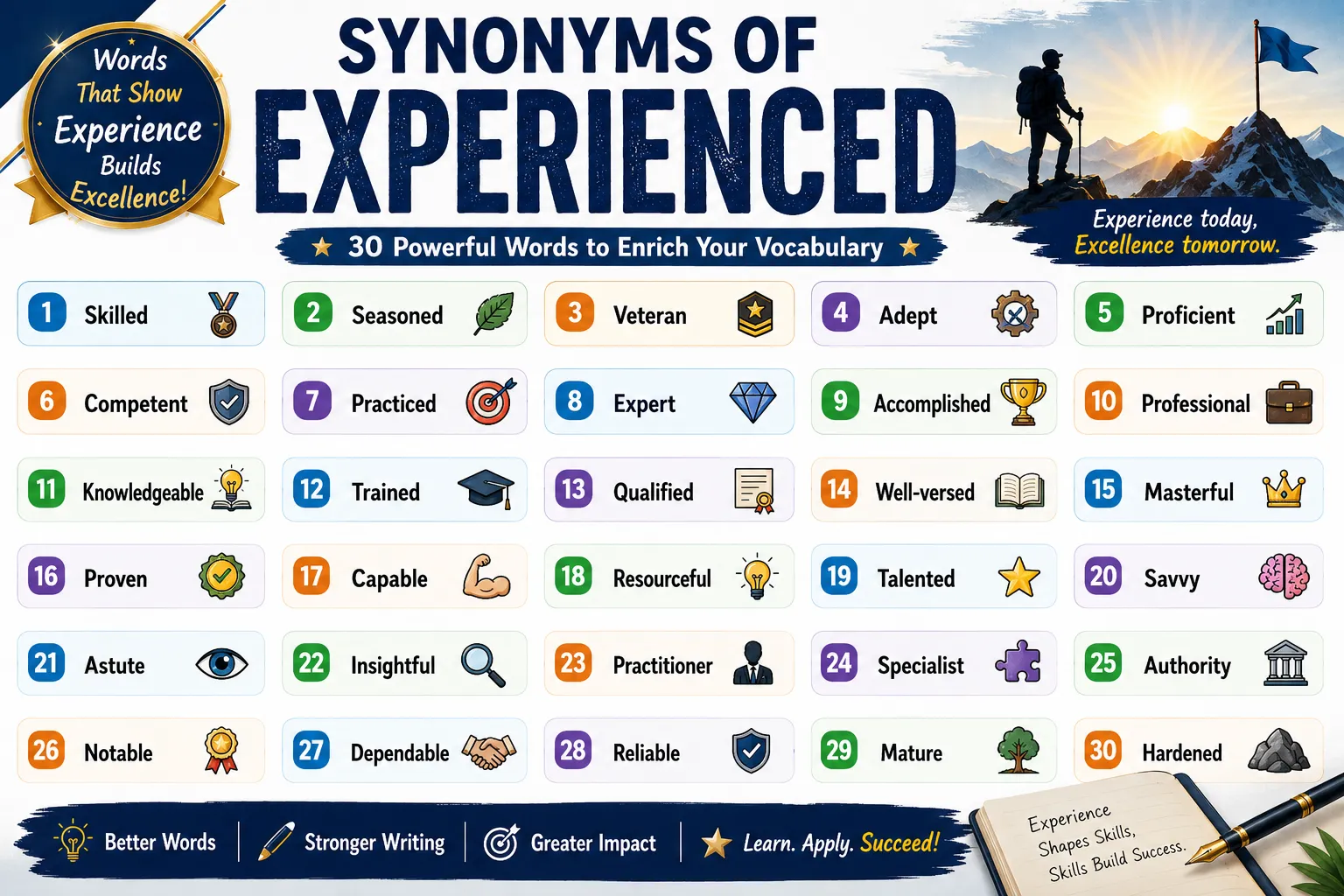
This article looks at the word “experienced” in a simple way. You will learn what it means, how to say it, where it came from, and how to use it. Then you will learn 30 other words that mean almost the same thing.
Meaning of Experienced
Definition
Experienced (adjective): Having skill or knowledge gained through years of practice or doing something many times.
Examples
- She is an experienced teacher with twenty years in the classroom.
- He hired an experienced driver for the long trip.
Connotative Meaning
- Positive tone: “Experienced” almost always feels positive, showing skill, trust, and reliability.
- Negative tone: “Experienced” is rarely negative, though it can sound intimidating to a beginner.
- Neutral tone: In job listings or reports, “experienced” is often a simple requirement. Like “the role requires an experienced candidate.”
Etymology
- “Experienced” comes from the word experience, based on the Latin word experientia.
- This word came from the Latin verb experiri, meaning “to try” or “to test.”
- The adjective “experienced” developed to describe someone who has been “tested” through years of practice, shaping their skill.
Short History
- Old English (450–1100): The word “experienced” did not exist. People used words like “cunnende,” meaning knowing or skilled, to describe someone with ability.
- .Middle English (1100–1500): “Experience” entered English as a noun around the 1300s. The adjective “experienced” formed a bit later, describing someone shaped by years of trying and practicing.
- Modern English (1500–Present): “Experienced” became a common word for describing skill built through practice. It is now widely used in jobs, hobbies, sports, and everyday life.
Pronunciation (US & UK – IPA)
- US: /ɪkˈspɪriənst/
- UK: /ɪkˈspɪəriənst/
Syllables
ex-pe-ri-enced
Affixation Pattern of Experienced
- Root: experience (from Latin “experiri,” meaning to try)
- Prefix: ex- (out, found in the Latin root)
- Suffix: -ed (forms the adjective “experienced” from the noun “experience”)
Word formation: This root gives us several words. “Experience” is a noun and a verb. “Experienced” is the adjective form, describing skill built over time. “Inexperienced” is its opposite, meaning lacking skill or practice. “Experiential” is a more formal adjective, often used in academic writing.
Synonyms of Experienced
1. Skilled (adjective) — US /skɪld/ | UK /skɪld/
Meaning: Having ability gained through training or practice. Examples:
- She is a skilled painter with years of practice.
- They hired a skilled electrician for the job.
2. Practiced (adjective) — US /ˈpræktɪst/ | UK /ˈpræktɪst/
Meaning: Made skillful through repeated practice. Examples:
- He gave a practiced speech without any notes.
- Her practiced hands moved quickly through the recipe.
3. Seasoned (adjective) — US /ˈsiːzənd/ | UK /ˈsiːzənd/
Meaning: Made skillful and steady through years of experience. Examples:
- The seasoned traveler knew exactly what to pack.
- She is a seasoned teacher with decades in the classroom.
4. Veteran (adjective) — US /ˈvɛtərən/ | UK /ˈvɛtərən/
Meaning: Having a long history of skill or service in a certain area. Examples:
- The veteran coach knew how to handle pressure.
- She is a veteran journalist known for her sharp writing.
5. Expert (adjective) — US /ˈɛkspɜːrt/ | UK /ˈɛkspɜːt/
Meaning: Having very high skill and deep knowledge. Examples:
- He gave expert advice on fixing the engine.
- She is an expert chef with her own cooking show.
6. Proficient (adjective) — US /prəˈfɪʃənt/ | UK /prəˈfɪʃənt/
Meaning: Skilled enough to do something well. Examples:
- She is proficient in three languages.
- He became proficient at coding after years of practice.
7. Accomplished (adjective) — US /əˈkɑːmplɪʃt/ | UK /əˈkʌmplɪʃt/
Meaning: Highly skilled, often with visible success. Examples:
- She is an accomplished violinist.
- He is an accomplished writer with several published books.
8. Trained (adjective) — US /treɪnd/ | UK /treɪnd/
Meaning: Taught and prepared for a certain skill or job. Examples:
- The trained nurse handled the emergency calmly.
- He is a trained pilot with years of flying hours.
9. Knowledgeable (adjective) — US /ˈnɑːlɪdʒəbəl/ | UK /ˈnɒlɪdʒəbəl/
Meaning: Having a lot of knowledge, often from experience. Examples:
- She is knowledgeable about local history.
- He is knowledgeable in matters of finance.
10. Qualified (adjective) — US /ˈkwɑːlɪfaɪd/ | UK /ˈkwɒlɪfaɪd/
Meaning: Having the right skills or training for a task. Examples:
- She is fully qualified to teach math.
- They hired a qualified engineer for the project.
11. Adept (adjective) — US /əˈdɛpt/ | UK /əˈdɛpt/
Meaning: Very skilled at doing something. Examples:
- He is adept at solving tricky problems.
- She became adept at public speaking over time.
12. Competent (adjective) — US /ˈkɑːmpɪtənt/ | UK /ˈkɒmpɪtənt/
Meaning: Skilled enough to do a job well. Examples:
- The competent nurse handled the busy shift with ease.
- He is a competent manager who leads by example.
13. Well-versed (adjective) — US /ˈwɛl vɜːrst/ | UK /ˈwɛl vɜːst/
Meaning: Having deep knowledge in a certain area. Examples:
- She is well-versed in ancient history.
- He is well-versed in the rules of the game.
14. Masterful (adjective) — US /ˈmæstərfəl/ | UK /ˈmɑːstəfʊl/
Meaning: Showing very high, expert-level skill. Examples:
- She gave a masterful performance on stage.
- His masterful handling of the crisis impressed everyone.
15. Polished (adjective) — US /ˈpɑːlɪʃt/ | UK /ˈpɒlɪʃt/
Meaning: Refined and smooth from years of practice. Examples:
- He gave a polished presentation to the board.
- Her polished technique showed years of training.
16. Capable (adjective) — US /ˈkeɪpəbəl/ | UK /ˈkeɪpəbəl/
Meaning: Able to do something well due to skill or experience. Examples:
- She is a capable leader who handles pressure well.
- He is capable of solving even the hardest problems.
17. Professional (adjective) — US /prəˈfɛʃənəl/ | UK /prəˈfɛʃənəl/
Meaning: Skilled and trained in a certain field of work. Examples:
- He works as a professional photographer.
- Her professional approach impressed the clients.
18. Battle-tested (adjective) — US /ˈbætəl ˈtɛstɪd/ | UK /ˈbætəl ˈtɛstɪd/
Meaning: Proven skilled through real, difficult experience. Examples:
- The battle-tested team handled the crisis calmly.
- She is a battle-tested manager who has seen it all.
19. Time-served (adjective) — US /ˈtaɪm sɜːrvd/ | UK /ˈtaɪm sɜːvd/
Meaning: Having earned skill through many years in a role, a formal term. Examples:
- The time-served engineer trained the new hires.
- He is a time-served electrician with a strong reputation.
20. Tested (adjective) — US /ˈtɛstɪd/ | UK /ˈtɛstɪd/
Meaning: Proven skilled through past challenges. Examples:
- Her tested leadership helped the team through hard times.
- He is a tested coach who knows how to win.
21. Savvy (adjective) — US /ˈsævi/ | UK /ˈsævi/
Meaning: Practically skilled and smart, especially about a certain field. Examples:
- She is a savvy investor who studies every deal.
- He is tech-savvy and fixes computers easily.
22. Well-trained (adjective) — US /ˈwɛl treɪnd/ | UK /ˈwɛl treɪnd/
Meaning: Skilled through careful, thorough training. Examples:
- The well-trained staff handled every question calmly.
- She is a well-trained singer with a strong voice.
23. Long-serving (adjective) — US /ˈlɔːŋ ˈsɜːrvɪŋ/ | UK /ˈlɒŋ ˈsɜːvɪŋ/
Meaning: Having worked in a role for many years. Examples:
- The long-serving employee trained the newer staff.
- She is a long-serving member of the city council.
24. Established (adjective) — US /ɪˈstæblɪʃt/ | UK /ɪˈstæblɪʃt/
Meaning: Well known and respected due to years of skill. Examples:
- He is an established artist with work in major galleries.
- She is an established leader in her field.
25. Ace (adjective) — US /eɪs/ | UK /eɪs/
Meaning: Extremely skilled, used casually. Examples:
- He is an ace mechanic who fixes anything.
- She is an ace swimmer with many medals.
26. Worldly-wise (adjective) — US /ˈwɜːrldli waɪz/ | UK /ˈwɜːldli waɪz/
Meaning: Experienced and wise from seeing a lot of life. Examples:
- The worldly-wise traveler gave helpful advice.
- She became worldly-wise after years of working abroad.
27. Hardened (adjective) — US /ˈhɑːrdənd/ | UK /ˈhɑːdənd/
Meaning: Made tough and skilled through difficult experience. Examples:
- The hardened firefighter stayed calm during the blaze.
- She is a hardened negotiator who rarely loses a deal.
28. Mature (adjective) — US /məˈtʊr/ | UK /məˈtʃʊə/
Meaning: Developed and skilled through time and growth. Examples:
- His mature approach to the problem impressed the team.
- She showed a mature understanding of the topic.
29. Well-practiced (adjective) — US /ˈwɛl ˈpræktɪst/ | UK /ˈwɛl ˈpræktɪst/
Meaning: Made skilled through steady, repeated effort. Examples:
- His well-practiced routine looked effortless.
- She gave a well-practiced answer to the tricky question.
30. Old hand (noun phrase) — US /oʊld hænd/ | UK /əʊld hænd/
Meaning: Someone with a lot of experience in a certain area. Examples:
- He is an old hand at fixing old cars.
- She’s an old hand when it comes to public speaking.
Prototype Meaning
When people hear the word experienced, they usually picture someone who has done a task many times . It could be a teacher, a driver, or a craftsman. This simple picture of skill built through years of practice sits at the center of the word. Synonyms for experienced add detail, showing whether the skill feels formal, casual, deep.
Prototype Categorization
You can group these synonyms by the kind of experience they show:
- General skill: skilled, capable, competent, qualified, trained
- High-level expertise: expert, masterful, accomplished, ace
- Skill built through time: seasoned, veteran, long-serving, established, time-served
- Skill from difficult challenges: battle-tested, hardened, tested
- Deep knowledge: knowledgeable, well-versed, worldly-wise, savvy
- Polished through practice: practiced, well-practiced, well-trained, polished, proficient, adept, mature, professional, old hand.
Antonyms of Experienced
inexperienced, untrained, unskilled, novice, green
Short Questions and Answers
- What does “experienced” mean? It means having skill or knowledge gained through years of practice or doing something many times.
- When should “experienced” be used? Use it to describe someone with real skill built over time, at work, in hobbies, or in daily life.
- Is “experienced” positive or negative? It is almost always positive. It shows trust, reliability, and hard-earned skill.
- How is it different from similar words? “Experienced” is broad and common. “Expert” shows an even higher level of skill. “Seasoned” often points to years of steady practice. “Trained” focuses more on formal teaching than time.
Conclusion
Synonyms of experienced will help your English grow strong. Each word shows a different level or kind of skill, from a simple “trained” worker to a true “expert.” These words help your writing sound clear and professional, not repeated. Synonyms for experienced also help you describe skill and knowledge with more precision. Anyone learning English can use synonyms of experienced to speak and write with more confidence. Try to learn one new word each day. Use it in a sentence about a skill you have built over time. Over time, this small habit will make your English much strong.

I’m Zahid Abbas, an educator, researcher, and digital publishing strategist with a passion for linguistics, grammar, and clear communication. As a content creator and SEO specialist, I craft research-driven, reader-focused content that empowers learners and makes knowledge accessible worldwide.