Discuss means to talk about something with someone else to share ideas. Think about a group of students working on a school project. They sit together and talk about their plans, sharing ideas and making decisions. That is what “discuss” means.
People use synonyms of discuss every day, in school, at work, and in daily life. It helps show that two or more people are sharing thoughts about a topic.
But saying “discuss” again and again can make writing feel plain. English learners and writers need synonyms of discuss too. Synonyms of discuss help to show different kinds of talking, from a quick chat to a serious debate. They also help your writing sound more natural and clear.
This article looks at the word “discuss” in a simple way. You will learn what it means, how to say it, where it came from, and how to use it. Then you will learn 30 other words that mean almost the same thing.
Meaning of Discuss
Definition
Discuss (verb): To talk about something with someone else in order to share ideas or make a decision.
Examples
- They discussed the plan for the weekend trip.
- She discussed her ideas with her teacher after class.
Connotative Meaning
- Positive tone: “Discuss” often feels helpful and open, showing that people are sharing ideas calmly.
- Negative tone: “Discuss” is rarely negative, though it can feel tense if the topic is difficult.
- Neutral tone: In reports or meetings, “discuss” is often just a simple fact, like “the team will discuss the budget tomorrow.”
Etymology
- “Discuss” comes from the Latin word discussus, the past form of discutere, meaning “to shake apart” or “to break up.”
- This word came from “dis-” (apart) and “quatere” (to shake).
- At first, “discuss” meant to break something apart to study it carefully. Over time, it grew to mean talking something over with others.
Short History
- Old English (450–1100): The word “discuss” did not exist yet. People used words like “sprecan,” meaning to speak, to describe talking about a topic.
- Middle English (1100–1500): “Discuss” entered English around the 1300s from Latin. It first meant to examine or investigate something carefully, often in legal settings.
- Modern English (1500–Present): The meaning shifted toward everyday use. “Discuss” came to mean talking about something with others to share ideas, which is how it is used today.
Pronunciation (US & UK – IPA)
- US: /dɪˈskʌs/
- UK: /dɪˈskʌs/
Syllables
dis-cuss
Affixation Pattern of Discuss
- Root: discuss (from Latin “discutere,” meaning to shake apart)
- Prefix: dis- (apart, found in the Latin root)
- Suffix: -ion (makes the noun “discussion”), -ed (makes the past tense “discussed”), -ing (makes “discussing”)
Word formation: This root gives us a few related words. “Discuss” is the base verb. “Discussion” is a noun that means the act of talking about a topic. “Discussed” and “discussing” are the past and present forms of the verb.
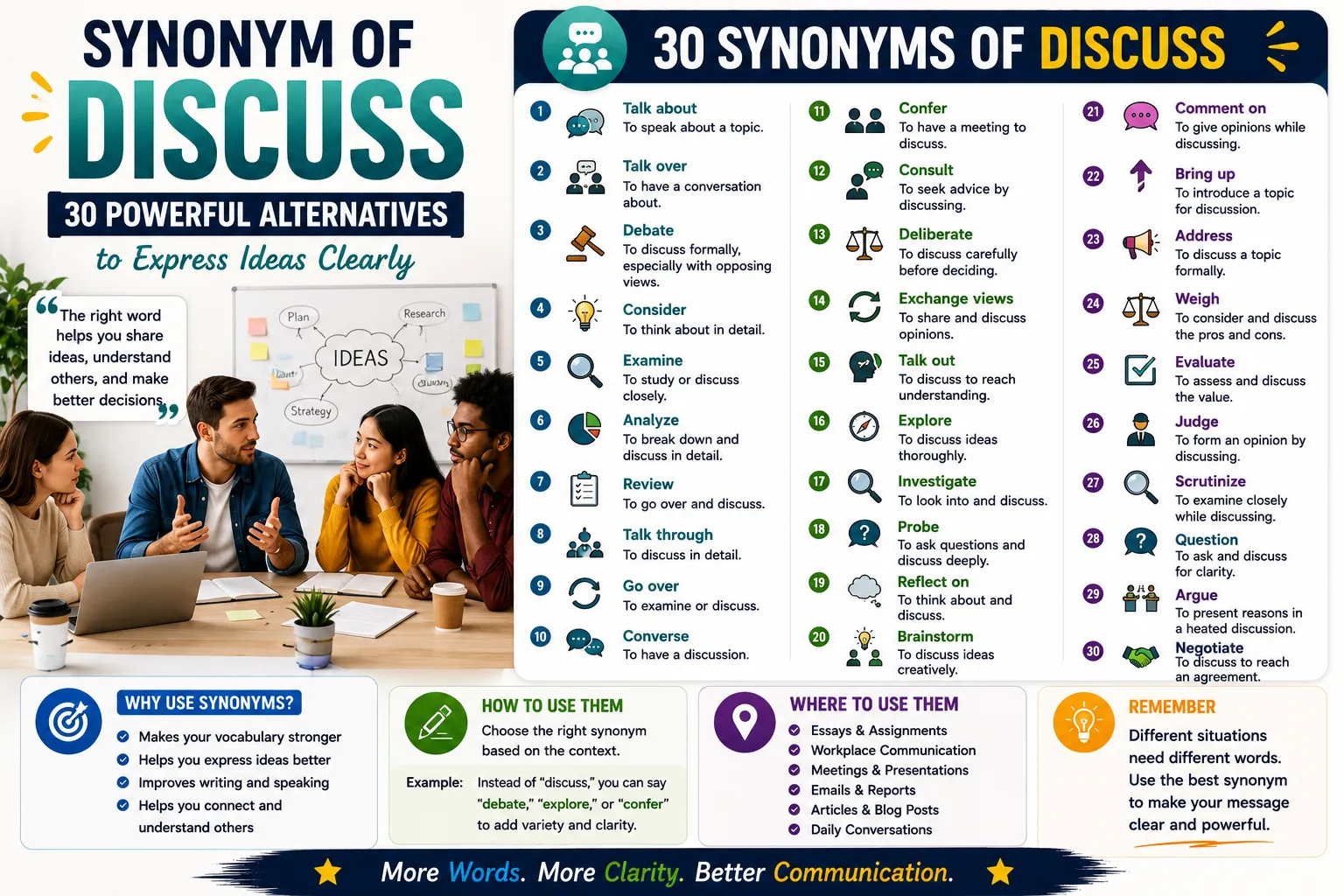
Synonyms of Discuss
1. Talk about (verb phrase) — US /tɔːk əˈbaʊt/ | UK /tɔːk əˈbaʊt/
Meaning: To speak about a topic with someone else. Examples:
- They talked about the movie after watching it.
- She wanted to talk about her plans for next year.
2. Debate (verb) — US /dɪˈbeɪt/ | UK /dɪˈbeɪt/
Meaning: To discuss a topic with different opinions, often formally. Examples:
- The class debated the new school rule.
- They debated which restaurant to choose.
3. Converse (verb) — US /kənˈvɜːrs/ | UK /kənˈvɜːs/
Meaning: To talk with someone in a friendly, back-and-forth way. Examples:
- They conversed about their travel plans over lunch.
- She enjoyed conversing with her new neighbor.
4. Confer (verb) — US /kənˈfɜːr/ | UK /kənˈfɜː/
Meaning: To talk with someone in order to exchange ideas or reach a decision. Examples:
- The doctors conferred before making a decision.
- She conferred with her team before replying.
5. Deliberate (verb) — US /dɪˈlɪbəreɪt/ | UK /dɪˈlɪbəreɪt/
Meaning: To discuss something carefully before deciding. Examples:
- The judges deliberated for an hour before choosing a winner.
- They deliberated over which plan to follow.
6. Discourse (verb) — US /ˈdɪskɔːrs/ | UK /ˈdɪskɔːs/
Meaning: To talk about a topic in a formal or thoughtful way. Examples:
- The professor discoursed on the history of the city.
- They discoursed at length about the new policy.
7. Chat about (verb phrase) — US /tʃæt əˈbaʊt/ | UK /tʃæt əˈbaʊt/
Meaning: To talk casually about something. Examples:
- They chatted about their weekend plans.
- She loves to chat about books with her friends.
8. Argue (verb) — US /ˈɑːrɡjuː/ | UK /ˈɑːɡjuː/
Meaning: To discuss something with strong or opposing opinions. Examples:
- They argued about the best way to solve the problem.
- She argued her point clearly during the meeting.
9. Examine (verb) — US /ɪɡˈzæmɪn/ | UK /ɪɡˈzæmɪn/
Meaning: To look closely at and discuss the details of something. Examples:
- The committee examined the report carefully.
- They examined every option before choosing.
10. Consider (verb) — US /kənˈsɪdər/ | UK /kənˈsɪdə/
Meaning: To think and talk about something before deciding. Examples:
- They considered the new plan during the meeting.
- She asked the team to consider both options.
11. Review (verb) — US /rɪˈvjuː/ | UK /rɪˈvjuː/
Meaning: To go over and discuss something again carefully. Examples:
- They reviewed the schedule before the trip.
- The teacher reviewed the answers with the class.
12. Negotiate (verb) — US /nɪˈɡoʊʃieɪt/ | UK /nɪˈɡəʊʃieɪt/
Meaning: To discuss something in order to reach an agreement. Examples:
- They negotiated the price of the car.
- She negotiated a better schedule with her manager.
13. Consult (verb) — US /kənˈsʌlt/ | UK /kənˈsʌlt/
Meaning: To talk with someone to get advice or share ideas. Examples:
- He consulted his coworkers before making a decision.
- She consulted her doctor about the symptoms.
14. Address (verb) — US /əˈdrɛs/ | UK /əˈdrɛs/
Meaning: To speak directly about a topic or problem. Examples:
- The manager addressed the team’s concerns.
- She addressed the issue during the meeting.
15. Cover (verb) — US /ˈkʌvər/ | UK /ˈkʌvə/
Meaning: To discuss a topic fully, often in a class or meeting. Examples:
- The lesson covered three important topics.
- They covered every part of the plan in the meeting.
16. Explore (verb) — US /ɪkˈsplɔːr/ | UK /ɪkˈsplɔː/
Meaning: To discuss and think about different ideas or options. Examples:
- They explored several ideas before choosing one.
- The team explored ways to improve the process.
17. Analyze (verb) — US /ˈænəlaɪz/ | UK /ˈænəlaɪz/
Meaning: To study and discuss something in careful detail. Examples:
- They analyzed the results after the test.
- She analyzed the plan before giving feedback.
18. Talk over (verb phrase) — US /tɔːk ˈoʊvər/ | UK /tɔːk ˈəʊvə/
Meaning: To discuss something carefully with someone. Examples:
- They talked over the details before signing.
- She wanted to talk over the plan with her partner.
19. Hash out (verb phrase) — US /hæʃ aʊt/ | UK /hæʃ aʊt/
Meaning: To discuss something in detail until it is settled. Examples:
- They hashed out the schedule during the meeting.
- The team hashed out the final details of the plan.
20. Go over (verb phrase) — US /ɡoʊ ˈoʊvər/ | UK /ɡəʊ ˈəʊvə/
Meaning: To discuss or review something step by step. Examples:
- They went over the report before sending it.
- She went over the instructions with the new worker.
21. Brainstorm (verb) — US /ˈbreɪnstɔːrm/ | UK /ˈbreɪnstɔːm/
Meaning: To discuss many ideas quickly to solve a problem or find new ideas. Examples:
- They brainstormed ideas for the new project.
- The team brainstormed names for the product.
22. Dialogue (verb) — US /ˈdaɪəlɔːɡ/ | UK /ˈdaɪəlɒɡ/
Meaning: To have an open conversation about a topic. Examples:
- The two groups discussed their differences.
- They dialogued for hours to find common ground.
23. Confab (verb) — US /ˈkɑːnfæb/ | UK /ˈkɒnfæb/
Meaning: To talk together informally about something, a casual word. Examples:
- They confabbed about the weekend plans.
- The friends confabbed over coffee.
24. Weigh (verb) — US /weɪ/ | UK /weɪ/
Meaning: To discuss and think carefully about the pros and cons. Examples:
- They weighed the options before deciding.
- She weighed each idea with her team.
25. Dissect (verb) — US /daɪˈsɛkt/ | UK /daɪˈsɛkt/
Meaning: To discuss something by breaking it into small, detailed parts. Examples:
- The critics dissected the movie’s plot.
- They dissected the plan piece by piece.
26. Canvass (verb) — US /ˈkænvəs/ | UK /ˈkænvəs/
Meaning: To discuss and gather opinions from many people. Examples:
- They canvassed the neighborhood about the new park.
- She canvassed her classmates for feedback.
27. Parley (verb) — US /ˈpɑːrli/ | UK /ˈpɑːli/
Meaning: To hold a discussion, especially to settle a disagreement. Examples:
- The two sides agreed to parley before the deadline.
- They parlayed for hours to reach an agreement.
28. Speak about (verb phrase) — US /spiːk əˈbaʊt/ | UK /spiːk əˈbaʊt/
Meaning: To talk about a certain topic. Examples:
- She spoke about her goals for the year.
- They spoke about the changes at the meeting.
29. Touch on (verb phrase) — US /tʌtʃ ɒn/ | UK /tʌtʃ ɒn/
Meaning: To briefly discuss part of a topic. Examples:
- The speech touched on several important issues.
- She touched on the budget during her update.
30. Deal with (verb phrase) — US /diːl wɪð/ | UK /diːl wɪð/
Meaning: To discuss and handle a topic or problem. Examples:
- They dealt with the complaint during the meeting.
- She dealt with each question carefully.
Prototype Meaning
When people hear the word “discuss,” they usually picture two or more people talking about a topic. To share ideas or reach a decision. It could be a quick chat, a serious meeting, or a classroom conversation. This simple picture of sharing thoughts sits at the center of the word. Synonym of discuss adds detail, showing whether the talk is casual, or focused on solving a disagreement.
Prototype Categorization
You can group these synonyms by how the discussion happens:
- Casual talking: talk about, chat about, confab, speak about
- Careful or formal discussion: deliberate, discourse, review, examine, analyze
- Disagreement or opinions: debate, argue, negotiate, parley
- Sharing ideas together: brainstorm, dialogue, converse, confer, explore
- Going through details: talk over, hash out, go over, dissect, cover
- Getting input or handling topics: consult, canvass, address, touch on, deal with, consider, weigh.
Antonyms of Discuss
ignore, avoid, silence, dismiss
Short Questions and Answers
- What does “discuss” mean? It means to talk about something with someone else to share ideas or make a decision.
- When should “discuss” be used? Use it any time people talk together about a topic, whether casual or formal.
- Is “discuss” positive or negative? It is mostly positive or neutral. It shows open sharing of ideas, even if the topic is difficult.
- How is it different from similar words? “Discuss” is broad and common. “Debate” focuses on opposing views. “Brainstorm” is about creating new ideas. “Negotiate” is aimed at reaching an agreement.
Conclusion
Synonyms of discuss will help your English grow strong. Each word shows a different way of talking, from a casual “chat about” to a careful “deliberate.” These words help your writing sound clear and full of detail, not repeated. Synonyms of discuss also help you describe conversations with more precision. Anyone learning English can use the synonyms of discuss to speak and write. Try to learn one new word each day. Use it in a sentence about a topic you talked about recently. Over time, this small habit will make your English much stronger.

I’m Zahid Abbas, an educator, researcher, and digital publishing strategist with a passion for linguistics, grammar, and clear communication. As a content creator and SEO specialist, I craft research-driven, reader-focused content that empowers learners and makes knowledge accessible worldwide.