Express means to show or share your thoughts and feelings. Think about a girl who writes a letter to her grandmother. She wants to express how much she misses her, so she chooses her words carefully. That act of sharing feelings in words is what “express” means.
People use this word every day. They use Synonyms of express for feelings, ideas, art, and even simple opinions. It is a useful word for talking about how people share what is inside them.
But saying “express” again and again can make writing feel plain. English learners and writers need synonyms of express too. Synonyms of express help to show different ways of sharing thoughts. These thoughts are from a quiet hint to a bold announcement. They also help your writing sound more clear and full of life.
This article looks at the word “express” in a simple way. You will learn what it means, how to say it, where it came from, and how to use it. Then you will learn 30 other words that mean almost the same thing.
Meaning of Express
Definition
Express (verb): To show or share thoughts, feelings, or ideas through words, actions, or art.
Examples
- She expressed her thanks with a warm hug.
- He expressed his opinion during the meeting.
Connotative Meaning
- Positive tone: “Express” often feels open and healthy, showing that someone is sharing feelings honestly.
- Negative tone: “Express” is rarely negative, though expressing anger or frustration can feel tense.
- Neutral tone: In formal writing, “express” can be a simple, plain word, like “the report expresses the company’s goals.”
Etymology
- “Express” comes from the Old French word expresser, based on the Latin word expressus.
- This word came from the Latin verb exprimere, made of “ex-” (out) and “premere” (to press), literally meaning “to press out.”
- Over time, the meaning moved from “pressing something out” to “showing thoughts.
Short History
- Old English (450–1100): The word “express” did not exist yet. People used simpler words, like “cweþan,” meaning to say or speak.
- Middle English (1100–1500): “Express” entered English around the 1300s from Old French and Latin. It first meant to press something out, then grew to mean stating something clearly.
- Modern English (1500–Present): “Express” kept its core meaning of showing thoughts. It is now used for speech, writing, art, and even facial expressions.
Pronunciation (US & UK – IPA)
- US: /ɪkˈsprɛs/
- UK: /ɪkˈsprɛs/
Syllables
ex-press
Affixation Pattern of Express
- Root: express (from Latin “exprimere,” meaning to press out)
- Prefix: ex- (out, found in the Latin root)
- Suffix: -ion (makes the noun “expression”), -ive (makes the adjective “expressive”), -ly (makes the adverb “expressly”)
Word formation: This root gives us several words. “Express” works as a verb, adjective, and noun. “Expression” is a noun that means a way of showing feelings or ideas. “Expressive” is an adjective that means full of feeling. “Expressly” is an adverb that means clearly or specifically stated.
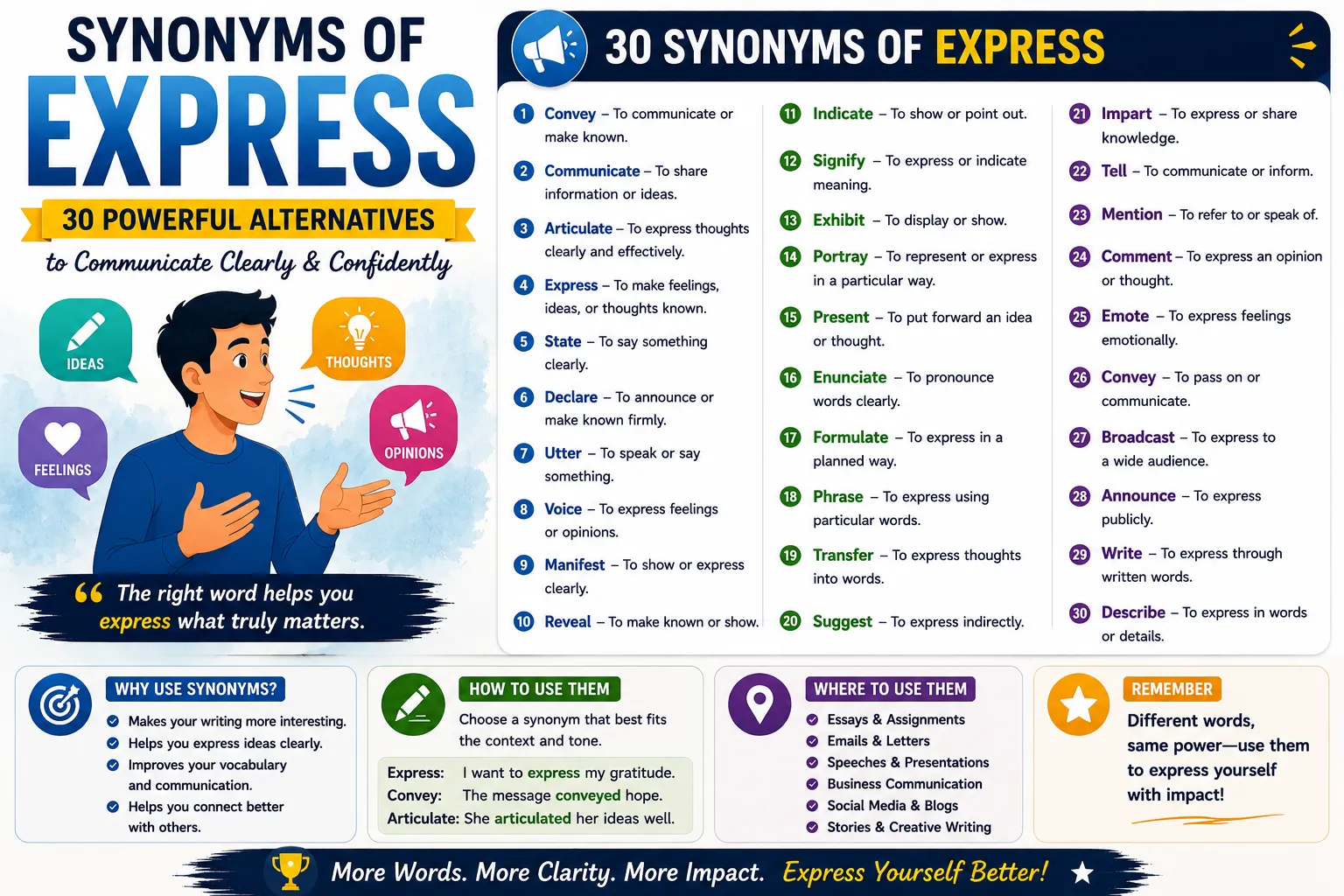
Synonyms of Express
1. Convey (verb) — US /kənˈveɪ/ | UK /kənˈveɪ/
Meaning: To share or communicate an idea or feeling. Examples:
- Her letter conveyed deep gratitude.
- He tried to convey his excitement about the trip.
2. Communicate (verb) — US /kəˈmjuːnɪkeɪt/ | UK /kəˈmjuːnɪkeɪt/
Meaning: To share information, thoughts, or feelings with others. Examples:
- She communicated her plans clearly to the team.
- He struggled to communicate how he felt.
3. Voice (verb) — US /vɔɪs/ | UK /vɔɪs/
Meaning: To say a thought or feeling out loud. Examples:
- She voiced her concerns during the meeting.
- He finally voiced his opinion about the plan.
4. Articulate (verb) — US /ɑːrˈtɪkjəleɪt/ | UK /ɑːˈtɪkjʊleɪt/
Meaning: To explain thoughts or feelings clearly. Examples:
- She articulated her goals for the new year.
- He struggled to articulate why he felt upset.
5. State (verb) — US /steɪt/ | UK /steɪt/
Meaning: To say something clearly and directly. Examples:
- She stated her reasons for leaving early.
- He stated his opinion without hesitation.
6. Declare (verb) — US /dɪˈklɛr/ | UK /dɪˈkleə/
Meaning: To announce something clearly and firmly. Examples:
- He declared his support for the new plan.
- She declared her love for painting.
7. Show (verb) — US /ʃoʊ/ | UK /ʃəʊ/
Meaning: To make a feeling or idea clear through actions or words. Examples:
- She showed her appreciation with a kind note.
- He showed his frustration through his tone.
8. Reveal (verb) — US /rɪˈviːl/ | UK /rɪˈviːl/
Meaning: To share something that was hidden or unknown. Examples:
- She revealed her true feelings after the trip.
- He revealed his plans for the future.
9. Manifest (verb) — US /ˈmænɪfɛst/ | UK /ˈmænɪfɛst/
Meaning: To show clearly, often through behavior or signs. Examples:
- Her stress manifested as trouble sleeping.
- His excitement manifested in his fast talking.
10. Utter (verb) — US /ˈʌtər/ | UK /ˈʌtə/
Meaning: To say something out loud. Examples:
- She uttered a quiet thank you.
- He uttered his complaint under his breath.
11. Vocalize (verb) — US /ˈvoʊkəlaɪz/ | UK /ˈvəʊkəlaɪz/
Meaning: To say a thought or feeling out loud. Examples:
- She vocalized her worries to her friend.
- He vocalized his disagreement during the debate.
12. Verbalize (verb) — US /ˈvɜːrbəlaɪz/ | UK /ˈvɜːbəlaɪz/
Meaning: To put a feeling or thought into spoken words. Examples:
- She verbalized her fears before the exam.
- He struggled to verbalize his gratitude.
13. Demonstrate (verb) — US /ˈdɛmənstreɪt/ | UK /ˈdɛmənstreɪt/
Meaning: To show a feeling or idea clearly through actions. Examples:
- She demonstrated her skill during the interview.
- He demonstrated his support by showing up early.
14. Display (verb) — US /dɪˈspleɪ/ | UK /dɪˈspleɪ/
Meaning: To show a feeling or quality openly. Examples:
- She displayed great patience with the children.
- He displayed his talent during the show.
15. Illustrate (verb) — US /ˈɪləstreɪt/ | UK /ˈɪləstreɪt/
Meaning: To make something clear through examples or description. Examples:
- She illustrated her point with a personal story.
- He illustrated the idea using a simple drawing.
16. Portray (verb) — US /pɔːrˈtreɪ/ | UK /pɔːˈtreɪ/
Meaning: To show or represent a feeling or idea, often through art or writing. Examples:
- The painting portrayed deep sadness.
- Her writing portrayed the joy of travel.
17. Signify (verb) — US /ˈsɪɡnɪfaɪ/ | UK /ˈsɪɡnɪfaɪ/
Meaning: To show or represent a meaning or feeling. Examples:
- A nod can signify agreement.
- Her silence signified deep thought.
18. Indicate (verb) — US /ˈɪndɪkeɪt/ | UK /ˈɪndɪkeɪt/
Meaning: To show or point out a feeling or fact. Examples:
- Her smile indicated she was happy with the news.
- He indicated his interest in joining the club.
19. Proclaim (verb) — US /proʊˈkleɪm/ | UK /prəˈkleɪm/
Meaning: To announce something openly and with confidence. Examples:
- She proclaimed her excitement to the whole room.
- He proclaimed his love for his hometown.
20. Assert (verb) — US /əˈsɜːrt/ | UK /əˈsɜːt/
Meaning: To state something firmly and confidently. Examples:
- She asserted her opinion during the discussion.
- He asserted his right to speak first.
21. Announce (verb) — US /əˈnaʊns/ | UK /əˈnaʊns/
Meaning: To share information or feelings publicly. Examples:
- They announced their engagement at dinner.
- She announced her decision to the whole team.
22. Air (verb) — US /ɛr/ | UK /eə/
Meaning: To share thoughts or complaints openly. Examples:
- She aired her concerns during the meeting.
- He aired his frustration about the delay.
23. Put into words (verb phrase) — US /pʊt ˈɪntə wɜːrdz/ | UK /pʊt ˈɪntə wɜːdz/
Meaning: To describe a feeling clearly using language. Examples:
- She finally put her feelings into words.
- He couldn’t put his excitement into words.
24. Phrase (verb) — US /freɪz/ | UK /freɪz/
Meaning: To say something in a particular way. Examples:
- She phrased her question carefully.
- He phrased his apology with kindness.
25. Formulate (verb) — US /ˈfɔːrmjəleɪt/ | UK /ˈfɔːmjʊleɪt/
Meaning: To carefully put together a thought or idea before sharing it. Examples:
- She formulated her thoughts before speaking.
- He formulated a clear response to the question.
26. Depict (verb) — US /dɪˈpɪkt/ | UK /dɪˈpɪkt/
Meaning: To show a feeling or idea through images or description. Examples:
- The mural depicted the town’s history.
- Her poem depicted quiet hope.
27. Emote (verb) — US /ɪˈmoʊt/ | UK /ɪˈməʊt/
Meaning: To show strong feelings openly, often through expression. Examples:
- He emoted with wide gestures during the story.
- She emoted deep sadness in her performance.
28. Give voice to (verb phrase) — US /ɡɪv vɔɪs tə/ | UK /ɡɪv vɔɪs tə/
Meaning: To speak up about a feeling or idea. Examples:
- She gave voice to her hopes for the future.
- He gave voice to the group’s shared concern.
29. Exhibit (verb) — US /ɪɡˈzɪbɪt/ | UK /ɪɡˈzɪbɪt/
Meaning: To clearly show a quality or feeling. Examples:
- She exhibited great calm during the storm.
- He exhibited real talent at a young age.
30. Vent (verb) — US /vɛnt/ | UK /vɛnt/
Meaning: To release strong feelings, often frustration. Examples:
- She vented her anger to a close friend.
- He needed to vent after a hard day.
Prototype Meaning
When people hear the word “express,” they usually picture someone sharing a idea. Whether through speech, writing, or actions. It could be a heartfelt letter, a spoken opinion, or a piece of art. This basic idea of turning something inside into something others can see or hear sits at the center of the word. Synonyms of express add detail, showing whether the sharing feels calm, bold, or emotional.
Prototype Categorization
You can group these synonyms by how the sharing happens:
- Everyday sharing: show, voice, state, phrase, put into words
- Speaking clearly and confidently: articulate, assert, declare, proclaim, announce
- Sharing through art or description: portray, depict, illustrate
- Showing without direct words: manifest, indicate, signify, exhibit, display
- Releasing strong feelings: vent, emote, air, give voice to
- Careful or thoughtful sharing: formulate, communicate, convey, verbalize, vocalize, utter, reveal.
Antonyms of Express
hide, conceal, suppress, withhold, mask
Short Questions and Answers
- What does “express” mean? It means to show or share thoughts, feelings, or ideas through words, actions, or art.
- When should “express” be used? Use it any time someone shares an opinion, feeling, or idea clearly with others.
- Is “express” positive or negative? It is mostly positive or neutral. It shows honest, open sharing, even when the feeling itself is difficult.
- How is it different from similar words? “Express” is broad and common. “Convey” often fits written communication. “Vent” focuses on releasing strong emotion. “Portray” is specific to art or storytelling.
Conclusion
Synonyms of express will help your English grow strong. Each word shows a different way of sharing thoughts and feelings, from a simple “show” to a bold “proclaim.” Synonyms of express words help your writing sound clear and full of life, not repeated. They also help you describe communication with more color. Anyone learning English can use these words to speak and write with more confidence. Try to learn one new word each day. Use Synonyms of express in a sentence about a feeling or idea you want to share. Over time, this small habit will make your English much stronger.

I’m Zahid Abbas, an educator, researcher, and digital publishing strategist with a passion for linguistics, grammar, and clear communication. As a content creator and SEO specialist, I craft research-driven, reader-focused content that empowers learners and makes knowledge accessible worldwide.