The word destroy means to damage something so badly that it no longer exists or works. Imagine a strong storm hitting a small house. After the storm, the house is broken and ruined. The storm destroyed it.
People use this word often in daily conversations, news reports, books, movies, and academic writing. It can describe physical damage, emotional harm, or the end of something important. However, repeating the same word many times can make writing weak and repetitive.
Learning synonyms of destroy helps English learners improve vocabulary and express ideas more clearly. It also helps writers choose stronger and more accurate words for different situations. In this article, you will learn the meaning of destroy, its pronunciation, history, grammar, and 30 useful synonyms with examples. You will also explore semantic categories, antonyms, and simple questions to improve your English communication skills.
Meaning of Destroy
Definition
Destroy (verb): to damage something completely so it cannot continue to exist or function.
Examples
- The fire destroyed the old building.
- Strong waves destroyed the small boat.
Connotative Meaning
(Connotation means the feeling or emotion a word suggests beyond its basic meaning.)
- Positive tone: removing danger or ending something harmful
- Negative tone: damage, loss, violence, ruin
- Neutral tone: complete removal or breakdown
Etymology
- From Latin destruere meaning “tear down”
- Entered English through Old French influence
Short History:
- Old English (450–1100): similar words meant ruin or break
- Middle English (1100–1500): destroy became common in literature
- Modern English (1500–Present): widely used for physical and emotional damage
Pronunciation (US & UK – IPA)
- US: /dɪˈstrɔɪ/
- UK: /dɪˈstrɔɪ/
Syllables
- de-stroy
Affixation Pattern of Destroy
- Root: stroy/struct
- Prefix: de-
- Suffix: none
Word Formation:
- destroy (verb)
- destruction (noun)
- destructive (adjective)
- destroyer (noun)
- indestructible (adjective)
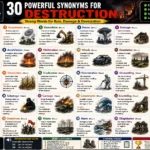
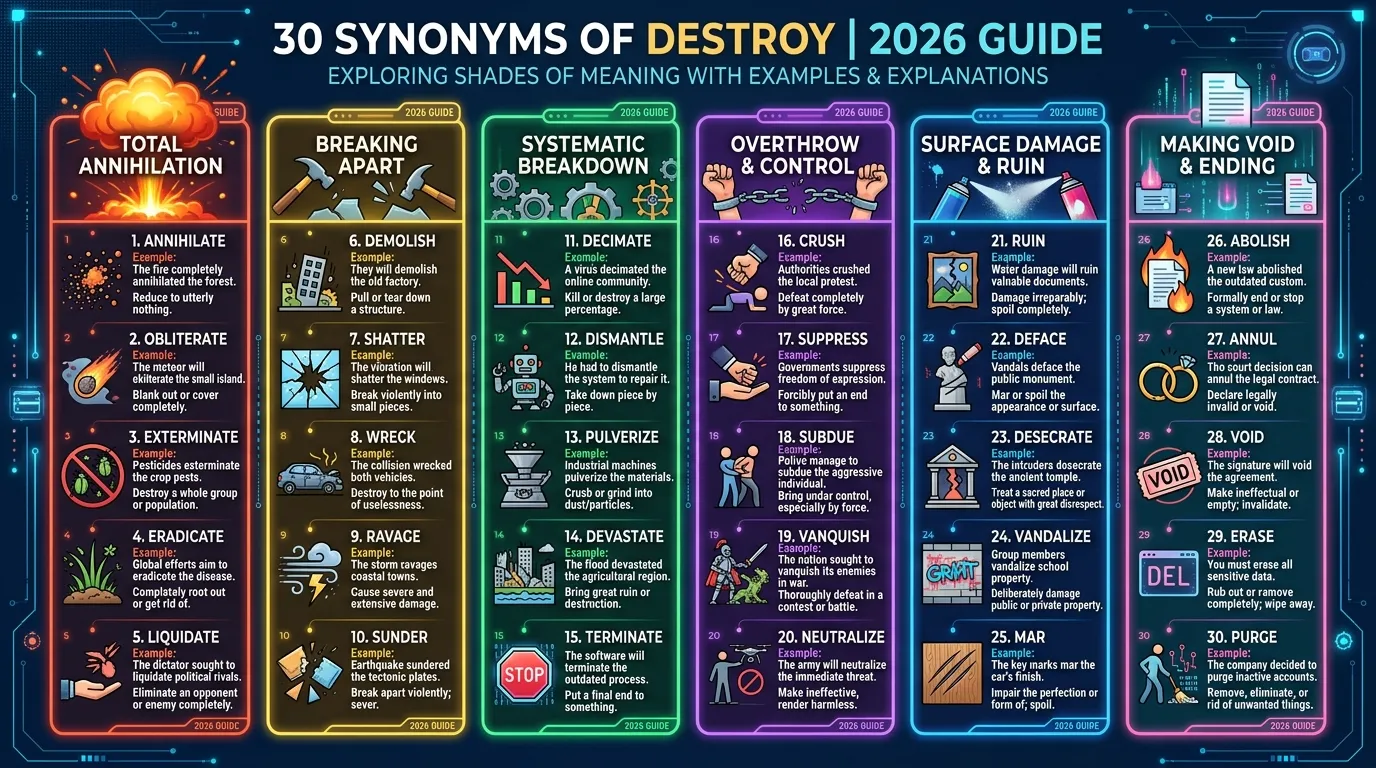
30 Synonyms of Destroy
1. Ruin (verb)
US: /ˈruːɪn/ | UK: /ˈruːɪn/
Meaning: to damage something badly
Examples:
- Heavy rain ruined the crops.
- The scandal ruined his career.
2. Demolish (verb)
US: /dɪˈmɑːlɪʃ/ | UK: /dɪˈmɒlɪʃ/
Meaning: to tear down completely
Examples:
- Workers demolished the old bridge.
- The building was demolished safely.
3. Wreck (verb)
US: /rek/ | UK: /rek/
Meaning: to badly damage something
Examples:
- The crash wrecked the car.
- The storm wrecked the roof.
4. Smash (verb)
US: /smæʃ/ | UK: /smæʃ/
Meaning: to break violently into pieces
Examples:
- He smashed the glass.
- Waves smashed the boat.
5. Shatter (verb)
US: /ˈʃætər/ | UK: /ˈʃætə/
Meaning: to break into many small pieces
Examples:
- The mirror shattered instantly.
- Bad news shattered her hopes.
6. Crush (verb)
US: /krʌʃ/ | UK: /krʌʃ/
Meaning: to press something until broken
Examples:
- The machine crushed the cans.
- The box was crushed under weight.
7. Break (verb)
US: /breɪk/ | UK: /breɪk/
Meaning: to separate into pieces
Examples:
- He accidentally broke the chair.
- The toy broke yesterday.
8. Devastate (verb)
US: /ˈdevəsteɪt/ | UK: /ˈdevəsteɪt/
Meaning: to destroy completely
Examples:
- Floods devastated the village.
- The loss devastated her emotionally.
9. Annihilate (verb)
US: /əˈnaɪəleɪt/ | UK: /əˈnaɪəleɪt/
Meaning: to destroy totally
Examples:
- The army annihilated the enemy.
- Fire nearly annihilated the forest.
10. Eliminate (verb)
US: /ɪˈlɪməneɪt/ | UK: /ɪˈlɪmɪneɪt/
Meaning: to remove completely
Examples:
- The medicine eliminated the disease.
- They eliminated all mistakes.
11. Erase (verb)
US: /ɪˈreɪs/ | UK: /ɪˈreɪz/
Meaning: to remove completely
Examples:
- He erased the writing.
- Time cannot erase memories.
12. Obliterate (verb)
US: /əˈblɪtəreɪt/ | UK: /əˈblɪtəreɪt/
Meaning: to destroy without leaving anything
Examples:
- The explosion obliterated the building.
- The records were obliterated.
13. Tear Down (verb)
US: /ter daʊn/ | UK: /teə daʊn/
Meaning: to pull apart or demolish
Examples:
- Workers tore down the wall.
- They will tear down the factory.
14. Dismantle (verb)
US: /dɪsˈmæntl/ | UK: /dɪsˈmæntl/
Meaning: to take apart piece by piece
Examples:
- They dismantled the machine.
- The old bridge was dismantled.
15. Damage (verb)
US: /ˈdæmɪdʒ/ | UK: /ˈdæmɪdʒ/
Meaning: to cause harm
Examples:
- The storm damaged the roof.
- Heat can damage plants.
16. Kill (verb)
US: /kɪl/ | UK: /kɪl/
Meaning: to cause death
Examples:
- Pollution can kill fish.
- The poison nearly killed him.
17. Flatten (verb)
US: /ˈflætn/ | UK: /ˈflætn/
Meaning: to knock down completely
Examples:
- The tornado flattened the houses.
- The truck flattened the fence.
18. Collapse (verb)
US: /kəˈlæps/ | UK: /kəˈlæps/
Meaning: to fall down suddenly
Examples:
- The bridge collapsed after the quake.
- The roof collapsed inward.
19. Corrupt (verb)
US: /kəˈrʌpt/ | UK: /kəˈrʌpt/
Meaning: to damage morally or mentally
Examples:
- Greed can corrupt people.
- Bad habits corrupted him.
20. Undo (verb)
US: /ʌnˈduː/ | UK: /ʌnˈduː/
Meaning: to ruin previous progress
Examples:
- One mistake can undo success.
- The error undid months of work.
21. Ravage (verb)
US: /ˈrævɪdʒ/ | UK: /ˈrævɪdʒ/
Meaning: to badly destroy
Examples:
- War ravaged the city.
- Disease ravaged the crops.
22. Waste (verb)
US: /weɪst/ | UK: /weɪst/
Meaning: to destroy or weaken completely
Examples:
- Illness wasted his strength.
- The fire wasted the forest.
23. Spoil (verb)
US: /spɔɪl/ | UK: /spɔɪl/
Meaning: to ruin quality or enjoyment
Examples:
- Rain spoiled the picnic.
- The smell spoiled the food.
24. Burn (verb)
US: /bɜːrn/ | UK: /bɜːn/
Meaning: to destroy with fire
Examples:
- Fire burned the house.
- They burned old papers.
25. Exterminate (verb)
US: /ɪkˈstɜːrmɪneɪt/ | UK: /ɪkˈstɜːmɪneɪt/
Meaning: to destroy completely, especially pests
Examples:
- The company exterminated the insects.
- Farmers tried to exterminate rats.
26. Scrap (verb)
US: /skræp/ | UK: /skræp/
Meaning: to throw away or destroy
Examples:
- They scrapped the old plan.
- The car was scrapped.
27. Terminate (verb)
US: /ˈtɜːrmɪneɪt/ | UK: /ˈtɜːmɪneɪt/
Meaning: to end completely
Examples:
- The company terminated the project.
- The agreement was terminated.
28. Nullify (verb)
US: /ˈnʌlɪfaɪ/ | UK: /ˈnʌlɪfaɪ/
Meaning: to make ineffective
Examples:
- The court nullified the decision.
- His actions nullified the effort.
29. Decimate (verb)
US: /ˈdesɪmeɪt/ | UK: /ˈdesɪmeɪt/
Meaning: to destroy a large part
Examples:
- Disease decimated the population.
- The storm decimated farms.
30. Extinguish (verb)
US: /ɪkˈstɪŋɡwɪʃ/ | UK: /ɪkˈstɪŋɡwɪʃ/
Meaning: to end or destroy completely
Examples:
- Firefighters extinguished the fire.
- Fear can extinguish hope.
Prototype Meaning
The most common meaning of destroy is causing something to break, disappear, or stop existing completely. People usually imagine fire, storms, war, or accidents damaging objects, places, or lives.
Prototype Categorization
- Physical destruction: smash, demolish, shatter
- Complete removal: annihilate, obliterate, eliminate
- Emotional or moral damage: devastate, corrupt, ruin
- Ending or stopping: terminate, extinguish, nullify
Categorization helps writers choose the best synonym based on tone, strength, and situation.
Antonyms of Destroy
Antonyms
- Build (verb): to create or construct
- Repair (verb): to fix damage
- Protect (verb): to keep safe
- Preserve (verb): to keep in good condition
- Restore (verb): to bring back to original condition
Short Questions and Answers
What does destroy mean?
- It means to damage something completely.
When should destroy be used?
- Use it when talking about complete damage, ruin, or removal.
Is destroy positive or negative?
- It is usually negative because it suggests harm or loss.
How is it different from similar words?
- “Destroy” means complete damage, while “damage” may describe partial harm.
Conclusion
Learning synonyms of destroy and synonyms of destroy improves vocabulary and communication skills. It helps English learners express ideas about damage, endings, and emotional effects more clearly. Using different synonyms also avoids repetition and makes writing stronger and more natural. These words are useful in storytelling, academic writing, conversations, and professional communication. They help speakers and writers describe different levels of harm, destruction, or removal with greater accuracy. Practice using new vocabulary daily to build confidence and improve English fluency over time.

I’m Zahid Abbas, an educator, researcher, and digital publishing strategist with a passion for linguistics, grammar, and clear communication. As a content creator and SEO specialist, I craft research-driven, reader-focused content that empowers learners and makes knowledge accessible worldwide.