Interest means a feeling of wanting to know more about something. Think about a boy who finds an old map in his grandfather’s attic. He studies every line and mark, wondering where the paths lead. That strong wish to learn more is interest.
People use this word every day. They use synonyms of interest for hobbies, school subjects, news, and even people they meet. It shows what catches someone’s attention and holds it.
But saying “interest” again and again can make writing feel plain. English learners and writers need other words too. New words help show different levels of interest, from a light curiosity to a deep passion. They also help your writing sound more clear and full of life.
This article looks at the word “interest” in a simple way. You will learn what it means, how to say it, where it came from, and how to use it. Then you will learn 30 other words that mean almost the same thing.
Meaning of Interest
Definition
Interest (noun): A feeling of wanting to know more about or pay attention to something.
Examples
- She has a strong interest in painting.
- His interest in space grew after the school trip.
Connotative Meaning
- Positive tone: “Interest” almost always feels good, showing curiosity, excitement, or care.
- Negative tone: “Interest” is rarely negative. It can feel odd if someone shows interest in something harmful.
- Neutral tone: In business or reports, “interest” can be a simple fact, like “there is public interest in the new law.”
Etymology
- “Interest” comes from the Old French word interest, based on the Latin word interesse.
- This word came from “inter-” (between) and “esse” (to be), meaning literally “to be between” or “to matter.”
- At first, “interest” was a legal and financial word meaning a share or stake in something. Over time, it grew to mean curiosity or attention.
Short History
- Old English (450–1100): The word “interest” did not exist. People expressed care or concern for something using other words and phrases.
- Middle English (1100–1500): “Interest” entered English around the 1400s, first used in legal and money matters to describe a share or right in something.
- Modern English (1500–Present): The word grew beyond money and law. It came to describe curiosity, attention, and enjoyment, which is how it is mostly used today.
Pronunciation (US & UK – IPA)
- US: /ˈɪntrəst/
- UK: /ˈɪntrəst/
Syllables
in-ter-est
Affixation Pattern of Interest
- Root: interest (from Latin “interesse,” meaning to be between or to matter)
- Prefix: inter- (between, found in the Latin root)
- Suffix: -ing (makes the adjective “interesting”), -ed (makes the adjective “interested”)
Word formation: This root gives us several words. “Interest” works as both a noun and a verb. “Interesting” is an adjective that means something catches attention. “Interested” is an adjective that describes someone who feels curious. “Uninterested” means not curious, while “disinterested” means fair and without bias.
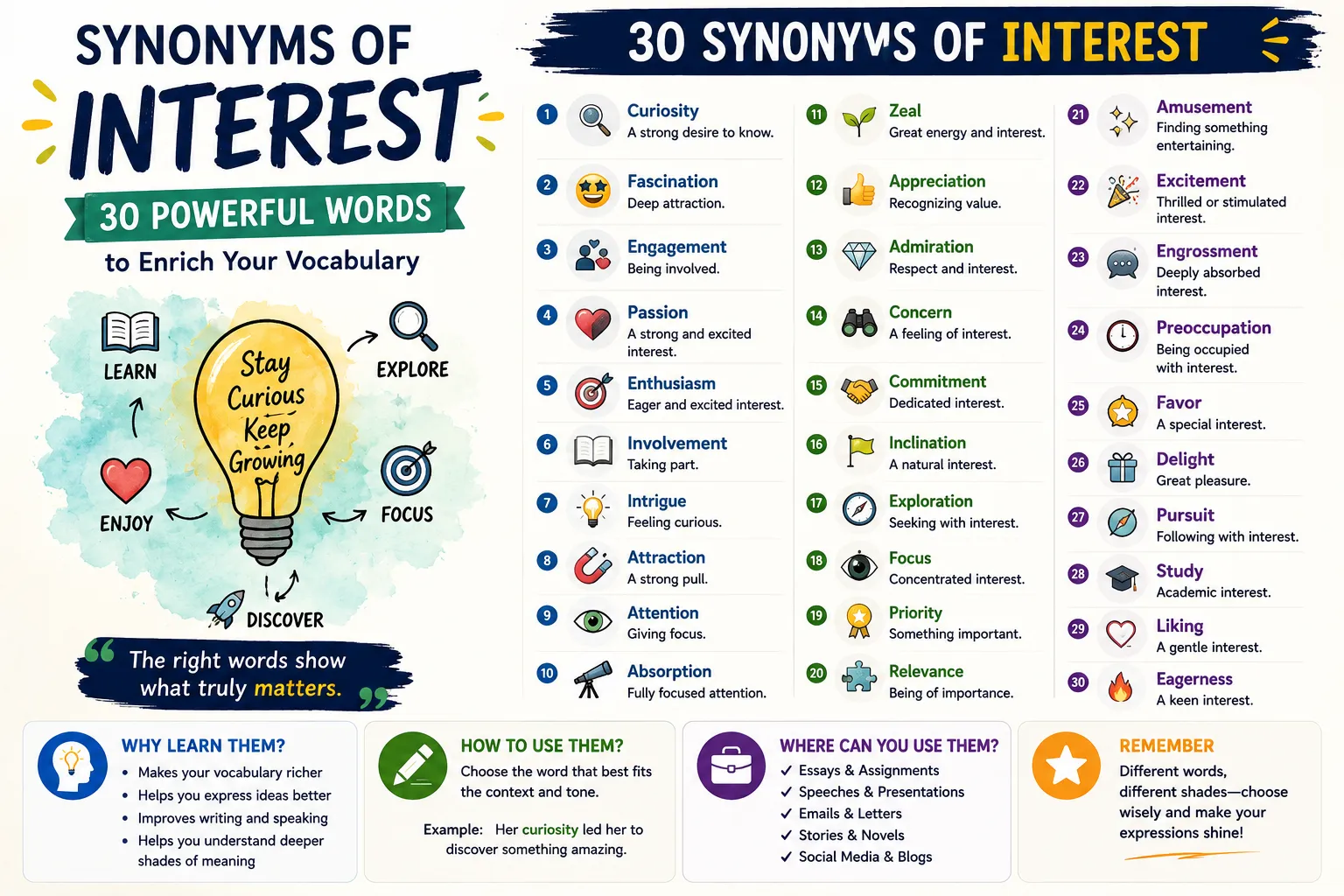
Synonyms of Interest
1. Curiosity (noun) — US /ˌkjʊriˈɑːsəti/ | UK /ˌkjʊəriˈɒsəti/
Meaning: A strong wish to know or learn more about something. Examples:
- Her curiosity led her to explore the old library.
- His curiosity about space never faded.
2. Attention (noun) — US /əˈtɛnʃən/ | UK /əˈtɛnʃən/
Meaning: Focus given to something because it catches your notice. Examples:
- The bright colors caught her attention right away.
- He gave his full attention to the lesson.
3. Concern (noun) — US /kənˈsɜːrn/ | UK /kənˈsɜːn/
Meaning: Interest and care shown toward something important. Examples:
- She showed concern for the environment.
- His concern for his friends made him a loyal person.
4. Fascination (noun) — US /ˌfæsəˈneɪʃən/ | UK /ˌfæsɪˈneɪʃən/
Meaning: A deep, strong interest that captures your attention. Examples:
- Her fascination with the stars started as a child.
- He watched the machine with total fascination.
5. Enthusiasm (noun) — US /ɪnˈθuːziæzəm/ | UK /ɪnˈθjuːziæzəm/
Meaning: Strong interest shown with energy and excitement. Examples:
- She joined the club with great enthusiasm.
- His enthusiasm for cooking grew every week.
6. Engagement (noun) — US /ɪnˈɡeɪdʒmənt/ | UK /ɪnˈɡeɪdʒmənt/
Meaning: Active interest and involvement in something. Examples:
- The students showed strong engagement during the lesson.
- Her engagement with the topic made the talk lively.
7. Involvement (noun) — US /ɪnˈvɑːlvmənt/ | UK /ɪnˈvɒlvmənt/
Meaning: Interest shown by taking part in something. Examples:
- His involvement in the project grew over time.
- Her involvement in the club kept her busy every week.
8. Appeal (noun) — US /əˈpiːl/ | UK /əˈpiːl/
Meaning: The quality of something that attracts interest. Examples:
- The mystery novel had a strong appeal to readers.
- The job’s appeal came from its flexible hours.
9. Attraction (noun) — US /əˈtrækʃən/ | UK /əˈtrækʃən/
Meaning: A pull of interest toward something. Examples:
- Her attraction to art history led her to study it.
- The town’s biggest attraction was the old lighthouse.
10. Intrigue (noun) — US /ˈɪntriːɡ/ | UK /ɪnˈtriːɡ/
Meaning: A feeling of curious interest, often about something mysterious. Examples:
- The old house filled the neighbors with intrigue.
- Her mysterious past added a sense of intrigue.
11. Absorption (noun) — US /əbˈsɔːrpʃən/ | UK /əbˈzɔːpʃən/
Meaning: Deep interest that takes up all your attention. Examples:
- His absorption in the book made him miss dinner.
- Her absorption in the puzzle lasted for hours.
12. Passion (noun) — US /ˈpæʃən/ | UK /ˈpæʃən/
Meaning: A very strong interest or love for something. Examples:
- Her passion for music led her to study it in college.
- He followed his passion for cooking and opened a restaurant.
13. Eagerness (noun) — US /ˈiːɡərnəs/ | UK /ˈiːɡənəs/
Meaning: A strong, excited interest in doing or learning something. Examples:
- Her eagerness to learn impressed her teacher.
- He showed eagerness to join the new team.
14. Inquisitiveness (noun) — US /ɪnˈkwɪzɪtɪvnəs/ | UK /ɪnˈkwɪzɪtɪvnəs/
Meaning: A strong habit of asking questions and wanting to know more. Examples:
- Her inquisitiveness led her to ask many questions.
- His inquisitiveness made him a great researcher.
15. Regard (noun) — US /rɪˈɡɑːrd/ | UK /rɪˈɡɑːd/
Meaning: Attention or care shown for something or someone. Examples:
- She held great regard for her teacher’s advice.
- His regard for nature shaped his career choice.
16. Care (noun) — US /kɛr/ | UK /keə/
Meaning: A feeling of interest and concern for something. Examples:
- Her care for the garden showed in every plant.
- He showed real care about his students’ progress.
17. Focus (noun) — US /ˈfoʊkəs/ | UK /ˈfəʊkəs/
Meaning: The main point of interest or attention. Examples:
- Her focus was on finishing the report first.
- His focus shifted to painting after retirement.
18. Preoccupation (noun) — US /priˌɑːkjəˈpeɪʃən/ | UK /priˌɒkjʊˈpeɪʃən/
Meaning: A strong interest that takes up most of your thoughts. Examples:
- His preoccupation with the game worried his parents.
- Her preoccupation with details made her a careful editor.
19. Zeal (noun) — US /ziːl/ | UK /ziːl/
Meaning: Strong, energetic interest and enthusiasm. Examples:
- She approached her studies with great zeal.
- His zeal for the project inspired the whole team.
20. Keenness (noun) — US /ˈkiːnnəs/ | UK /ˈkiːnnəs/
Meaning: A strong, eager interest in doing something. Examples:
- Her keenness to help was clear from the start.
- His keenness for sports never faded.
21. Appetite (noun) — US /ˈæpɪtaɪt/ | UK /ˈæpɪtaɪt/
Meaning: A strong desire or interest for something, often growth or knowledge. Examples:
- She had a growing appetite for new books.
- His appetite for learning kept him busy every night.
22. Taste (noun) — US /teɪst/ | UK /teɪst/
Meaning: A liking or interest for a certain kind of thing. Examples:
- She has a taste for classic movies.
- His taste in music changed over the years.
23. Liking (noun) — US /ˈlaɪkɪŋ/ | UK /ˈlaɪkɪŋ/
Meaning: A feeling of interest and enjoyment for something. Examples:
- She has a strong liking for old books.
- His liking for hiking grew after the trip.
24. Draw (noun) — US /drɔː/ | UK /drɔː/
Meaning: Something that attracts interest or attention. Examples:
- The museum’s biggest draw was the dinosaur exhibit.
- Her friendly smile was a big draw for new customers.
25. Pull (noun) — US /pʊl/ | UK /pʊl/
Meaning: A strong feeling that attracts interest toward something. Examples:
- The mountains had a strong pull for hikers.
- She felt a pull toward the art studio every weekend.
26. Hobby (noun) — US /ˈhɑːbi/ | UK /ˈhɒbi/
Meaning: An activity someone enjoys and follows with interest in their free time. Examples:
- Painting became her favorite hobby.
- His hobby of fishing kept him busy on weekends.
27. Pastime (noun) — US /ˈpæstaɪm/ | UK /ˈpɑːstaɪm/
Meaning: An enjoyable activity followed with interest during free time. Examples:
- Reading was her favorite pastime.
- His pastime of gardening brought him peace.
28. Pursuit (noun) — US /pərˈsuːt/ | UK /pəˈsjuːt/
Meaning: An activity or goal followed with strong interest. Examples:
- Her pursuit of knowledge took her to many countries.
- His pursuit of music started at a young age.
29. Predilection (noun) — US /ˌprɛdəˈlɛkʃən/ | UK /ˌpriːdɪˈlɛkʃən/
Meaning: A strong liking or interest for something, a formal word. Examples:
- She has a predilection for mystery novels.
- His predilection for classical art shaped his career.
30. Stake (noun) — US /steɪk/ | UK /steɪk/
Meaning: A personal interest or share in the outcome of something. Examples:
- She had a personal stake in the project’s success.
- His stake in the company grew every year.
Prototype Meaning
When people hear the word “interest,” they usually picture something that catches their attention and makes them want to learn more. It could be a hobby, a subject in school, or a person they just met. This simple idea of curiosity and attention sits at the center of the word. Synonym of interest add detail, showing whether the interest feels light, deep, urgent, or long-lasting.
Prototype Categorization
You can group these synonyms by how strong or what kind of interest they show:
- Simple curiosity: curiosity, attention, inquisitiveness, intrigue
- Deep or strong interest: fascination, passion, absorption, preoccupation, zeal
- Enjoyable, personal interest: hobby, pastime, taste, liking
- Active interest and effort: engagement, involvement, pursuit, eagerness, keenness
- Something that attracts interest: appeal, attraction, draw, pull
- Formal or careful interest: regard, care, concern, predilection, stake, focus, appetite.
Antonyms of Interest
boredom, indifference, apathy, disinterest
Short Questions and Answers
- What does “interest” mean? It means a feeling of wanting to know more about or pay attention to something.
- When should “interest” be used? Use it to describe curiosity, hobbies, or attention given to a topic, activity, or person.
- Is “interest” positive or negative? It is almost always positive. It shows curiosity, care, or enjoyment.
- How is it different from similar words? “Interest” is broad and common. “Fascination” shows a much deeper pull. “Hobby” is specific to a fun activity. “Concern” leans more toward care than curiosity.
Conclusion
Synonyms of interest will help your English grow strong. Each word shows a different level of curiosity, from a simple “attention” to a deep “passion.” These words help your writing sound clear and full of life, not repeated. Synonyms of interest also help you describe your hobbies, goals, and feelings with more color. Anyone learning English can use synonyms of interest to speak and write. Try to learn one new word each day. Use synonyms of interest in a sentence about something you enjoy. Over time, this small habit will make your English much stronger.

I’m Zahid Abbas, an educator, researcher, and digital publishing strategist with a passion for linguistics, grammar, and clear communication. As a content creator and SEO specialist, I craft research-driven, reader-focused content that empowers learners and makes knowledge accessible worldwide.