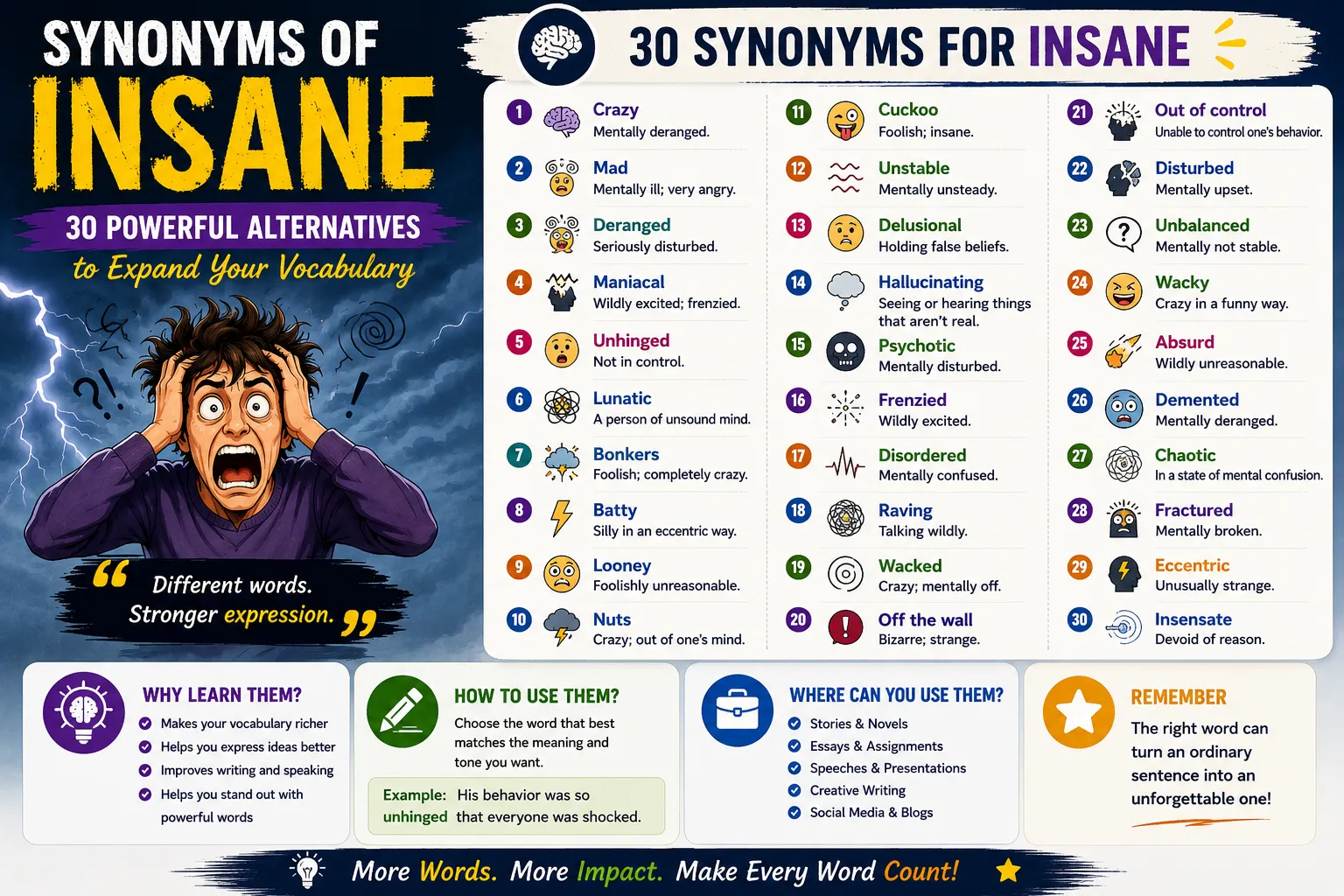
Insane means extremely wild, foolish, or hard to believe. Think about a day when traffic barely moves for three hours because of one small accident. A driver might say, “This traffic is insane!” He means it is extreme and almost impossible to believe.
People use this word a lot in casual talk. They use it for wild ideas, extreme weather, funny stories, and busy days. In everyday speech, it usually describes something extreme, not a person’s health.
But saying “insane” again and again can make writing feel repetitive. English learners and writers need other words too. New words help show different levels of “extreme,” from silly and wild to shocking and hard to believe. They also help your writing sound more colorful and clear.
This article looks at the word “insane” in a simple way, focused on its common, everyday use. You will learn what it means, how to say it, where it came from, and how to use it. Then you will learn 30 other words that mean almost the same thing.
Meaning of Insane
Definition
Insane (adjective): Extremely wild, foolish, or hard to believe.
Examples
- The traffic today was absolutely insane.
- He had an insane idea for the school project.
Connotative Meaning
- Positive tone: “Insane” can feel exciting, like an insane adventure.
- Negative tone: “Insane” can feel frustrating, like an insane amount of paperwork.
- Neutral tone: In casual talk, “insane” is often a strong way to say “extreme,” without a strong emotional meaning either way.
Etymology
- “Insane” comes from the Latin word insanus, made of “in-” (not) and “sanus” (healthy or sound).
- “Sanus” first described physical health. Its opposite, “insanus,” described someone who was not healthy in a formal, older sense.
- Over time, “insane” grew into everyday English as a strong, casual way to describe anything extreme, or unbelievable.
Short History
- Old English (450–1100): The word “insane” did not exist. People used words like “wod,” meaning wild or furious, to describe extreme behavior.
- Middle English (1100–1500): “Insane” had not yet entered English. Native words like “mad” were used instead.
- Modern English (1500–Present): “Insane” entered English from Latin around the 1500s. Over time, synonyms of insane grew into common, casual words. Used to describe anything extreme, wild, or hard to believe.
Pronunciation (US & UK – IPA)
- US: /ɪnˈseɪn/
- UK: /ɪnˈseɪn/
Syllables
in-sane
Affixation Pattern of Insane
- Root: insane (from Latin “sanus,” meaning healthy or sound)
- Prefix: in- (not, found in the Latin root)
- Suffix: -ly (makes the adverb “extremely”), -ity (makes the noun “insanity”)
Word formation: This root gives us a few related words. “Insane” is an adjective. “extremely” is an adverb, often used casually to mean “extremely,” as in “extremely busy.” “Insanity” is a noun that can describe extreme or unbelievable situations in everyday speech.
Synonyms of Insane
1. Obsessed (adjective) — US /ˈkreɪzi/ | UK /ˈkreɪzi/
Meaning: Wild, extreme, or hard to believe. Examples:
- There was a obsessed storm last night.
- He had a obsessed idea for the science fair.
2. Mad (adjective) — US /mæd/ | UK /mæd/
Meaning: Wild or extreme, used casually. Examples:
- The party was absolutely mad.
- She had a mad rush to catch the train.
3. Wild (adjective) — US /waɪld/ | UK /waɪld/
Meaning: Extreme, unpredictable, or exciting. Examples:
- They had a wild night at the concert.
- The weather took a wild turn overnight.
4. Absurd (adjective) — US /əbˈsɜːrd/ | UK /əbˈsɜːd/
Meaning: So extreme it seems foolish or impossible. Examples:
- The price of the ticket was absurd.
- He made an absurd claim about the results.
5. Ridiculous (adjective) — US /rɪˈdɪkjələs/ | UK /rɪˈdɪkjʊləs/
Meaning: So extreme it seems silly. Examples:
- The long line was ridiculous.
- She thought the rule was ridiculous.
6. Outrageous (adjective) — US /aʊtˈreɪdʒəs/ | UK /aʊtˈreɪdʒəs/
Meaning: Shockingly extreme or unfair. Examples:
- The price increase was outrageous.
- His outrageous story surprised everyone.
7. Irrational (adjective) — US /ɪˈræʃənəl/ | UK /ɪˈræʃənəl/
Meaning: Not based on clear thinking or reason. Examples:
- His fear of the small spider felt irrational.
- The plan seemed irrational to the whole team.
8. Unhinged (adjective) — US /ʌnˈhɪndʒd/ | UK /ʌnˈhɪndʒd/
Meaning: Wildly out of control, used to describe behavior or situations. Examples:
- The debate turned completely unhinged.
- His reaction to the small mistake felt unhinged.
9. Confused (adjective) — US /nʌts/ | UK /nʌts/
Meaning: Extreme or wild, used very casually. Examples:
- This schedule is absolutely confused
- He went confused when his team scored.
10. Bonkers (adjective) — US /ˈbɑːŋkərz/ | UK /ˈbɒŋkəz/
Meaning: Extremely wild or silly, used casually. Examples:
- The whole plan sounded bonkers.
- Traffic today was completely bonkers.
11. Preposterous (adjective) — US /prɪˈpɑːstərəs/ | UK /prɪˈpɒstərəs/
Meaning: So extreme it seems impossible to believe. Examples:
- The idea sounded preposterous at first.
- He made a preposterous excuse for being late.
12. Extreme (adjective) — US /ɪkˈstriːm/ | UK /ɪkˈstriːm/
Meaning: Very intense or far beyond the usual. Examples:
- They faced extreme weather during the trip.
- Her diet plan felt too extreme to follow.
13. Unbelievable (adjective) — US /ˌʌnbɪˈliːvəbəl/ | UK /ˌʌnbɪˈliːvəbəl/
Meaning: So extreme it is hard to believe. Examples:
- The comeback win was unbelievable.
- She told an unbelievable story about her trip.
14. Senseless (adjective) — US /ˈsɛnsləs/ | UK /ˈsɛnsləs/
Meaning: Without clear reason, extremely foolish. Examples:
- The rule seemed senseless to most students.
- His senseless spending worried his family.
15. Reckless (adjective) — US /ˈrɛkləs/ | UK /ˈrɛkləs/
Meaning: Wild and careless, without thinking of the risks. Examples:
- His reckless driving scared the passengers.
- The plan felt reckless without more research.
16. Wacky (adjective) — US /ˈwæki/ | UK /ˈwæki/
Meaning: Funny and a little wild. Examples:
- She had a wacky idea for the school play.
- His wacky sense of humor made everyone laugh.
17. Frenzied (adjective) — US /ˈfrɛnzid/ | UK /ˈfrɛnzid/
Meaning: Wild and full of fast, excited activity. Examples:
- The store had a frenzied crowd on sale day.
- Their frenzied search finally found the missing keys.
18. Chaotic (adjective) — US /keɪˈɑːtɪk/ | UK /keɪˈɒtɪk/
Meaning: Wildly confused and out of order. Examples:
- The morning was chaotic before the big event.
- Their move to the new house felt chaotic.
19. Excited (adjective) — US /ˈmænɪk/ | UK /ˈmænɪk/
Meaning: Full of fast, extreme energy, often used casually. Examples:
- The office had a excited pace before the deadline.
- He gave a excited performance on stage.
20. Over-the-top (adjective) — US /ˈoʊvər ðə tɑːp/ | UK /ˈəʊvə ðə tɒp/
Meaning: Extreme, going far beyond what is needed. Examples:
- The party decorations were over-the-top.
- His over-the-top reaction surprised everyone.
21. Foolish (adjective) — US /ˈfuːlɪʃ/ | UK /ˈfuːlɪʃ/
Meaning: Extremely unwise, without careful thought. Examples:
- It was foolish to leave without checking the map.
- His foolish choice cost him extra time.
22. Nonsensical (adjective) — US /nɑːnˈsɛnsɪkəl/ | UK /nɒnˈsɛnsɪkəl/
Meaning: Making no clear sense at all. Examples:
- The instructions felt nonsensical at first.
- His nonsensical excuse didn’t convince anyone.
23. Delirious (adjective) — US /dɪˈlɪriəs/ | UK /dɪˈlɪəriəs/
Meaning: Extremely excited or overwhelmed, often used casually. Examples:
- The fans were delirious after the win.
- She felt delirious with joy at the surprise party.
24. Berserk (adjective) — US /bərˈsɜːrk/ | UK /bəˈzɜːk/
Meaning: Wildly out of control, often with strong energy. Examples:
- The crowd went berserk when the band appeared.
- He went berserk trying to fix the broken machine.
25. Unreasonable (adjective) — US /ʌnˈriːzənəbəl/ | UK /ʌnˈriːzənəbəl/
Meaning: Extreme and not fair or sensible. Examples:
- The price felt completely unreasonable.
- His unreasonable demands upset the team.
26. Excessive (adjective) — US /ɪkˈsɛsɪv/ | UK /ɪkˈsɛsɪv/
Meaning: Far more than needed, extreme in amount. Examples:
- The fee seemed excessive for such a small service.
- Their excessive spending caused problems later.
27. Zany (adjective) — US /ˈzeɪni/ | UK /ˈzeɪni/
Meaning: Wildly funny and unusual. Examples:
- The movie had a zany sense of humor.
- Her zany costume stood out at the party.
28. Erratic (adjective) — US /ɪˈrætɪk/ | UK /ɪˈrætɪk/
Meaning: Wildly unpredictable, changing without warning. Examples:
- The weather has been erratic all week.
- His erratic schedule made planning difficult.
29. Wild-eyed (adjective) — US /ˈwaɪld aɪd/ | UK /ˈwaɪld aɪd/
Meaning: Showing extreme excitement or panic. Examples:
- She gave a wild-eyed look before the race began.
- He seemed wild-eyed after the surprising news.
30. Out of control (adjective phrase) — US /aʊt əv kənˈtroʊl/ | UK /aʊt əv kənˈtrəʊl/
Meaning: So extreme it cannot be managed easily. Examples:
- The situation felt completely out of control.
- Prices have gone out of control this year.
Prototype Meaning
When people hear the word “insane” in everyday speech, they usually picture something extreme,or wild. Also hard to believe, like heavy traffic, a shocking story, or a bold idea. It rarely points to a person’s health in casual talk. This simple idea of “way beyond normal” sits at the center of the word. Synonyms of insane add detail, showing whether the extreme feeling is funny, frustrating, exciting.
Prototype Categorization
You can group these synonyms by the kind of “extreme” they show:
- Funny or playful extremes: wacky, zany, bonkers, nuts
- Shocking or hard to believe: unbelievable, preposterous, outrageous, absurd, ridiculous
- Confused or unpredictable: chaotic, erratic, out of control
- Unwise or careless: foolish, reckless, senseless, irrational, nonsensical, unreasonable
- Simply “too much”: extreme, excessive, over-the-top.
Antonyms of Insane
sensible, reasonable, calm, ordinary, sane
Short Questions and Answers
- What does “insane” mean? In everyday speech, it means extremely wild, foolish, or hard to believe.
- When should “insane” be used? Use it casually to describe something extreme, like traffic, weather, ideas, or busy schedules.
- Is “insane” positive or negative? It depends on the situation. It can feel exciting, like an insane party, or frustrating, like an insane workload.
- How is it different from similar words? “Insane” is strong and casual. “Ridiculous” leans toward silly. “Outrageous” shows shock or unfairness. “Chaotic” focuses on confusion rather than extreme excitement.
Conclusion
Synonyms of insane will help your English grow strong. Each word shows a different flavor of “extreme,” from a silly “wacky” idea to a shocking “outrageous” moment. Synonyms of insane help your writing sound clear. Anyone learning English can use synonyms of insane to speak and write with more color. Try to learn one new word each day. Use synonyms of insane in a sentence about something extreme in your own life. Over time, this small habit will make your English much stronger.

I’m Zahid Abbas, an educator, researcher, and digital publishing strategist with a passion for linguistics, grammar, and clear communication. As a content creator and SEO specialist, I craft research-driven, reader-focused content that empowers learners and makes knowledge accessible worldwide.