The word evidence means facts or signs that show something is true. Imagine a young boy named Leo who loses his favorite red toy car in the backyard. He looks near the sandbox and sees small tire tracks pressed into the soft dirt. Those tiny tracks are the clues that prove where his toy went. That collection of clues and facts is what we call evidence.
People use synonyms for evidence often in school, science experiments, and daily conversations. Because proving ideas and solving problems happen every day. Evidence is a vital word for young students to know.
Learning synonyms for evidence is necessary for English learners and young writers. Synonyms for evidence enables you to describe solving mysteries, writing strong school papers, or sharing scientific facts. This article aims to discuss the meaning of the key word. Also its 30 synonyms with examples, grammar facts, word history, pronunciation guides, and simple categories.
Meaning of Evidence
Definition
Evidence (Noun): Facts, signs, or objects that prove something is true or real.
Examples
- The detective found clear evidence near the door.
- She used science facts as evidence for her report.
Connotative Meaning
- Positive tone: Shows clear truth, strong facts, and honest proof that helps people.
- Negative tone: Points to crime scenes, bad mistakes, or legal trouble.
- Neutral tone: Used by teachers and scientists to describe simple details and information.
Etymology
- Source language: Came from the Latin word evidentia, which means clearness or standing out in plain sight.
- Old English (450–1100): Early children used words like swutolung to mean showing or revealing proof.
- Middle English (1100–1500): French words like evidence entered English stories to describe clear proof.
- Modern English (1500–Present): Became the common word evidence used today in schoolbooks and science classes!
Pronunciation
- US: /ˈɛvədəns/
- UK: /ˈevɪdəns/
Syllables
ev-i-dence (3 parts)
Affixation Pattern of Evidence
- Root: Evident
- Prefix: None
- Suffix: -ence (Noun ending)
- Word Formation:
- Noun: Evidence
- Verb: Evidence
- Adjective: Evident, Evidential
- Adverb: Evidently
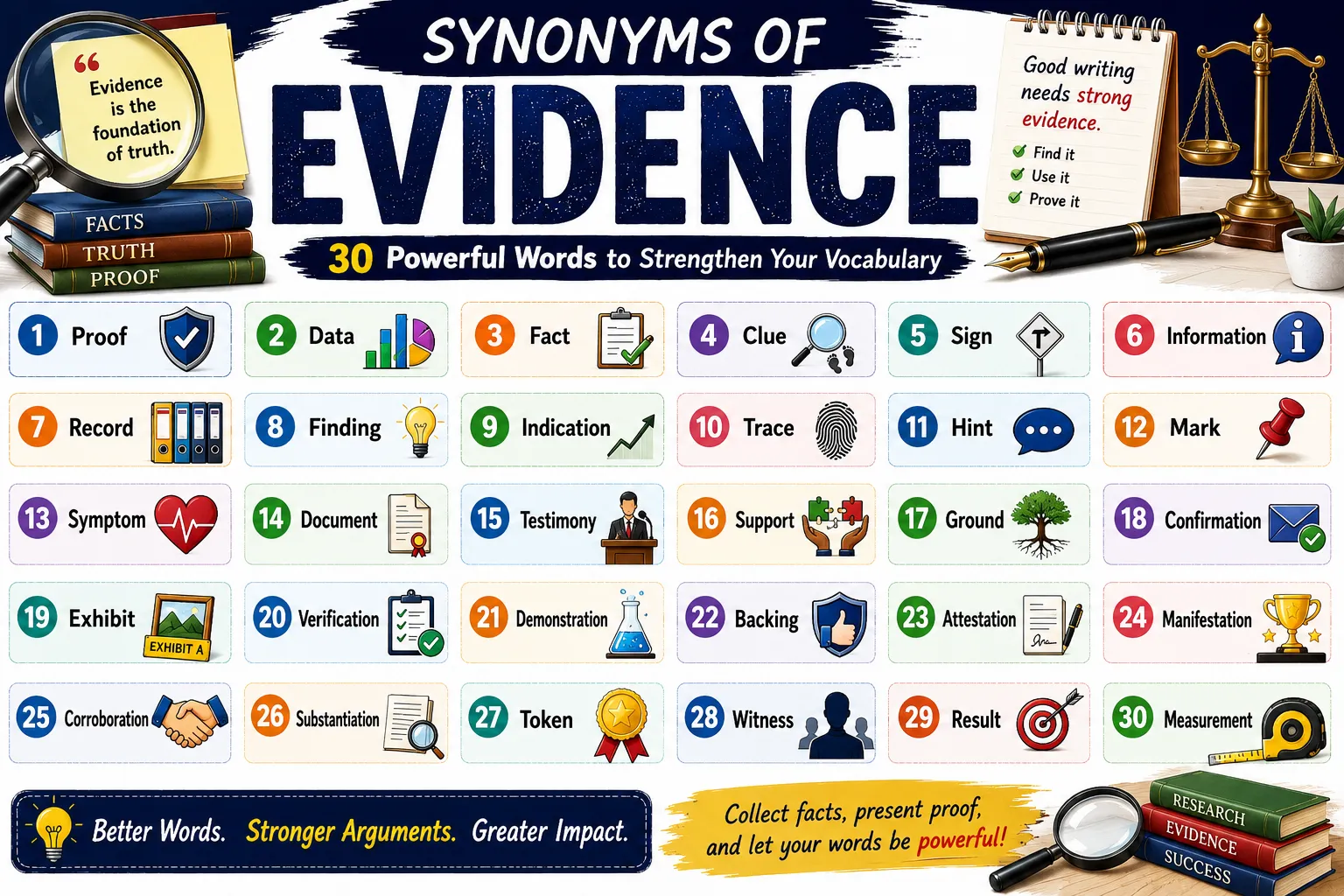
Synonyms of Evidence
1. Proof (Noun) — US: /pruːf/ | UK: /pruːf/
Meaning: Facts or information that show something is definitely true.
Examples:
The store receipt is proof that she bought the shoes.
He showed his dirty boots as proof that he walked in the mud.
2. Data (Noun) — US: /ˈdeɪtə/ | UK: /ˈdeɪtə/
Meaning: Facts and numbers gathered to learn about something.
Examples:
The students collected data about rain levels.
Computer charts store helpful data for the science project.
3. Fact (Noun) — US: /fækt/ | UK: /fækt/
Meaning: Something that is completely true and real.
Examples:
It is a clear fact that dogs have four legs.
She stated a helpful fact about space during class.
4. Clue (Noun) — US: /kluː/ | UK: /kluː/
Meaning: A small piece of information that helps solve a secret.
Examples:
A single footprint was the best clue in the game.
Look for a clue on the map to find the treasure.
5. Sign (Noun) — US: /saɪn/ | UK: /saɪn/
Meaning: An action or mark that shows something exists.
Examples:
Dark gray clouds are a sign of coming rain.
A warm smile is a sign of kindness.
6. Information (Noun) — US: /ˌɪnfərˈmeɪʃən/ | UK: /ˌɪnfəˈmeɪʃn/
Meaning: Knowledge or details shared about a topic.
Examples:
The textbook offers great information about animals.
He found new information about solar power online.
7. Record (Noun) — US: /ˈrɛkərd/ | UK: /ˈrekɔːd/
Meaning: Written notes kept to remember exact facts.
Examples:
The nurse looked at my health record at the clinic.
Our teacher keeps a record of class attendance.
8. Finding (Noun) — US: /ˈfaɪndɪŋ/ | UK: /ˈfaɪndɪŋ/
Meaning: An answer discovered after careful study or research.
Examples:
The main finding showed that plants need sunlight.
Scientists shared every new finding with the school.
9. Indication (Noun) — US: /ˌɪndəˈkeɪʃən/ | UK: /ˌɪndɪˈkeɪʃn/
Meaning: A hint or point that shows what is happening.
Examples:
A high temperature is an indication of an illness.
Her bright smile was an indication of pure joy.
10. Trace (Noun) — US: /treɪs/ | UK: /treɪs/
Meaning: A very tiny mark or amount left behind.
Examples:
The dog left a trace of mud on the carpet.
There was no trace of sugar left in the bowl.
11. Hint (Noun) — US: /hɪnt/ | UK: /hɪnt/
Meaning: A small suggestion that points to the truth.
Examples:
Grandma gave us a hint about our birthday present.
The cool breeze gave a hint of fall weather.
12. Mark (Noun) — US: /mɑːrk/ | UK: /mɑːk/
Meaning: A spot or shape that shows where something was.
Examples:
The sled left a long mark in the snow.
A crayon mark was visible on the white wall.
13. Symptom (Noun) — US: /ˈsɪmptəm/ | UK: /ˈsɪmptəm/
Meaning: A physical change that shows an illness is present.
Examples:
A sore throat is a common symptom of a cold.
Sneezing was her main symptom during spring.
14. Document (Noun) — US: /ˈdɑːkjəmənt/ | UK: /ˈdɒkjumənt/
Meaning: An official paper that records important information.
Examples:
A passport is an official document for travel.
He signed the paper document with a blue pen.
15. Testimony (Noun) — US: /ˈtɛstəˌmoʊni/ | UK: /ˈtestɪməni/
Meaning: A formal spoken story given to tell the truth.
Examples:
The witness gave clear testimony to the court.
Her honest testimony helped explain the event.
16. Support (Noun) — US: /səˈpɔːrt/ | UK: /səˈpɔːt/
Meaning: Facts or reasons that help prove an idea.
Examples:
Use book quotes as support for your essay.
Strong support makes a scientific idea reliable.
17. Ground (Noun) — US: /ɡraʊnd/ | UK: /ɡraʊnd/
Meaning: A solid reason for doing or believing something.
Examples:
Bad weather gave good ground to cancel the trip.
Fair rules give strong ground for teamwork.
18. Confirmation (Noun) — US: /ˌkɑːnfərˈmeɪʃən/ | UK: /ˌkɒnfəˈmeɪʃn/
Meaning: Proof that shows a choice or plan is correct.
Examples:
We got an email confirmation for our ticket order.
She waited for confirmation about the game time.
19. Exhibit (Noun) — US: /ɪɡˈzɪbət/ | UK: /ɪɡˈzɪbɪt/
Meaning: An object shown in court or class as proof.
Examples:
The detective held up the key as an exhibit.
Our science exhibit showed how water freezes.
20. Verification (Noun) — US: /ˌvɛrəfəˈkeɪʃən/ | UK: /ˌverɪfɪˈkeɪʃn/
Meaning: The process of double-checking that something is true.
Examples:
The bank needed ID for account verification.
We need quick verification of the test scores.
21. Demonstration (Noun) — US: /ˌdɛmənˈstreɪʃən/ | UK: /ˌdemənˈstreɪʃn/
Meaning: An act of showing clearly how something works.
Examples:
The teacher gave a demonstration of the experiment.
His neat drawing was a demonstration of his skill.
22. Backing (Noun) — US: /ˈbækɪŋ/ | UK: /ˈbækɪŋ/
Meaning: Extra help or facts that make a point stronger.
Examples:
The claim had scientific backing from doctors.
Her idea received strong backing from the team.
23. Attestation (Noun) — US: /ˌætɛˈsteɪʃən/ | UK: /ˌæteˈsteɪʃn/
Meaning: A formal statement that proves a fact is true.
Examples:
The signed paper was an attestation of his age.
Her letter served as an attestation of her hard work.
24. Manifestation (Noun) — US: /ˌmænəfɛˈsteɪʃən/ | UK: /ˌmænɪfeˈsteɪʃn/
Meaning: A clear visual sign that shows an idea in real life.
Examples:
The new garden was a manifestation of their hard work.
A high score is a manifestation of daily practice.
25. Corroboration (Noun) — US: /kəˌrɑːbəˈreɪʃən/ | UK: /kəˌrɒbəˈreɪʃn/
Meaning: Extra evidence that matches and agrees with a story.
Examples:
The video gave full corroboration of his words.
Two stories matched as helpful corroboration.
26. Substantiation (Noun) — US: /səbˌstænʃiˈeɪʃən/ | UK: /səbˌstænʃiˈeɪʃn/
Meaning: Proof that backs up a claim or statement.
Examples:
A good news story needs real substantiation.
He offered clear substantiation for his answers.
27. Token (Noun) — US: /ˈtoʊkən/ | UK: /ˈtəʊkən/
Meaning: A small object that stands for a feeling or fact.
Examples:
She gave a card as a token of thanks.
The shiny medal was a token of victory.
28. Witness (Noun) — US: /ˈwɪtnəs/ | UK: /ˈwɪtnəs/
Meaning: A person or thing that sees or proves an event.
Examples:
The tall tree stood as a quiet witness to history.
A reliable witness described the red car.
29. Result (Noun) — US: /rɪˈzʌlt/ | UK: /rɪˈzʌlt/
Meaning: An outcome that shows what happened at the end.
Examples:
The final result proved their plan was good.
Clean air was the best result of planting trees.
30. Measurement (Noun) — US: /ˈmɛʒərmənt/ | UK: /ˈmeʒəmənt/
Meaning: An exact size or amount found by using tools.
Examples:
A ruler gives an accurate measurement of length.
We took a daily measurement of plant growth.
Prototype Meaning
When children hear the word evidence, they usually picture a clever detective holding a magnifying glass over footprints in the dirt. A student looking closely at test tubes in science class to prove an idea.
Prototype Categorization
- School & Science Proof: Data, Fact, Finding, Result, Measurement, Document, Information, Record.
- Mysteries & Detective Clues: Clue, Sign, Trace, Hint, Mark, Symptom, Indication.
- Law & Official Court Terms: Testimony, Exhibit, Verification, Attestation, Confirmation, Substantiation.
- Writing & General Support: Support, Ground, Backing, Demonstration, Manifestation, Corroboration, Token, Witness.
Antonyms of Evidence
- Guess
- Lie
- Secret
- Hide
- Fiction
- Doubt
Short Questions and Answers
- What does evidence mean?
- Evidence means facts, signs, or proof that show something is true.
- When should evidence be used?
- Use evidence when writing school reports, solving mysteries, or proving facts.
- Is evidence positive or negative?
- Evidence is usually neutral and helpful because it reveals the truth.
- How is it different from similar words?
- Evidence includes all proof, while a clue is just a small hint, and data is a set of numbers.
CONCLUSION
Synonyms for evidence strengthens your overall English vocabulary. Relying on the same basic word every day can make your class stories sound plain. Using synonyms for evidence like clue for mysteries, data for science, or symptoms for health makes your sentences clear. Expanding your vocabulary sharpens your writing. Synonyms for evidence also builds speaking confidence, and helps you score higher on school tests. Start practicing two or three of these easy synonyms in your daily reading and writing today.

I’m Zahid Abbas, an educator, researcher, and digital publishing strategist with a passion for linguistics, grammar, and clear communication. As a content creator and SEO specialist, I craft research-driven, reader-focused content that empowers learners and makes knowledge accessible worldwide.