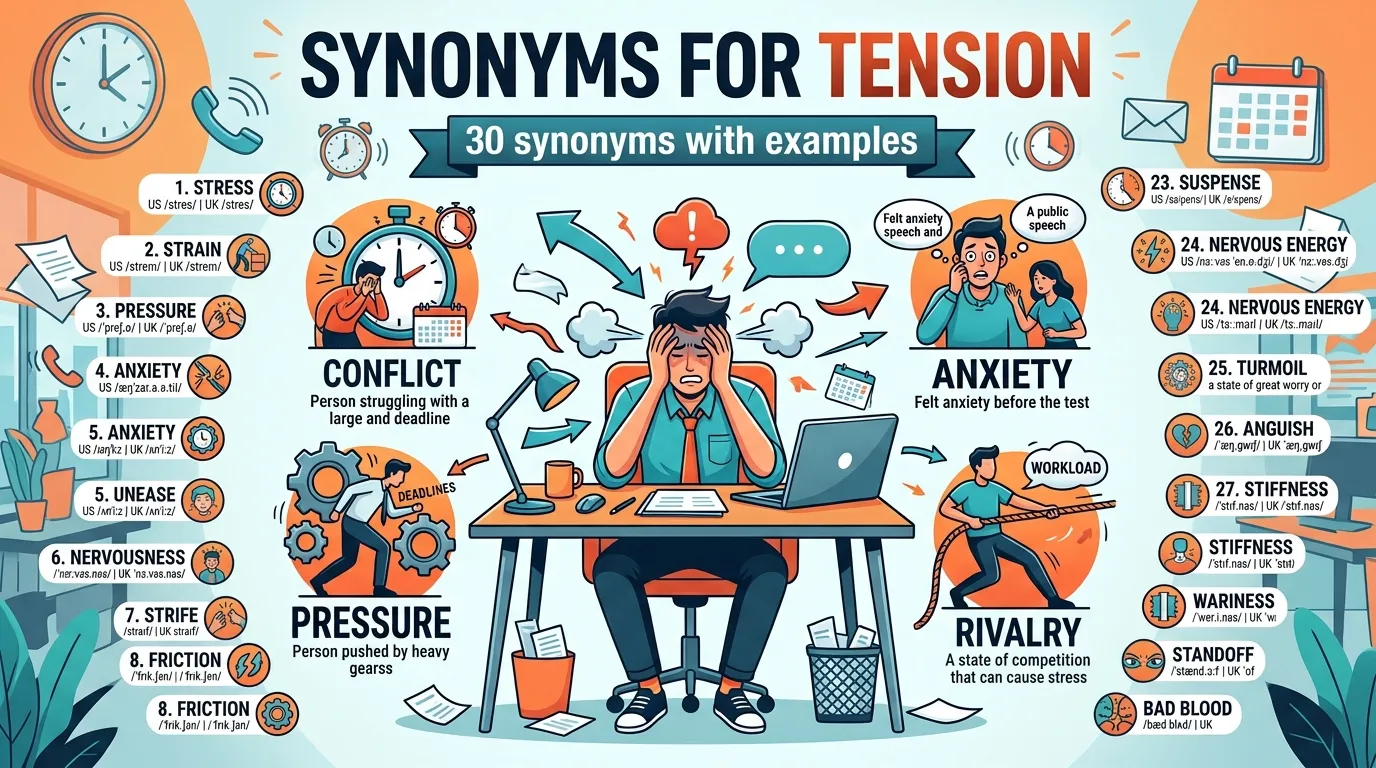
Tension means a feeling of stress or a tight, stretched state. Think about a big test at school. Your hands feel tight. Your heart beats fast. You feel worried. That feeling is tension. We use this word a lot. We use it for feelings. Learners use it for people who do not get along. We use it for things that are pulled tight, like a rope. New synonyms for tension help you talk better. Synonyms for tension help you write better too. You will not repeat the same word. Your writing will be more fun to read. This article will teach you the word “tension.” Learner will learn 30 other words like it. You will see easy examples. We will learn how to say each word. You will learn some history too.
Meaning of Tension
Definition
Tension (noun): a feeling of stress, worry, or being pulled tight.
Examples
- She felt tension before the big game.
- There was tension in the room after the fight.
Connotative Meaning
- Positive tone: exciting, full of energy
- Negative tone: stressful, scary, uneasy
- Neutral tone: just a state of being tight or stretched
Etymology
- This word comes from the Latin word tensio. It means “a stretching.”
- Tensio comes from the verb tendere. It means “to stretch.”
- The word moved into English through French long ago.
- Old English (450–1100): This word did not exist yet. People used words like stiþnes for stiffness or hardness.
- Middle English (1100–1500): The word was not common yet. English still used older, simple words for stress and strain.
- Modern English (1500–Present): The word tension came into English in the 1500s. First it meant a physical stretch, like a tight rope. Later, it also meant stress between people or inside the mind.
Pronunciation (US & UK — IPA)
- US: /ˈten.ʃən/
- UK: /ˈten.ʃən/
Syllables
ten-sion (2 parts)
Affixation Pattern of Tension
- Root: tens- (from Latin tendere, meaning “to stretch”)
- Prefix: none
- Suffix: -ion (turns the root into a noun)
- Word formation:
- This root makes many words. We get tension (noun), tense (adjective/verb), tensely (tells how), tensity (noun), and tensile (describing word).
Explore related words https://synonymhunting.com/synonyms-for-focused/
Synonyms for Tension
1. Stress (noun) — US /stres/ | UK /stres/
Meaning: a strong feeling of worry or pressure.
Examples:
- Work stress kept her up at night.
- He feels stress before every exam.
2. Strain (noun) — US /streɪn/ | UK /streɪn/
Meaning: a heavy pull or pressure on the mind or body.
Examples:
- The strain of the job wore him out.
- She felt the strain of long hours.
3. Pressure (noun) — US /ˈpreʃ.ɚ/ | UK /ˈpreʃ.ə/
Meaning: a strong push or force, often felt as stress.
Examples:
- He works well under pressure.
- The team felt pressure to win.
4. Anxiety (noun) — US /æŋˈzaɪ.ə.ti/ | UK /æŋˈzaɪ.ə.ti/
Meaning: a strong feeling of worry or fear.
Examples:
- She felt anxiety before the flight.
- His anxiety grew before the test.
5. Unease (noun) — US /ʌnˈiːz/ | UK /ʌnˈiːz/
Meaning: a mild feeling of worry or discomfort.
Examples:
- A sense of unease filled the room.
- He felt unease about the plan.
6. Nervousness (noun) — US /ˈnɝː.vəs.nəs/ | UK /ˈnɜː.vəs.nəs/
Meaning: a shaky, worried feeling before something hard.
Examples:
- Her nervousness showed before the speech.
- He hid his nervousness well.
7. Strife (noun) — US /straɪf/ | UK /straɪf/
Meaning: angry conflict between people.
Examples:
- The two families lived in strife.
- Years of strife hurt the town.
8. Friction (noun) — US /ˈfrɪk.ʃən/ | UK /ˈfrɪk.ʃən/
Meaning: conflict or disagreement between people.
Examples:
- There was friction between the two teams.
- Money often causes friction in families.
9. Conflict (noun) — US /ˈkɑːn.flɪkt/ | UK /ˈkɒn.flɪkt/
Meaning: a strong disagreement or fight.
Examples:
- The conflict lasted for weeks.
- They tried to solve the conflict calmly.
10. Unrest (noun) — US /ʌnˈrest/ | UK /ʌnˈrest/
Meaning: a state of trouble or worry, often in a group.
Examples:
- There was unrest in the city.
- The news caused public unrest.
11. Discomfort (noun) — US /dɪsˈkʌm.fɚt/ | UK /dɪsˈkʌm.fət/
Meaning: a feeling of unease or slight pain.
Examples:
- She felt discomfort during the talk.
- His words caused discomfort in the room.
12. Tightness (noun) — US /ˈtaɪt.nəs/ | UK /ˈtaɪt.nəs/
Meaning: a tense, stiff feeling in the body or mood.
Examples:
- He felt tightness in his chest.
- There was tightness in her voice.
13. Apprehension (noun) — US /ˌæp.rɪˈhen.ʃən/ | UK /ˌæp.rɪˈhen.ʃən/
Meaning: a fearful feeling about something that may happen.
Examples:
- She felt apprehension before the trip.
- His apprehension grew each day.
14. Hostility (noun) — US /hɑːˈstɪl.ə.ti/ | UK /hɒˈstɪl.ə.ti/
Meaning: strong unfriendly feelings between people.
Examples:
- Hostility grew between the two groups.
- She sensed hostility in his tone.
15. Discord (noun) — US /ˈdɪs.kɔːrd/ | UK /ˈdɪs.kɔːd/
Meaning: disagreement or lack of peace between people.
Examples:
- Discord filled the meeting room.
- The plan caused discord in the family.
16. Edginess (noun) — US /ˈedʒ.i.nəs/ | UK /ˈedʒ.i.nəs/
Meaning: a nervous, easily upset feeling.
Examples:
- His edginess showed before the game.
- She felt edginess all morning.
17. Restlessness (noun) — US /ˈrest.ləs.nəs/ | UK /ˈrest.ləs.nəs/
Meaning: a feeling of being unable to relax.
Examples:
- His restlessness kept him pacing.
- She felt restlessness before the exam.
18. Uptightness (noun) — US /ʌpˈtaɪt.nəs/ | UK /ʌpˈtaɪt.nəs/
Meaning: a stiff, worried, and nervous state.
Examples:
- His uptightness made the room quiet.
- She tried to hide her uptightness.
19. Worry (noun) — US /ˈwɝː.i/ | UK /ˈwʌr.i/
Meaning: a feeling of fear about what might happen.
Examples:
- Worry kept her awake at night.
- His worry grew as the storm came closer.
20. Angst (noun) — US /æŋkst/ | UK /æŋkst/
Meaning: a deep feeling of worry or fear.
Examples:
- Teen angst filled the movie.
- He felt angst about his future.
21. Antagonism (noun) — US /ænˈtæɡ.ə.nɪ.zəm/ | UK /ænˈtæɡ.ə.nɪ.zəm/
Meaning: strong dislike or opposition between people.
Examples:
- Antagonism grew between the two leaders.
- She felt his antagonism right away.
22. Rivalry (noun) — US /ˈraɪ.vəl.ri/ | UK /ˈraɪ.vəl.ri/
Meaning: a state of competition that can cause stress.
Examples:
- The rivalry between the teams was fierce.
- Sibling rivalry caused daily tension.
23. Suspense (noun) — US /səˈspens/ | UK /səˈspens/
Meaning: a nervous feeling of waiting for something to happen.
Examples:
- The movie was full of suspense.
- She waited in suspense for the results.
24. Nervous energy (phrase) — US /ˈnɝː.vəs ˈen.ɚ.dʒi/ | UK /ˈnɜː.vəs ˈen.ə.dʒi/
Meaning: a jumpy, tense feeling that makes you restless.
Examples:
- His nervous energy showed in his pacing.
- She had nervous energy before the show.
25. Turmoil (noun) — US /ˈtɝː.mɔɪl/ | UK /ˈtɜː.mɔɪl/
Meaning: a state of great worry or confusion.
Examples:
- Her mind was in turmoil.
- The country faced political turmoil.
26. Anguish (noun) — US /ˈæŋ.ɡwɪʃ/ | UK /ˈæŋ.ɡwɪʃ/
Meaning: deep pain or worry, often felt strongly.
Examples:
- He felt anguish over the loss.
- Her anguish was clear on her face.
27. Stiffness (noun) — US /ˈstɪf.nəs/ | UK /ˈstɪf.nəs/
Meaning: a tight, unmoving feeling in the body or mood.
Examples:
- He felt stiffness in his neck.
- There was stiffness between the old friends.
28. Wariness (noun) — US /ˈwer.i.nəs/ | UK /ˈweə.ri.nəs/
Meaning: careful worry about possible danger.
Examples:
- She showed wariness around strangers.
- His wariness grew after the warning.
29. Standoff (noun) — US /ˈstænd.ɔːf/ | UK /ˈstænd.ɒf/
Meaning: a tense state where no side gives in.
Examples:
- The talks ended in a standoff.
- A tense standoff lasted all night.
30. Bad blood (phrase) — US /bæd blʌd/ | UK /bæd blʌd/
Meaning: old anger or dislike between people.
Examples:
- There is bad blood between the two brothers.
- Bad blood ruined their old friendship.
Prototype Meaning
People hear “tension.” They think of a tight, stressed feeling. Learners think of worry before a big event. They think of two people who do not get along. This is the main picture the word gives us.
Prototype Categorization
- Feeling words: stress, anxiety, worry, unease, nervousness, angst
- Body words: strain, tightness, stiffness
- People-conflict words: friction, conflict, discord, hostility, antagonism, bad blood
- Group words: unrest, turmoil, standoff
- Waiting words: suspense, apprehension
- Extra words: pressure, edginess, restlessness, wariness, rivalry, anguish, uptightness, nervous energy
Antonyms of Tension:
- Calm
- Peace
- Ease
- Relaxation
- Harmony
Short Questions and Answers
- What does tension mean? It means a feeling of stress or being pulled tight.
- When should tension be used? Use it when you talk about stress, worry, or conflict.
- Is tension positive or negative? It is mostly negative. It can feel a bit positive in exciting moments, like a close game.
- How is it different from similar words? “Tension” is a general word for stress. “Friction” is used for conflict between people. “Suspense” is used for nervous waiting.
Conclusion
Synonyms for tension can help you a lot. It helps you speak better. It helps you write better too. You will not repeat the same word. Your English will sound clear. Your English will sound strong too. Synonyms for tension like “stress,” “friction,” and “unrest” each mean a small bit different. Knowing each word makes you a strong writer. Try to learn one new synonyms for tension each day. Use it in a sentence. Read it in a book. Small steps build big skills over time.

I’m Zahid Abbas, an educator, researcher, and digital publishing strategist with a passion for linguistics, grammar, and clear communication. As a content creator and SEO specialist, I craft research-driven, reader-focused content that empowers learners and makes knowledge accessible worldwide.










