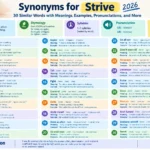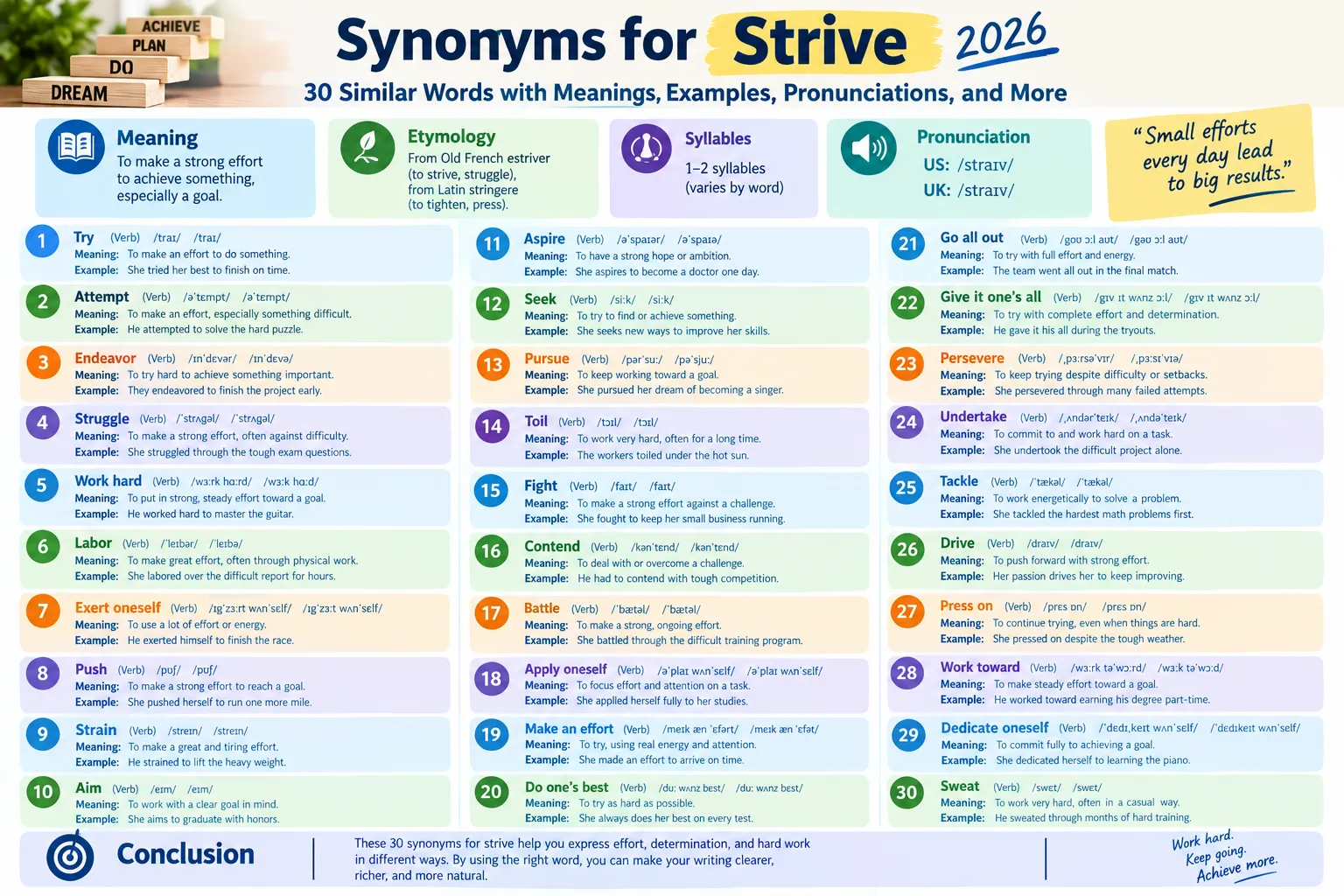
Strive means to try very hard to achieve or reach something. Think about a young runner who wakes up early every single morning to train, even when she feels tired or the weather is cold. She strives to become the fastest runner in her school, pushing herself a little more each day. This word describes strong, ongoing effort toward a goal, often one that is difficult to reach. People use synonyms for strive a lot when talking about hard work, dreams, and personal growth. Learning new synonyms for strive are helpful for English learners and writers. Who want to describe effort and determination in many different ways. It also makes writing feel more powerful and inspiring. This article explains the meaning of strive, its history, how to say it, and 30 words that share a similar meaning.
Meaning of Strive
Definition
Strive (Verb): To try very hard to achieve or reach something, often over a long period of time.
Examples
- She strives to improve her grades every semester.
- The team strives for excellence in every game.
Connotative Meaning
- Positive tone: This word usually has a positive feeling. It shows strong effort, determination, and hope of reaching a goal.
- Negative tone: It can sound negative when it describes a long, difficult, or tiring struggle.
- Neutral tone: In formal or business writing, it can simply mean steady effort toward a goal.
Etymology
- This word comes from the Old French word “estriver,” meaning “to quarrel” or “to struggle.”
- The word probably came from an old Germanic word connected to fighting or struggling for something.
- Over time, its meaning changed from fighting against someone to working hard to reach a goal.
Short History
- Old English (450–1100): This word did not exist yet. People used other native words to describe struggle or hard effort.
- Middle English (1100–1500): The word “striven” came into English from Old French. At first, it meant “to argue” or “to fight” with someone.
- Modern English (1500–Present): Over time, the meaning changed. It came to mean working hard to achieve a goal, which is the main meaning today.
Pronunciation (US & UK – IPA)
- US: /straɪv/
- UK: /straɪv/
Syllables
strive (1 syllable)
Affixation Pattern of Strive
- Root: strive
- Prefix: none
- Suffix: none (irregular verb: strive, strove, striven)
More Words to Explore https://synonymhunting.com/synonyms-for-promote/
Word Formation:
- Strive (verb)
- Striving (noun/verb form)
- Striver (noun, a person who works hard toward a goal)
Synonyms for Strive
1. Try (Verb) — US: /traɪ/ | UK: /traɪ/
Meaning: To make an effort to do something.
Examples:
- She tried her best to finish on time.
- He tried hard to fix the broken bike.
2. Attempt (Verb) — US: /əˈtɛmpt/ | UK: /əˈtɛmpt/
Meaning: To make an effort to do something, especially something difficult.
Examples:
- He attempted to solve the hard puzzle.
- She attempted the climb despite the steep path.
3. Endeavor (Verb) — US: /ɪnˈdɛvər/ | UK: /ɪnˈdɛvə/
Meaning: To try hard to achieve something important.
Examples:
- They endeavored to finish the project early.
- She endeavors to learn something new every day.
4. Struggle (Verb) — US: /ˈstrʌɡəl/ | UK: /ˈstrʌɡəl/
Meaning: To make a strong effort, often against difficulty.
Examples:
- He struggled to carry the heavy box upstairs.
- She struggled through the tough exam questions.
5. Work hard (Verb) — US: /wɜːrk hɑːrd/ | UK: /wɜːk hɑːd/
Meaning: To put in strong, steady effort toward a goal.
Examples:
- She works hard to support her family.
- He worked hard to master the guitar.
6. Labor (Verb) — US: /ˈleɪbər/ | UK: /ˈleɪbə/
Meaning: To make great effort, often through physical or mental work.
Examples:
- The farmers labored all day in the fields.
- She labored over the difficult report for hours.
7. Exert oneself (Verb) — US: /ɪɡˈzɜːrt wʌnˈsɛlf/ | UK: /ɪɡˈzɜːt wʌnˈsɛlf/
Meaning: To use a lot of effort or energy to do something.
Examples:
- He exerted himself to finish the race.
- She exerted herself to meet the tough deadline.
8. Push (Verb) — US: /pʊʃ/ | UK: /pʊʃ/
Meaning: To make a strong effort to reach a goal.
Examples:
- She pushed herself to run one more mile.
- He pushed hard to finish the project on time.
9. Strain (Verb) — US: /streɪn/ | UK: /streɪn/
Meaning: To make a great and tiring effort.
Examples:
- He strained to lift the heavy weight.
- She strained to understand the difficult lecture.
10. Aim (Verb) — US: /eɪm/ | UK: /eɪm/
Meaning: To work with a clear goal in mind.
Examples:
- She aims to graduate with honors.
- He aims to finish the marathon under four hours.
11. Aspire (Verb) — US: /əˈspaɪər/ | UK: /əˈspaɪə/
Meaning: To have a strong hope or ambition to achieve something.
Examples:
- She aspires to become a doctor one day.
- He aspires to travel the whole world.
12. Seek (Verb) — US: /siːk/ | UK: /siːk/
Meaning: To try to find or achieve something.
Examples:
- She seeks new ways to improve her skills.
- He seeks better opportunities for his family.
13. Pursue (Verb) — US: /pərˈsuː/ | UK: /pəˈsjuː/
Meaning: To keep working toward a goal with strong effort.
Examples:
- She pursued her dream of becoming a singer.
- He pursued the job with great determination.
14. Toil (Verb) — US: /tɔɪl/ | UK: /tɔɪl/
Meaning: To work very hard, often for a long time.
Examples:
- The workers toiled under the hot sun.
- She toiled late into the night on her thesis.
15. Fight (Verb) — US: /faɪt/ | UK: /faɪt/
Meaning: To make a strong effort against a difficult challenge.
Examples:
- She fought to keep her small business running.
- He fought hard to recover from his injury.
16. Contend (Verb) — US: /kənˈtɛnd/ | UK: /kənˈtɛnd/
Meaning: To make effort to deal with or overcome a challenge.
Examples:
- She contended with many setbacks along the way.
- He had to contend with tough competition.
17. Battle (Verb) — US: /ˈbætəl/ | UK: /ˈbætəl/
Meaning: To make a strong, ongoing effort to overcome something.
Examples:
- She battled through the difficult training program.
- He battled to keep his grades up while working.
18. Apply oneself (Verb) — US: /əˈplaɪ wʌnˈsɛlf/ | UK: /əˈplaɪ wʌnˈsɛlf/
Meaning: To focus effort and attention on a task.
Examples:
- She applied herself fully to her studies.
- He applied himself to learning the new skill quickly.
19. Make an effort (Verb) — US: /meɪk æn ˈɛfərt/ | UK: /meɪk æn ˈɛfət/
Meaning: To try, using real energy and attention.
Examples:
- She made an effort to arrive on time.
- He made an effort to be kinder to his classmates.
20. Do one’s best (Verb) — US: /duː wʌnz bɛst/ | UK: /duː wʌnz bɛst/
Meaning: To try as hard as possible.
Examples:
- She always does her best on every test.
- He did his best to finish the race strong.
21. Go all out (Verb) — US: /ɡoʊ ɔːl aʊt/ | UK: /ɡəʊ ɔːl aʊt/
Meaning: To try with full effort and energy.
Examples:
- The team went all out in the final match.
- She went all out to prepare for the big exam.
22. Give it one’s all (Verb) — US: /ɡɪv ɪt wʌnz ɔːl/ | UK: /ɡɪv ɪt wʌnz ɔːl/
Meaning: To try with complete effort and determination.
Examples:
- He gave it his all during the tryouts.
- She gave it her all in the final performance.
23. Persevere (Verb) — US: /ˌpɜːrsəˈvɪr/ | UK: /ˌpɜːsɪˈvɪə/
Meaning: To keep trying despite difficulty or setbacks.
Examples:
- She persevered through many failed attempts.
- He persevered until he finally passed the exam.
24. Undertake (Verb) — US: /ˌʌndərˈteɪk/ | UK: /ˌʌndəˈteɪk/
Meaning: To commit to and work hard on a task or goal.
Examples:
- She undertook the difficult project alone.
- He undertook the training with full commitment.
25. Tackle (Verb) — US: /ˈtækəl/ | UK: /ˈtækəl/
Meaning: To work energetically to solve or handle something difficult.
Examples:
- She tackled the hardest math problems first.
- He tackled the messy garage over the weekend.
26. Drive (Verb) — US: /draɪv/ | UK: /draɪv/
Meaning: To push forward with strong effort toward a goal.
Examples:
- Her passion drives her to keep improving.
- He is driven to finish the race in record time.
27. Press on (Verb) — US: /prɛs ɒn/ | UK: /prɛs ɒn/
Meaning: To continue trying, even when things are hard.
Examples:
- She pressed on despite the tough weather.
- He pressed on with the project after the setback.
28. Work toward (Verb) — US: /wɜːrk təˈwɔːrd/ | UK: /wɜːk təˈwɔːd/
Meaning: To make steady effort in the direction of a goal.
Examples:
- She works toward her dream every single day.
- He worked toward earning his degree part-time.
29. Dedicate oneself (Verb) — US: /ˈdɛdɪˌkeɪt wʌnˈsɛlf/ | UK: /ˈdɛdɪkeɪt wʌnˈsɛlf/
Meaning: To commit fully to achieving a goal.
Examples:
- She dedicated herself to learning the piano.
- He dedicated himself to helping his community.
30. Sweat (Verb) — US: /swɛt/ | UK: /swɛt/
Meaning: To work very hard, often used in a casual way.
Examples:
- She sweated over the difficult assignment for hours.
- He sweated through months of hard training.
Prototype Meaning
When people hear the word strive, they often think of someone pushing forward with strong effort toward a difficult but meaningful goal. It brings to mind images of hard work, determination, and staying focused, even when the path feels hard. This word carries a feeling of hope and steady effort.
Prototype Categorization
- Basic trying: try, attempt, make an effort, do one’s best
- Strong physical or mental effort: labor, toil, exert oneself, strain, sweat
- Working through difficulty: struggle, fight, battle, contend, persevere
- Focused determination: apply oneself, dedicate oneself, undertake, drive
- Working toward a goal: aim, aspire, seek, pursue, work toward
- Full or complete effort: go all out, give it one’s all, push, press on, tackle, work hard
Antonyms of Strive
- Give up
- Quit
- Neglect
- Relax
- Abandon
Short Questions and Answers
- What does strive mean?
- It means to try very hard to achieve or reach something.
- When should strive be used?
- Use it when describing strong, ongoing effort toward a goal, especially difficult one.
- Is strive positive or negative?
- It is almost always positive, showing determination, hope, and hard work.
- How is it different from similar words?
- “Try” often describes a single act of effort. “Strive” usually shows ongoing, strong effort over time toward a meaningful goal.
Conclusion
Synonyms for strive helps you build a richer, more powerful vocabulary. It strengthens your writing and speaking by giving you many ways to describe effort, determination, and hard work. Synonyms for strive also helps you avoid repeating the same word again and again. Synonyms for strive keeps your writing more inspiring and expressive. Most importantly, learning synonyms for strive builds your confidence as an English speaker and writer. Try learning one new word from this list each day, and watch your vocabulary grow steadily over time.

I’m Zahid Abbas, an educator, researcher, and digital publishing strategist with a passion for linguistics, grammar, and clear communication. As a content creator and SEO specialist, I craft research-driven, reader-focused content that empowers learners and makes knowledge accessible worldwide.