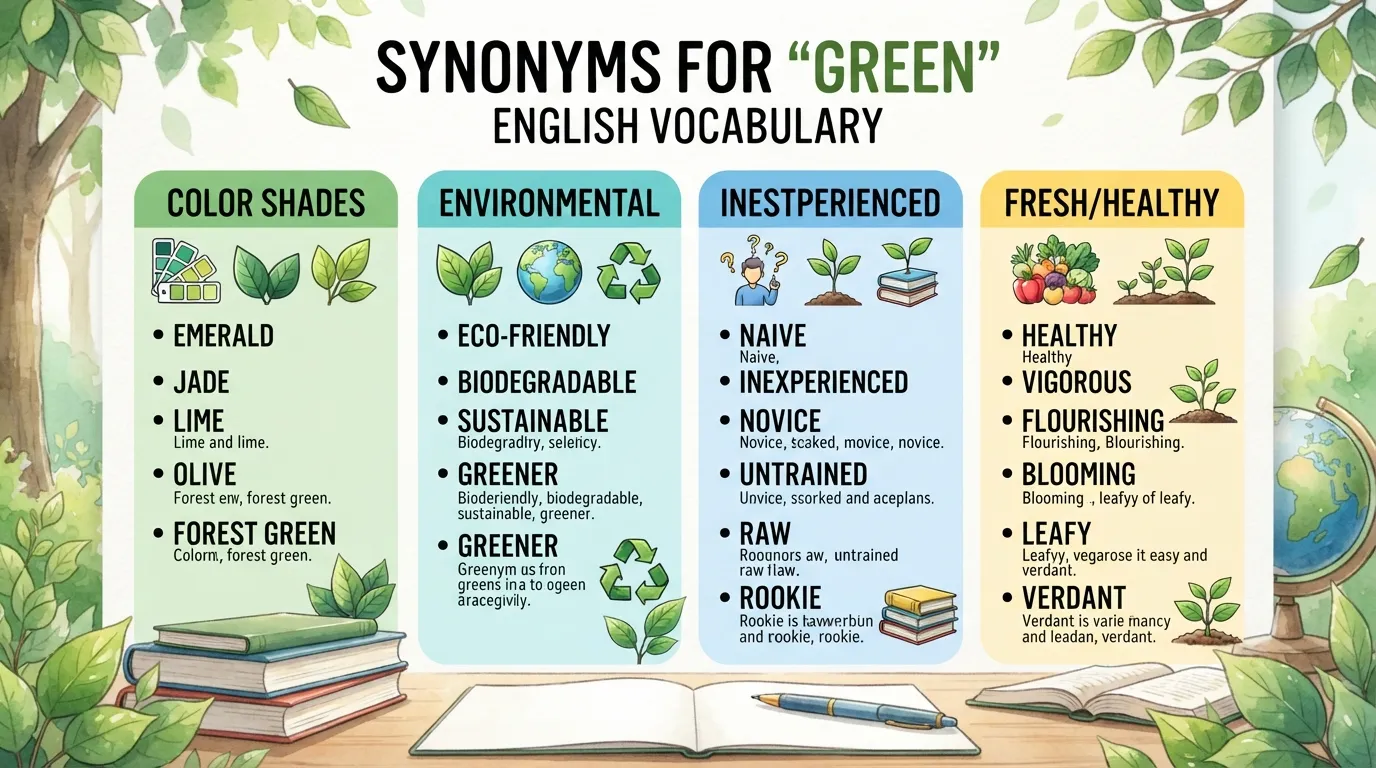
Green means having the color of grass or leaves, but it can also describe nature, freshness, growth, or a person with little experience. Imagine walking through a park after rain. The fresh green grass, trees, and leaves make the place look alive. Learning synonyms of green helps English learners use more exact and interesting words instead of repeating the same word. It also helps content writers create clearer and richer sentences. In this article, we will explore the meaning of green and 30 useful synonyms with simple examples. By the end, you will know which word fits different situations best.
Meaning of Green
Definition
Green (adjective, noun, verb): A color between blue and yellow, often linked with plants, nature, freshness, and growth.
Examples
- The green leaves looked bright after the rain.
- She wore a beautiful green dress to the party.
Connotative Meaning
Connotation (the feelings or ideas that a word suggests beyond its basic meaning) can change depending on context.
- Positive tone: Freshness, nature, health, growth, peace, and renewal.
- Negative tone: Jealousy, inexperience, or lack of skill in some contexts.
- Neutral tone: Simply describing the color or something related to vegetation.
Etymology
- Source: Old English grēne.
- Original meaning: The word referred to the color of growing plants and grass.
- It is related to the idea of growing and being fresh or young.
Short History
- Old English (450–1100): Grēne was used for the color of living plants and growing grass.
- Middle English (1100–1500): The spelling developed into forms such as grene and remained strongly connected with vegetation.
- Modern English (1500–Present): Green gained many wider meanings, including environmental ideas, youth, inexperience, and jealousy.
Pronunciation (US & UK – IPA)
US: /ɡriːn/ UK: /ɡriːn/
Syllables
green
Affixation Pattern of Green
- Root: green
- Prefix: None
- Suffix: None
- Basic word: green
- Grammatical categories: adjective, noun, and verb
Read more about:https://synonymhunting.com/synonyms-of-sustainable-2/
Synonyms of Green
1. Verdant (Adjective) — US /ˈvɝːdənt/ | UK /ˈvɜːdənt/
Meaning: Covered with healthy green plants or vegetation.
Examples:
- The valley was verdant after the spring rains.
- We walked through a verdant forest.
2. Leafy (Adjective) — US /ˈliːfi/ | UK /ˈliːfi/
Meaning: Full of leaves or trees.
Examples:
- They live on a quiet, leafy street.
- The garden has many leafy plants.
3. Lush (Adjective) — US /lʌʃ/ | UK /lʌʃ/
Meaning: Growing thickly and looking healthy and rich.
Examples:
- The hotel has a lush tropical garden.
- Rain made the fields lush and bright.
4. Grassy (Adjective) — US /ˈɡrəsi/ | UK /ˈɡrɑːsi/
Meaning: Covered with or made of grass.
Examples:
- Children played on the grassy field.
- We found a grassy area for our picnic.
5. Emerald (Adjective) — US /ˈemərəld/ | UK /ˈemərəld/
Meaning: Having a rich, bright green color like an emerald.
Examples:
- The lake was surrounded by emerald hills.
- She admired the bird’s emerald feathers.
6. Jade (Adjective) — US /dʒeɪd/ | UK /dʒeɪd/
Meaning: Having a green color similar to the gemstone jade.
Examples:
- The walls were painted jade.
- He bought a jade scarf.
7. Olive (Adjective) — US /ˈɑːlɪv/ | UK /ˈɒlɪv/
Meaning: Having a dull yellowish-green color.
Examples:
- He wore an olive jacket.
- The designer chose an olive shade for the room.
8. Mossy (Adjective) — US /ˈmɔːsi/ | UK /ˈmɒsi/
Meaning: Covered with or resembling moss.
Examples:
- We crossed an old mossy bridge.
- The stones had a soft, mossy surface.
9. Viridescent (Adjective) — US /ˌvɪrəˈdesənt/ | UK /ˌvɪrɪˈdesənt/
Meaning: Becoming green or having a fresh green color.
Examples:
- Viridescent leaves appeared in early spring.
- The garden looked viridescent in the morning light.
10. Chlorophyllous (Adjective) — US /ˌklɔːrəˈfɪləs/ | UK /ˌklɒrəˈfɪləs/
Meaning: Containing or relating to chlorophyll and green plant tissue.
Examples:
- The plant has chlorophyllous leaves.
- Scientists studied the chlorophyllous tissue.
11. Botanical (Adjective) — US /bəˈtænɪkəl/ | UK /bəˈtænɪkəl/
Meaning: Related to plants or plant life.
Examples:
- The garden has great botanical value.
- She enjoys studying botanical species.
12. Vegetative (Adjective) — US /ˈvedʒətətɪv/ | UK /ˈvedʒətətɪv/
Meaning: Related to plant growth or vegetation.
Examples:
- The plant is in its vegetative stage.
- Good soil supports vegetative growth.
13. Natural (Adjective) — US /ˈnætʃərəl/ | UK /ˈnætʃərəl/
Meaning: Existing in nature rather than being artificial.
Examples:
- The park has a natural beauty.
- We prefer natural green spaces.
14. Eco-friendly (Adjective) — US /ˌiːkoʊ ˈfrendli/ | UK /ˌiːkəʊ ˈfrendli/
Meaning: Designed to cause little harm to the environment.
Examples:
- They use eco-friendly cleaning products.
- The company sells eco-friendly packaging.
15. Sustainable (Adjective) — US /səˈsteɪnəbəl/ | UK /səˈsteɪnəbəl/
Meaning: Able to continue without seriously harming the environment or using up resources.
Examples:
- The city supports sustainable farming.
- We need more sustainable energy sources.
16. Environmental (Adjective) — US /ɪnˌvaɪrənˈmentəl/ | UK /ɪnˌvaɪərənˈmentəl/
Meaning: Related to the natural world and its protection.
Examples:
- The group works on environmental projects.
- Schools should teach environmental awareness.
17. Fresh (Adjective) — US /freʃ/ | UK /freʃ/
Meaning: New, clean, or full of natural energy.
Examples:
- The garden looked fresh after the rain.
- We bought fresh vegetables from the market.
18. Growing (Adjective) — US /ˈɡroʊɪŋ/ | UK /ˈɡrəʊɪŋ/
Meaning: Developing or increasing in size, strength, or amount.
Examples:
- The growing plants need more sunlight.
- The company has a growing interest in green technology.
19. Young (Adjective) — US /jʌŋ/ | UK /jʌŋ/
Meaning: New or not fully developed; sometimes used for inexperienced people.
Examples:
- The young plants need careful attention.
- He is still young in his career.
20. Inexperienced (Adjective) — US /ˌɪnɪkˈspɪriənst/ | UK /ˌɪnɪkˈspɪəriənst/
Meaning: Lacking experience or practical knowledge.
Examples:
- The inexperienced worker needed help.
- She was inexperienced but eager to learn.
21. Unseasoned (Adjective) — US /ʌnˈsiːzənd/ | UK /ʌnˈsiːzənd/
Meaning: Lacking experience or training.
Examples:
- The unseasoned player made several mistakes.
- An unseasoned worker may need extra guidance.
22. Novice (Noun) — US /ˈnɑːvɪs/ | UK /ˈnəʊvɪs/
Meaning: A person who is new to an activity or skill.
Examples:
- As a novice, he practiced every day.
- The course is suitable for novices.
23. Naive (Adjective) — US /naɪˈiːv/ | UK /naɪˈiːv/
Meaning: Lacking experience or showing too much trust.
Examples:
- It was naive to believe every online offer.
- His naive approach caused problems.
24. Jealous (Adjective) — US /ˈdʒeləs/ | UK /ˈdʒeləs/
Meaning: Feeling unhappy because someone has something you want.
Examples:
- She felt jealous of her friend’s success.
- He became jealous when his brother received praise.
25. Envious (Adjective) — US /ˈenviəs/ | UK /ˈenviəs/
Meaning: Wanting something that another person has.
Examples:
- He was envious of her new car.
- She felt envious of their peaceful lifestyle.
26. Verdure (Noun) — US /ˈvɝːdʒər/ | UK /ˈvɜːdʒə/
Meaning: Green vegetation, especially when it looks fresh and rich.
Examples:
- The hills were covered in beautiful verdure.
- Spring brought fresh verdure to the valley.
27. Greenery (Noun) — US /ˈɡriːnəri/ | UK /ˈɡriːnəri/
Meaning: Green plants, leaves, and vegetation.
Examples:
- The office is filled with greenery.
- We added more greenery to the garden.
28. Viridity (Noun) — US /vəˈrɪdəti/ | UK /vɪˈrɪdəti/
Meaning: The quality or condition of being green or fresh.
Examples:
- The viridity of the forest was striking.
- Spring is known for the viridity of new leaves.
29. Greenish (Adjective) — US /ˈɡriːnɪʃ/ | UK /ˈɡriːnɪʃ/
Meaning: Slightly green in color.
Examples:
- The water had a greenish color.
- He noticed a greenish light in the distance.
30. Verdant (Adjective) — US /ˈvɝːdənt/ | UK /ˈvɜːdənt/
Meaning: Richly green because of healthy plants or vegetation.
Examples:
- The mountains looked verdant in spring.
- A verdant landscape surrounded the village.
Prototype Meaning
The most typical meaning of green is the color we see in grass, leaves, and many plants. When people hear the word, they usually imagine a fresh green leaf, a grassy field, or a tree in spring.
Prototype Categorization
- Color and shades: emerald, jade, olive, mossy, greenish, chartreuse.
- Plants and vegetation: verdant, leafy, lush, grassy, greenery, verdure, viridescent.
- Nature and biology: botanical, vegetative, chlorophyllous, natural.
- Environment: eco-friendly, sustainable, environmental.
- Freshness and growth: fresh, growing, young.
- Lack of experience: inexperienced, unseasoned, novice, naive.
- Emotional meanings: jealous, envious.
Antonyms of Green
Depending on the meaning, possible antonyms include:
- Red — the opposite color in some color contexts.
- Dry — opposite of fresh or lush vegetation.
- Dead — opposite of living green plants.
- Mature — opposite of young or inexperienced.
- Experienced — opposite of green when it means inexperienced.
- Artificial — opposite of natural in some contexts.
- Unfriendly to the environment — opposite of eco-friendly or sustainable.
Short Questions and Answers
- What does green mean? Green is a color commonly seen in grass and leaves. It can also relate to nature, growth, the environment, or inexperience.
- When should green be used? Use green when you want to describe the color, vegetation, environmental ideas, or someone with little experience.
- Is green positive or negative? It depends on the context. It can suggest nature and freshness, but it can also suggest jealousy or inexperience.
- How is green different from similar words? Green is a broad word. Emerald describes a rich green color, verdant describes green vegetation, sustainable relates to environmental practices, and inexperienced describes a person who lacks experience.
Conclusion
Learning green and its synonyms can make your English more accurate and interesting. Instead of using the same word in every sentence, you can choose a word that gives a clearer picture. Words such as emerald, lush, and verdant are useful for nature and color. Words such as sustainable, eco-friendly, and environmental work well when discussing the planet. Other words, such as novice and inexperienced, show how green can have a different meaning when it describes a person. Understanding pronunciation, tone, history, grammar, and meaning also helps you use these words correctly. Try learning two or three new synonyms each day. Use them in your own sentences, conversations, and writing. With regular practice, your vocabulary and English confidence will grow.

I’m Zahid Abbas, an educator, researcher, and digital publishing strategist with a passion for linguistics, grammar, and clear communication. As a content creator and SEO specialist, I craft research-driven, reader-focused content that empowers learners and makes knowledge accessible worldwide.










