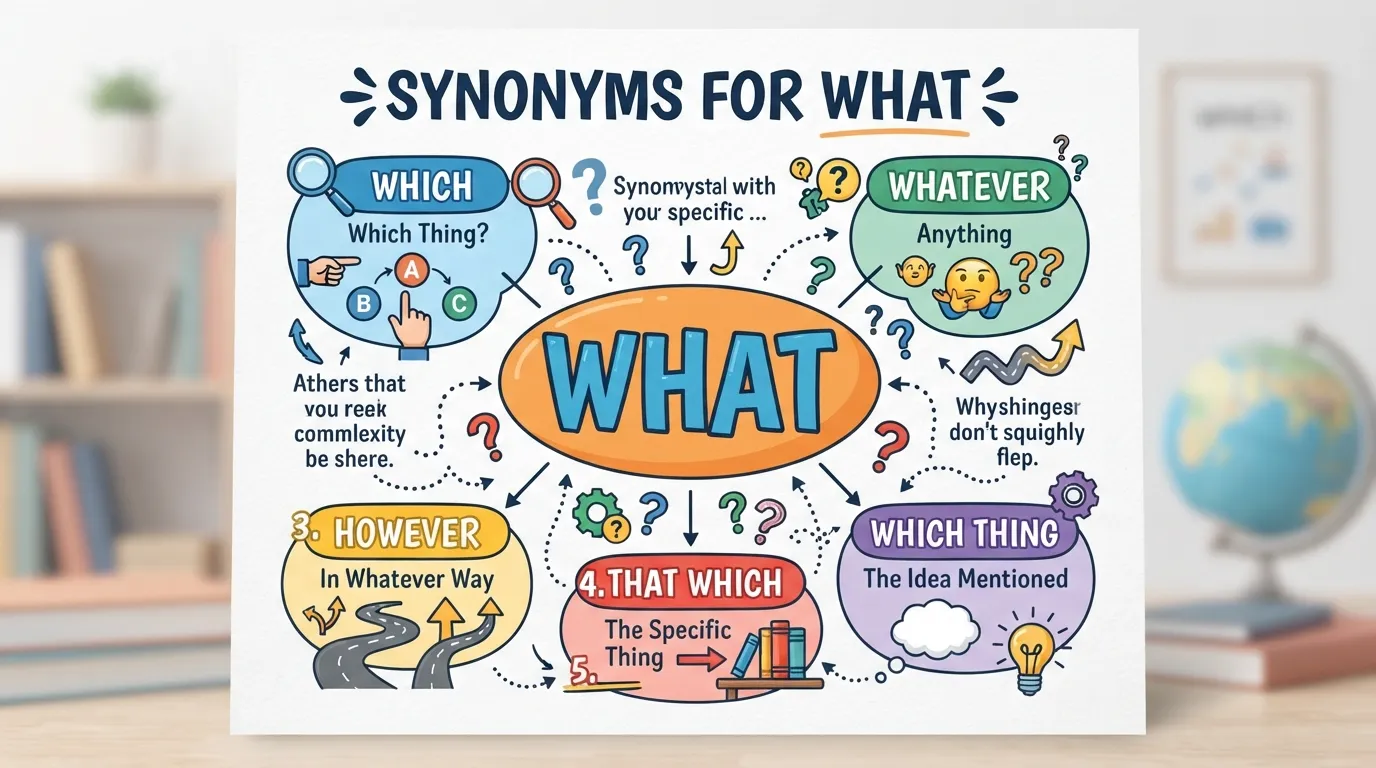
What is a common English question word used to ask about a thing, fact, choice, action, or information. For example, if a friend asks, “What do you want for lunch?” you may answer, “I want a sandwich.” We use what every day because it helps us ask questions and get clear information. For content writers, learning related words can also improve sentence variety and style. However, many alternatives to what do not work in every sentence. This article explains the meaning of what, its synonyms and related expressions, their examples, pronunciation, grammar, history, tone, and semantic categories.
Meaning of What
Definition
What (pronoun, determiner, adjective, exclamation): A word used to ask about a thing, information, identity, choice, or type, or to show surprise or emphasis.
Examples
- What is your name?
- What book are you reading?
Connotative Meaning
Connotation (the feeling or idea that a word suggests beyond its basic meaning):
- Positive tone: “What an amazing idea!” can express admiration or excitement.
- Negative tone: “What a terrible mistake!” can express shock or criticism.
- Neutral tone: “What time is the meeting?” simply asks for information.
Etymology
- Source: Old English
- Old English form: hwæt
- Original meaning: “what,” “which,” or “of what kind”
- It is related to similar question words in other Germanic languages.
Short History
- Old English (450–1100): The word appeared as hwæt and was used to ask about things, facts, or identity.
- Middle English (1100–1500): Its form gradually changed through sound and spelling changes, becoming forms such as what.
- Modern English (1500–Present): What became the standard modern spelling and remains one of the most common question words in English.
Read more about:https://synonymhunting.com/synonyms-for-ran/
Pronunciation (US & UK – IPA)
- US: /wʌt/
- UK: /wɒt/
Syllables
what
Affixation Pattern of What
- Root: what
- Prefix: None
- Suffix: None
Word formation: The basic word what does not normally take prefixes or suffixes. However, English forms related expressions and compounds from it, such as whatever, whatsoever, whatnot, and whatsoever. These can function as pronouns, determiners, adverbs, or parts of fixed expressions depending on their use.
Synonyms of What
1. Which (Pronoun/Determiner) — US /wɪtʃ/ | UK /wɪtʃ/
Meaning: Used to ask someone to choose or identify one person or thing from a group.
Examples:
- Which book do you want?
- Which color do you prefer?
2. Whatever (Pronoun/Determiner) — US /wətˈɛvər/ | UK /wɒtˈɛvə/
Meaning: Refers to any thing or choice without a specific limit.
Examples:
- Choose whatever you like.
- Take whatever you need.
3. Anything (Pronoun) — US /ˈɛniˌθɪŋ/ | UK /ˈeniˌθɪŋ/
Meaning: Refers to any possible thing.
Examples:
- Is there anything you need?
- Did you hear anything unusual?
4. Something (Pronoun) — US /ˈsʌmθɪŋ/ | UK /ˈsʌmθɪŋ/
Meaning: Refers to an unspecified thing.
Examples:
- I want something to eat.
- She said something interesting.
5. Anything at All (Phrase) — US /ˈɛniθɪŋ ət ɔl/ | UK /ˈeniθɪŋ ət ɔːl/
Meaning: Refers to any possible thing, often with emphasis.
Examples:
- Do you need anything at all?
- Is there anything at all I can do?
6. Whatever Thing (Phrase) — US /wətˈɛvər θɪŋ/ | UK /wɒtˈevə θɪŋ/
Meaning: Refers to any thing without naming it.
Examples:
- Take whatever thing you need.
- Choose whatever thing seems useful.
7. That Which (Phrase) — US /ðæt wɪtʃ/ | UK /ðæt wɪtʃ/
Meaning: A formal expression meaning the thing that.
Examples:
- We should protect that which matters.
- He explained that which he had learned.
8. The Thing That (Phrase) — US /ðə θɪŋ ðæt/ | UK /ðə θɪŋ ðæt/
Meaning: Refers to a particular thing or idea.
Examples:
- Tell me the thing that you saw.
- I remember the thing that surprised me.
9. The Thing (Noun Phrase) — US /ðə θɪŋ/ | UK /ðə θɪŋ/
Meaning: Refers to an unspecified or already understood object, matter, or idea.
Examples:
- The thing is that we are late.
- I forgot the thing you asked for.
10. Matter (Noun) — US /ˈmætər/ | UK /ˈmætə/
Meaning: A subject, issue, or situation being discussed.
Examples:
- What is the matter?
- We need to discuss this matter.
11. Issue (Noun) — US /ˈɪʃuː/ | UK /ˈɪʃuː/
Meaning: A subject, problem, or topic that needs attention.
Examples:
- What is the main issue?
- We discussed the issue yesterday.
12. Subject (Noun) — US /ˈsʌbdʒɪkt/ | UK /ˈsʌbdʒɪkt/
Meaning: A topic or area being talked about or studied.
Examples:
- What is the subject of the meeting?
- English is my favorite subject.
13. Topic (Noun) — US /ˈtɑːpɪk/ | UK /ˈtɒpɪk/
Meaning: The main idea or subject being discussed.
Examples:
- What is today’s topic?
- The teacher introduced a new topic.
14. Question (Noun) — US /ˈkwɛstʃən/ | UK /ˈkwestʃən/
Meaning: Something asked to get information or an answer.
Examples:
- What is your question?
- I have a question about the lesson.
15. Information (Noun) — US /ˌɪnfərˈmeɪʃən/ | UK /ˌɪnfəˈmeɪʃən/
Meaning: Facts or details about something.
Examples:
- What information do you need?
- Please give me more information.
16. Detail (Noun) — US /ˈdiːteɪl/ | UK /ˈdiːteɪl/
Meaning: A small piece of information about something.
Examples:
- What details do you remember?
- She gave us every detail.
17. Fact (Noun) — US /fækt/ | UK /fækt/
Meaning: A piece of information that is known or proven to be true.
Examples:
- What is the fact behind the story?
- We need to check every fact.
18. Identity (Noun) — US /aɪˈdɛntəti/ | UK /aɪˈdentəti/
Meaning: The name or characteristics that show who someone or something is.
Examples:
- What is his identity?
- The police confirmed the person’s identity.
19. Kind (Noun) — US /kaɪnd/ | UK /kaɪnd/
Meaning: A type or category of person or thing.
Examples:
- What kind of music do you like?
- What kind of food is this?
20. Type (Noun) — US /taɪp/ | UK /taɪp/
Meaning: A particular group or category of things.
Examples:
- What type of car do you drive?
- What type of exercise do you enjoy?
21. Sort (Noun) — US /sɔːrt/ | UK /sɔːt/
Meaning: A particular kind or type.
Examples:
- What sort of book is it?
- What sort of person is he?
22. Choice (Noun) — US /tʃɔɪs/ | UK /tʃɔɪs/
Meaning: An act or possibility of choosing between things.
Examples:
- What is your choice?
- We need to make a choice.
23. Option (Noun) — US /ˈɑːpʃən/ | UK /ˈɒpʃən/
Meaning: One possible choice.
Examples:
- What option do you prefer?
- We have three options.
24. Reason (Noun) — US /ˈriːzən/ | UK /ˈriːzən/
Meaning: A cause or explanation for something.
Examples:
- What is the reason for the delay?
- Tell me the reason you left.
25. Cause (Noun) — US /kɔːz/ | UK /kɔːz/
Meaning: The person, thing, or event that makes something happen.
Examples:
- What was the cause of the problem?
- Scientists studied the cause of the change.
26. Purpose (Noun) — US /ˈpɜːrpəs/ | UK /ˈpɜːpəs/
Meaning: The reason why something exists or is done.
Examples:
- What is the purpose of this tool?
- We asked about the purpose of the meeting.
27. Explanation (Noun) — US /ˌɛkspləˈneɪʃən/ | UK /ˌekspləˈneɪʃən/
Meaning: Information that makes something clear or understandable.
Examples:
- What is your explanation?
- The teacher gave a simple explanation.
28. Meaning (Noun) — US /ˈmiːnɪŋ/ | UK /ˈmiːnɪŋ/
Meaning: The idea or message that a word, phrase, or action expresses.
Examples:
- What is the meaning of this word?
- I do not understand its meaning.
29. Content (Noun) — US /ˈkɑːntent/ | UK /ˈkɒntent/
Meaning: The information or ideas contained in something.
Examples:
- What is the content of the article?
- The teacher checked the content carefully.
30. Whatever Is Relevant (Phrase) — US /wətˈɛvər ɪz ˈrɛləvənt/ | UK /wɒtˈevə ɪz ˈreləvənt/
Meaning: Any information, thing, or point that is connected to the situation.
Examples:
- Bring whatever is relevant to the meeting.
- Include whatever is relevant to the topic.
Prototype Meaning
The most typical meaning of what is a question about a thing, fact, identity, or piece of information. When people hear what, they usually imagine someone asking for an answer or asking someone to identify something. For example, “What is that?” asks the listener to identify a thing, while “What happened?” asks for information about an event.
Prototype Categorization
The related words and expressions can be grouped into useful categories:
- Choice and selection: which, option, choice, type, kind, sort.
- Unknown things: something, anything, whatever, whatever thing.
- Information: information, detail, fact, explanation, meaning.
- Topics and issues: subject, topic, matter, issue, content.
- Causes and reasons: reason, cause, purpose.
- Identity and description: identity, kind, type, the thing that.
- Formal expressions: that which, whatever is relevant.
This categorization helps writers choose the best alternative for a specific meaning. Instead of replacing what randomly, writers can first decide whether they mean a choice, fact, topic, reason, type, or unknown thing.
Antonyms of What
What does not have a direct antonym because it is mainly an interrogative word. However, several expressions can communicate the opposite idea of asking for unknown information:
- Known
- Certain
- Specific
- Identified
- That
- This
- The known thing
- A definite answer
These are contextual opposites rather than true dictionary antonyms.
Short Questions and Answers
- What does what mean? What is used to ask about a thing, fact, information, choice, identity, or type.
- When should what be used? Use what when you want information about something that is not known or has not been identified.
- Is what positive or negative? What is neutral. Its tone depends on the words and situation around it.
- How is what different from similar words? What is a question word. Words such as which, whatever, anything, kind, type, reason, and meaning express related ideas but cannot replace what in every sentence.
Conclusion
Learning what and its related words can improve both everyday English and formal writing. The word what is simple, but it has many uses. It can ask about things, information, choices, identity, types, reasons, and ideas. Learning related expressions such as which, whatever, anything, kind, type, subject, topic, reason, purpose, and meaning helps you understand these different uses. It also helps writers avoid repeating the same sentence pattern. Practice by writing a few questions each day and looking for different ways to express the same idea. Over time, this simple habit can strengthen vocabulary, speaking, reading, and writing skills.

I’m Zahid Abbas, an educator, researcher, and digital publishing strategist with a passion for linguistics, grammar, and clear communication. As a content creator and SEO specialist, I craft research-driven, reader-focused content that empowers learners and makes knowledge accessible worldwide.










