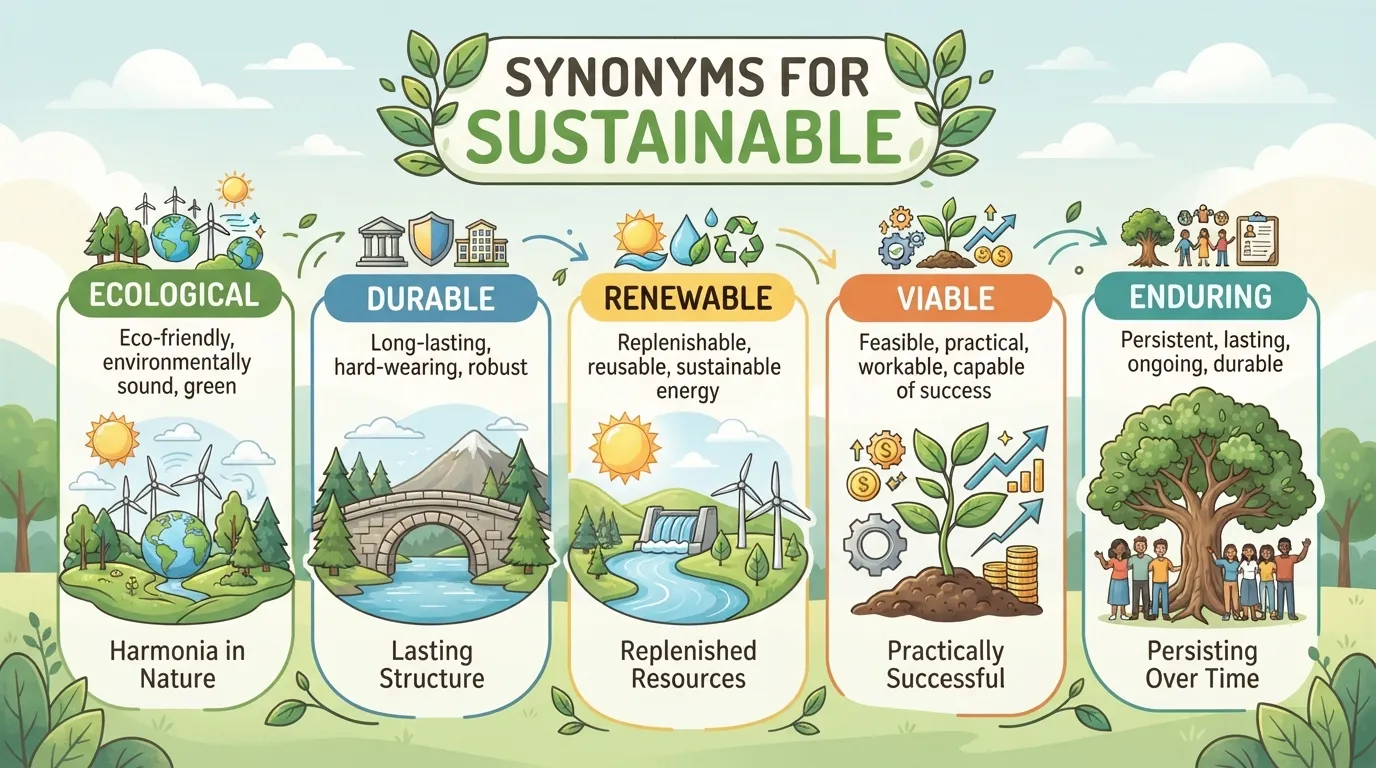
Sustainable means able to continue for a long time without causing serious harm or using up resources. Imagine a family that saves water, uses solar energy, and grows vegetables at home. These choices can be called sustainable because they help meet today’s needs while protecting resources for the future.
Learning synonyms is useful for English learners because it helps them express the same idea in different ways. It is also valuable for students, bloggers, and content writers who want clear and varied writing.
These details will help you choose the right word for each situation.
Read more about:https://synonymhunting.com/synonyms-for-variety/
Meaning of Sustainable
Definition
Sustainable (adjective): able to continue for a long time without damaging the environment, using too many resources, or creating serious problems.
Examples
- Solar power is a sustainable source of energy.
- We need a sustainable plan for managing water.
Connotative Meaning
Connotation (the feelings or ideas that a word suggests beyond its basic meaning):
- Positive tone: Often suggests responsibility, balance, care, progress, and long-term thinking.
- Negative tone: It can sound negative when used to describe a plan that is not sustainable or cannot continue.
Etymology
- Origin: Sustainable comes through Middle English and Anglo-French/Old French forms related to Latin sustinere.
- Latin root: sustinere means “to hold up,” “support,” or “maintain.”
- The modern sense developed toward the idea of supporting something so that it can continue.
- The environmental meaning became especially important in modern discussions about conservation and development.
Short History of the Keyword
- Old English (450–1100): The modern word sustainable was not part of Old English vocabulary. Related ideas were expressed through words meaning to support, hold, keep, or maintain.
- Middle English (1100–1500): French and Latin influence brought forms related to sustain into English. The basic idea was connected with supporting or maintaining something.
- Modern English (1500–Present): Sustain and sustainable developed broader meanings. In modern English, sustainable is strongly linked with environmental protection, responsible resource use, business, and long-term development.
Pronunciation (US & UK – IPA)
- US: /səˈsteɪnəbəl/
- UK: /səˈsteɪnəbəl/
Syllables
sus-tain-a-ble
Affixation Pattern of Sustainable
- Root: sustain
- Prefix: None
- Suffix: -able
- Word formation: sustain → sustainable
The suffix -able means “capable of” or “able to be.” Therefore, sustainable carries the idea of something that can be sustained or continued.
Related grammatical forms include:
- Sustain — verb
- Sustained — adjective/past participle
- Sustainable — adjective
- Sustainably — adverb
- Sustainability — noun
- Sustainer — noun
Synonyms of Sustainable
1. Durable (Adjective) — US /ˈdʊrəbəl/ | UK /ˈdjʊərəbəl/
Meaning: Able to last for a long time without breaking or failing.
Examples:
- We bought a durable table for the classroom.
- These shoes are strong and durable.
2. Long-lasting (Adjective) — US /ˌlɔːŋ ˈlæstɪŋ/ | UK /ˌlɒŋ ˈlɑːstɪŋ/
Meaning: Continuing to work or exist for a long time.
Examples:
- This battery provides long-lasting power.
- We need a long-lasting solution to the problem.
3. Viable (Adjective) — US /ˈvaɪəbəl/ | UK /ˈvaɪəbəl/
Meaning: Able to work successfully and continue over time.
Examples:
- Solar energy is a viable option for many homes.
- The company needs a viable business plan.
4. Maintainable (Adjective) — US /meɪnˈteɪnəbəl/ | UK /meɪnˈteɪnəbəl/
Meaning: Able to be kept in good condition or continued without too much difficulty.
Examples:
- The garden has a simple and maintainable design.
- We need a maintainable system for the school.
5. Renewable (Adjective) — US /rɪˈnuːəbəl/ | UK /rɪˈnjuːəbəl/
Meaning: Able to be naturally replaced after being used.
Examples:
- Wind is a renewable source of energy.
- The country is investing in renewable resources.
6. Reusable (Adjective) — US /riːˈjuːzəbəl/ | UK /riːˈjuːzəbəl/
Meaning: Able to be used again instead of being thrown away.
Examples:
- I carry a reusable water bottle.
- Reusable bags can reduce plastic waste.
7. Eco-friendly (Adjective) — US /ˌiːkoʊ ˈfrendli/ | UK /ˌiːkəʊ ˈfrendli/
Meaning: Causing little or no harm to the environment.
Examples:
- We chose eco-friendly cleaning products.
- The hotel uses eco-friendly materials.
8. Environmentally friendly (Adjective) — US /ɪnˌvaɪrənˈmentəli ˈfrendli/ | UK /ɪnˌvaɪərənˈmentəli ˈfrendli/
Meaning: Designed to reduce harm to the natural environment.
Examples:
- The company produces environmentally friendly packaging.
- Public transport can be more environmentally friendly than private cars.
9. Green (Adjective) — US /ɡriːn/ | UK /ɡriːn/
Meaning: Related to protecting the environment and reducing environmental harm.
Examples:
- The city is building more green transport systems.
- They developed a green energy project.
10. Conservation-minded (Adjective) — US /ˌkɑːnsərˈveɪʃən ˈmaɪndɪd/ | UK /ˌkɒnsəˈveɪʃən ˈmaɪndɪd/
Meaning: Focused on protecting natural resources and avoiding waste.
Examples:
- The community is becoming more conservation-minded.
- A conservation-minded farmer carefully manages water.
11. Responsible (Adjective) — US /rɪˈspɑːnsəbəl/ | UK /rɪˈspɒnsəbəl/
Meaning: Showing careful and sensible use of resources or power.
Examples:
- The company promotes responsible use of water.
- We should make responsible choices about energy.
12. Balanced (Adjective) — US /ˈbælənst/ | UK /ˈbæləntst/
Meaning: Keeping different needs or factors in a suitable proportion.
Examples:
- The project needs a balanced approach.
- We need a balanced plan for economic and environmental needs.
13. Enduring (Adjective) — US /ɪnˈdʊrɪŋ/ | UK /ɪnˈdjʊərɪŋ/
Meaning: Continuing for a very long time.
Examples:
- They built an enduring relationship with the community.
- The project created enduring benefits.
14. Perennial (Adjective) — US /pəˈreniəl/ | UK /pəˈreniəl/
Meaning: Continuing or returning for a long period.
Examples:
- Water is a perennial concern in dry regions.
- The organization faces a perennial need for funding.
15. Stable (Adjective) — US /ˈsteɪbəl/ | UK /ˈsteɪbəl/
Meaning: Firm and unlikely to change or fail suddenly.
Examples:
- The business needs a stable source of income.
- Farmers need a stable supply of water.
16. Steady (Adjective) — US /ˈstedi/ | UK /ˈstedi/
Meaning: Continuing at a regular and reliable rate.
Examples:
- The company has shown steady growth.
- We need steady progress rather than quick results.
17. Resilient (Adjective) — US /rɪˈzɪliənt/ | UK /rɪˈzɪliənt/
Meaning: Able to recover and continue after difficulty or damage.
Examples:
- Farmers are developing resilient crops.
- A resilient community can recover after a disaster.
18. Self-sufficient (Adjective) — US /ˌself səˈfɪʃənt/ | UK /ˌself səˈfɪʃənt/
Meaning: Able to provide what is needed without depending heavily on others.
Examples:
- The village hopes to become self-sufficient in food.
- Solar panels can help a home become more self-sufficient.
19. Economical (Adjective) — US /ˌiːkəˈnɑːmɪkəl/ | UK /ˌiːkəˈnɒmɪkəl/
Meaning: Using money, time, energy, or resources carefully.
Examples:
- This car is economical to run.
- We need an economical way to heat the building.
20. Efficient (Adjective) — US /ɪˈfɪʃənt/ | UK /ɪˈfɪʃənt/
Meaning: Producing good results while using little waste, time, or energy.
Examples:
- The new machine is more efficient.
- Energy-efficient homes can reduce electricity use.
21. Practical (Adjective) — US /ˈpræktɪkəl/ | UK /ˈpræktɪkəl/
Meaning: Suitable for real use and likely to work well.
Examples:
- We need a practical solution to the problem.
- Solar power can be a practical choice in sunny areas.
22. Feasible (Adjective) — US /ˈfiːzəbəl/ | UK /ˈfiːzəbəl/
Meaning: Possible and realistic to achieve.
Examples:
- The team studied whether the project was feasible.
- A feasible plan must fit the available budget.
23. Permanent (Adjective) — US /ˈpɜːrmənənt/ | UK /ˈpɜːmənənt/
Meaning: Intended to last for a very long time or forever.
Examples:
- The village needs a permanent water supply.
- They are looking for a permanent solution.
24. Continuable (Adjective) — US /kənˈtɪnjuəbəl/ | UK /kənˈtɪnjuəbəl/
Meaning: Able to continue without stopping.
Examples:
- The program must be continuable after the first year.
- We need a continuable process for future projects.
25. Supportable (Adjective) — US /səˈpɔːrtəbəl/ | UK /səˈpɔːrtəbəl/
Meaning: Able to be maintained or supported successfully.
Examples:
- The costs must remain supportable for the community.
- The organization needs a supportable financial model.
26. Viable long-term (Adjective phrase) — US /ˈvaɪəbəl ˌlɔːŋ ˈtɜːrm/ | UK /ˈvaɪəbəl ˌlɒŋ ˈtɜːm/
Meaning: Able to work successfully for a long period.
Examples:
- The plan must be viable long-term.
- We are searching for a viable long-term energy solution.
27. Future-proof (Adjective) — US /ˈfjuːtʃər pruːf/ | UK /ˈfjuːtʃə pruːf/
Meaning: Designed to remain useful despite future changes.
Examples:
- The company wants a future-proof technology system.
- Good planning can create a more future-proof business.
28. Regenerative (Adjective) — US /rɪˈdʒenərətɪv/ | UK /rɪˈdʒenərətɪv/
Meaning: Helping restore or renew natural systems or resources.
Examples:
- Regenerative farming can improve soil health.
- The farmer uses regenerative agricultural methods.
29. Restorative (Adjective) — US /rɪˈstɔːrətɪv/ | UK /rɪˈstɒrətɪv/
Meaning: Helping repair, renew, or bring something back to a healthy condition.
Examples:
- The project uses restorative methods to improve damaged land.
- The forest needs restorative action after years of pollution.
30. Conservative (Adjective) — US /kənˈsɜːrvətɪv/ | UK /kənˈsɜːvətɪv/
Meaning: Careful about using resources and avoiding unnecessary waste.
Examples:
- The farmer follows a conservative approach to water use.
- A conservative use of resources can reduce waste.
Prototype Meaning
The most typical meaning of sustainable is something that can continue for a long time without exhausting resources or causing serious harm. When people hear the word, they often think of environmental protection, renewable energy.
Prototype Categorization
- Environmental synonyms: eco-friendly, green, environmentally friendly, renewable, regenerative, restorative
- Long-term synonyms: durable, long-lasting, enduring, perennial, permanent
- Business and planning synonyms: viable, feasible, practical, stable, future-proof
- Resource-use synonyms: economical, efficient, reusable, conservative, responsible
- Resilience and continuity synonyms: resilient, steady, continuable, maintainable, self-sufficient
- Balance-focused synonyms: balanced, supportable, conservation-minded
Categorizing synonyms helps writers select words based on context. For example, renewable is especially useful for energy and resources, while viable works well for business plans.
Antonyms of Sustainable
- Unsustainable
- Temporary
- Short-lived
- Wasteful
- Destructive
- Harmful
- Exhaustible
- Unstable
- Unviable
- Disposable
Short Questions and Answers
- What does sustainable mean? It means able to continue for a long time without causing serious harm or using resources irresponsibly.
- When should sustainable be used? Use it when discussing long-term environmental, social, economic, business, or resource-related practices.
- Is sustainable positive or negative? It usually has a positive meaning because it suggests long-term care and responsible use of resources.
- How is sustainable different from similar words? Sustainable has a broad meaning. . Viable focuses on whether something can work successfully.
Conclusion
Learning sustainable and its synonyms can make your English clearer, richer, and more flexible. Instead of repeating the same word, you can choose a synonym that matches your exact meaning. Words such as renewable, eco-friendly, viable, durable, efficient, resilient, and long-lasting are useful in different situations. Understanding their meanings, pronunciation, tone, history, and categories also helps you avoid using the wrong word. For students, ESL learners, bloggers, and content writers, this wider vocabulary can strengthen both writing and speaking. It can also make your ideas easier to understand and more interesting to read. Try learning two or three new synonyms each day. Use them in your own sentences, conversations, and writing. With regular practice, your vocabulary will grow and your confidence in English will become stronger.

I’m Zahid Abbas, an educator, researcher, and digital publishing strategist with a passion for linguistics, grammar, and clear communication. As a content creator and SEO specialist, I craft research-driven, reader-focused content that empowers learners and makes knowledge accessible worldwide.










