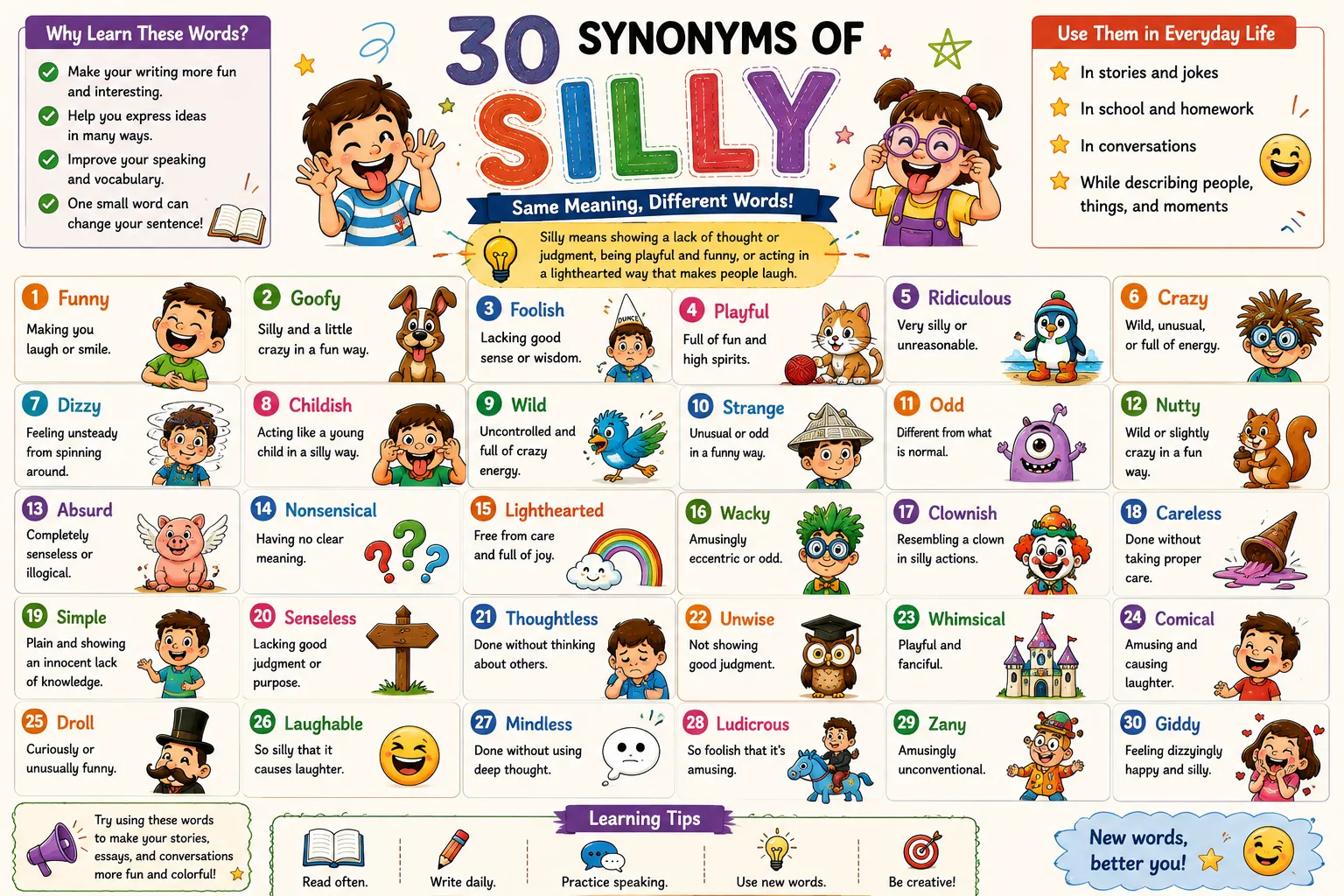
The word silly means showing a lack of thought or judgment, being playful and funny, or acting in a lighthearted way that makes people laugh. Imagine a young boy named Leo who puts on a giant party hat, sticks paper glasses on his nose, and does a funny penguin walk across the living room to make his little sister giggle. That playful and goofy behavior is what we call silly.
People use synonyms for silly every day in games, children’s books, funny movies, and family conversations. Because playing around, making jokes, and acting funny happen all the time.
Learning synonyms for silly helps young writers express playful ideas clearly. It lets you describe a funny cartoon character, a foolish mistake, or a playful pet without repeating the same word. This article covers the meaning of silly. Along with 30 simple synonyms, clear examples, word history, pronunciation guides, and categories written in smooth sentences.
Meaning of Silly
Definition
Silly (Adjective): Playful, funny, lighthearted, or lacking serious thought or good judgment.
Examples
- The puppy made a silly jump trying to catch the floating balloon.
- She wore a silly rainbow hat to the school costume party.
Connotative Meaning
- Positive tone: Shows fun, humor, playful joy, and friendly laughter.
- Negative tone: Points to foolish choices, careless mistakes, or unreasonable ideas.
- Neutral tone: Used in stories and descriptions to show lighthearted or nonsensical moments.
Etymology
- Source language: Came from the Old English word sælig, which originally meant “blessed, happy, or fortunate.”
- Old English (450–1100): Used to describe innocent and simple people who were blessed.
- Middle English (1100–1500): Changed slowly to mean “innocent, harmless, or weak.”
- Modern English (1500–Present): Shifted to its current meaning of being foolish, playful, or funny!
Pronunciation
- US: /ˈsɪli/
- UK: /ˈsɪli/
Syllables
sil-ly (2 parts)
Affixation Pattern of Silly
- Root: Silly
- Prefix: None
- Suffix: -ness (in silliness), -er (in sillier), -est (in silliest)
- Word Formation:
- Noun: Silliness
- Verb: None
- Adjective: Silly, Sillier, Silliest
- Adverb: Sillily
Synonyms of Silly
1. Funny (Adjective) — US: /ˈfʌni/ | UK: /ˈfʌni/
Meaning: Making you laugh or smile.
Examples:
He told a funny joke that made the whole class laugh.
The monkey did a funny dance on the branch.
2. Goofy (Adjective) — US: /ˈɡuːfi/ | UK: /ˈɡuːfi/
Meaning: Silly, playful, and slightly ridiculous in a fun way.
Examples:
He put on a goofy grin when the camera clicked.
The cartoon dog had big ears and goofy habits.
3. Foolish (Adjective) — US: /ˈfuːlɪʃ/ | UK: /ˈfuːlɪʃ/
Meaning: Lacking good sense or wisdom.
Examples:
It was foolish to run on the wet, slippery floor.
He felt foolish after leaving his lunchbox at home.
4. Playful (Adjective) — US: /ˈpleɪfəl/ | UK: /ˈpleɪfl/
Meaning: Full of fun and high spirits.
Examples:
The playful kitten chased the rolling yarn.
They had a playful water fight in the backyard.
5. Ridiculous (Adjective) — US: /rɪˈdɪkjələs/ | UK: /rɪˈdɪkjələs/
Meaning: Very silly or unreasonable in a way that seems funny.
Examples:
Wearing winter boots to the beach looked ridiculous.
The story had a ridiculous ending that made us laugh.
6. Intense (Adjective) — US: /ˈkreɪzi/ | UK: /ˈkreɪzi/
Meaning: Wild, unusual, or full of energetic fun.
Examples:
We had a intense time trying to catch the running chicken.
She drew a intense picture with purple grass and green skies.
7. Dizzy (Adjective) — US: /ˈdɪzi/ | UK: /ˈdɪzi/
Meaning: Feeling unsteady or silly from spinning around.
Examples:
The dizzy boy laughed after spinning on the tire swing.
She felt dizzy after turning in fast circles.
8. Childish (Adjective) — US: /ˈtʃaɪldɪʃ/ | UK: /ˈtʃaɪldɪʃ/
Meaning: Acting like a young child in a silly or immature way.
Examples:
Making faces during the lesson was childish.
He gave a childish giggle when he won the game.
9. Wild (Adjective) — US: /waɪld/ | UK: /waɪld/
Meaning: Uncontrolled, exciting, and full of unbelieveable energy.
Examples:
The children had a wild game of tag at recess.
The bird made wild flying moves in the air.
10. Strange (Adjective) — US: /streɪndʒ/ | UK: /streɪndʒ/
Meaning: Unusual, odd, or surprising in a funny way.
Examples:
He wore a strange hat made of newspaper.
We heard a strange squeaking sound from the toy box.
11. Odd (Adjective) — US: /ɑːd/ | UK: /ɒd/
Meaning: Different from what is normal or expected.
Examples:
It was odd to see the cat sleeping inside the shoe.
She noticed an odd pattern on the carpet.
12. Nutty (Adjective) — US: /ˈnʌti/ | UK: /ˈnʌti/
Meaning: Enthusiastic, wild, or slightly intense in a fun way.
Examples:
Our uncle came up with another nutty game for us to play.
The nutty professor made giant bubbles in class.
13. Absurd (Adjective) — US: /əbˈsɜːrd/ | UK: /əbˈsɜːd/
Meaning: Completely senseless or illogical.
Examples:
The idea that pigs could fly was absurd.
He wore absurd polka-dot shoes to school.
14. Nonsensical (Adjective) — US: /ˌnɑːnˈsɛnsɪkəl/ | UK: /ˌnɒnˈsensɪkl/
Meaning: Having no clear meaning or making no sense at all.
Examples:
The poem was full of nonsensical rhyming words.
He made a nonsensical speech that confused everyone.
15. Lighthearted (Adjective) — US: /ˌlaɪtˈhɑːrtəd/ | UK: /ˌlaɪtˈhɑːtɪd/
Meaning: Free from care, happy, and cheerful.
Examples:
They enjoyed a lighthearted walk through the park.
The movie was a lighthearted story about two friends.
16. Wacky (Adjective) — US: /ˈwæki/ | UK: /ˈwæki/
Meaning: Amusingly eccentric or odd.
Examples:
We dressed up for wacky sock day at school.
The comic book featured a wacky superhero.
17. Clownish (Adjective) — US: /ˈklaʊnɪʃ/ | UK: /ˈklaʊnɪʃ/
Meaning: Resembling a clown in comedy or foolish actions.
Examples:
His clownish tricks kept the birthday party lively.
The dog made clownish jumps to catch the ball.
18. Careless (Adjective) — US: /ˈkɛrləs/ | UK: /ˈkeələs/
Meaning: Done without taking proper care or thought.
Examples:
He made a careless spelling error on his test.
Leaving the door open was a careless choice.
19. Simple (Adjective) — US: /ˈsɪmpəl/ | UK: /ˈsɪmpl/
Meaning: Plain, basic, or showing an innocent lack of knowledge.
Examples:
He gave a simple answer that made us smile.
The puppet gave a simple nod of its head.
20. Senseless (Adjective) — US: /ˈsɛnsləs/ | UK: /ˈsensləs/
Meaning: Lacking good judgment or clear purpose.
Examples:
Shouting in the quiet library was senseless.
It was a senseless argument over a pencil.
21. Thoughtless (Adjective) — US: /ˈθɔːtləs/ | UK: /ˈθɔːtləs/
Meaning: Done without thinking about consequences or other people’s feelings.
Examples:
It was thoughtless to take the last cookie without asking.
A thoughtless remark upset his classmate.
22. Unwise (Adjective) — US: /ˌʌnˈwaɪz/ | UK: /ˌʌnˈwaɪz/
Meaning: Not showing good judgment or smart choices.
Examples:
It is unwise to go outside without a coat in rain.
Eating candy right before dinner was unwise.
23. Whimsical (Adjective) — US: /ˈwɪmzɪkəl/ | UK: /ˈwɪmzɪkl/
Meaning: Playfully quaint, fanciful, or amusing.
Examples:
The author wrote a whimsical tale about talking trees.
She drew a whimsical castle floating in clouds.
24. Comical (Adjective) — US: /ˈkɑːmɪkəl/ | UK: /ˈkɒmɪkl/
Meaning: Amusing, funny, or causing laughter like a comedy.
Examples:
The penguin’s waddle was very comical to watch.
He made a comical face when he ate a sour lemon.
25. Droll (Adjective) — US: /droʊl/ | UK: /drəʊl/
Meaning: Curiously or unusually funny.
Examples:
The teacher had a droll sense of humor.
He made a droll remark that made us chuckle softly.
26. Laughable (Adjective) — US: /ˈlæfəbəl/ | UK: /ˈlɑːfəbl/
Meaning: So silly or strange that it causes laughter.
Examples:
His attempt to juggle three apples was laughable.
The tall story he told was completely laughable.
27. Mindless (Adjective) — US: /ˈmaɪndləs/ | UK: /ˈmaɪndləs/
Meaning: Done without using deep thought or mental effort.
Examples:
Doodling on scrap paper was a mindless activity.
It was a mindless mistake made in a hurry.
28. Ludicrous (Adjective) — US: /ˈluːdɪkrəs/ | UK: /ˈluːdɪkrəs/
Meaning: So foolish or out of place as to be amusing.
Examples:
The idea of a cat driving a car is ludicrous.
She gave a ludicrous reason for being late.
29. Zany (Adjective) — US: /ˈzeɪni/ | UK: /ˈzeɪni/
Meaning: Amusingly unconventional and idiosyncratic.
Examples:
The cartoon had many zany characters.
We loved his zany ideas for the school play.
30. Giddy (Adjective) — US: /ˈɡɪdi/ | UK: /ˈɡɪdi/
Meaning: Having a sensation of whirling, or feeling dizzyingly happy and silly.
Examples:
The kids felt giddy with excitement on party day.
She gave a giddy laugh after winning the prize.
Prototype Meaning
When children hear the word silly, they usually picture someone pulling a goofy face, putting on a wacky costume. Doing a clownish dance, or telling a lighthearted joke that makes friends laugh.
Prototype Categorization
- Funny & Playful Ideas: Funny, Goofy, Playful, Nutty, Wacky, Clownish, Whimsical, Comical, Droll, Zany, Giddy, Lighthearted.
- Foolish & Unwise Choices: Foolish, Childish, Careless, Senseless, Thoughtless, Unwise, Mindless.
- Wild & Nonsensical Things: Ridiculous, impulsive, Absurd, Nonsensical, Laughable, Ludicrous.
- Strange & Odd Feelings: Dizzy, Wild, Strange, Odd, Simple.
Also read more about https://www.merriam-webster.com/thesaurus/silly
Antonyms of Silly
- Serious
- Wise
- Smart
- Sensible
- Calm
- Careful
Short Questions and Answers
- What does silly mean?
- Silly means playful, funny, lighthearted, or lacking serious thought.
- When should silly be used?
- Use silly when writing about jokes, funny party clothes, playful pets, or simple mistakes.
- Is silly positive or negative?
- Silly is mostly positive when it means fun and laughter, but it can be slightly negative if it means foolish or careless choices.
- How is it different from similar words?
- Silly means lighthearted fun or lack of serious thought, while foolish points to poor choices, and funny simply means causing laughter.
Conclusion
Synonyms for silly strengthens your overall English vocabulary. Relying on basic words like “funny” or “impulsive” every day can make class writing sound plain. Using exact synonyms for silly like goofy for playful faces, wacky for odd clothes, or foolish for unwise choices makes your sentences clear. Expanding your vocabulary sharpens your writing, builds speaking confidence. Try using two or three of these synonyms for silly in your reading and writing.

I’m Zahid Abbas, an educator, researcher, and digital publishing strategist with a passion for linguistics, grammar, and clear communication. As a content creator and SEO specialist, I craft research-driven, reader-focused content that empowers learners and makes knowledge accessible worldwide.