Harsh is a common English word that describes something unpleasant, severe, rough, or difficult to accept. Imagine a teacher giving very strict criticism to a student after a mistake. The student’s feelings may be hurt because the comments sound harsh. People often use this word when talking about weather, rules, words, conditions, or behavior.
Learning synonyms of harsh is important for English learners, writers, bloggers, and content creators. Using different words instead of repeating the same word makes writing more interesting and professional. It also helps speakers express ideas more accurately.
In this article, you will learn the meaning of harsh, its pronunciation, history, grammar, connotation, and 30 powerful synonyms. You will also see easy examples and useful categories that help you choose the right synonym in different situations.
Meaning of Harsh
Harsh (Adjective):
Something that is harsh is unpleasant, severe, rough, strict, or difficult to endure.
Examples
- The manager gave harsh feedback about the project.
- The desert has a harsh climate during summer.
Connotative Meaning
- Positive tone: Can suggest honesty, discipline, or toughness when necessary.
- Negative tone: Often suggests cruelty, severity, roughness, or unpleasantness.
- Neutral tone: May simply describe difficult conditions or strong sounds without emotion.
Etymology
- Origin: Old French harsch and Germanic roots.
- Original meaning: Rough, coarse, unpleasant, or severe.
Short History of the Keyword
- Old English (450–1100): Related Germanic words described rough or coarse qualities.
- Middle English (1100–1500): The word developed meanings related to roughness and severity.
- Modern English (1500–Present): Harsh became widely used for strict behavior, difficult conditions, unpleasant sounds, and severe criticism.
Pronunciation (US & UK – IPA)
- US: /hɑːrʃ/
- UK: /hɑːʃ/
Syllables
- harsh
Affixation Pattern of Harsh
- Root: harsh
- Prefix: None
- Suffix: None
Word Formation of Harsh
- Harsh (Adjective)
- Harshly (Adverb)
- Harshness (Noun)
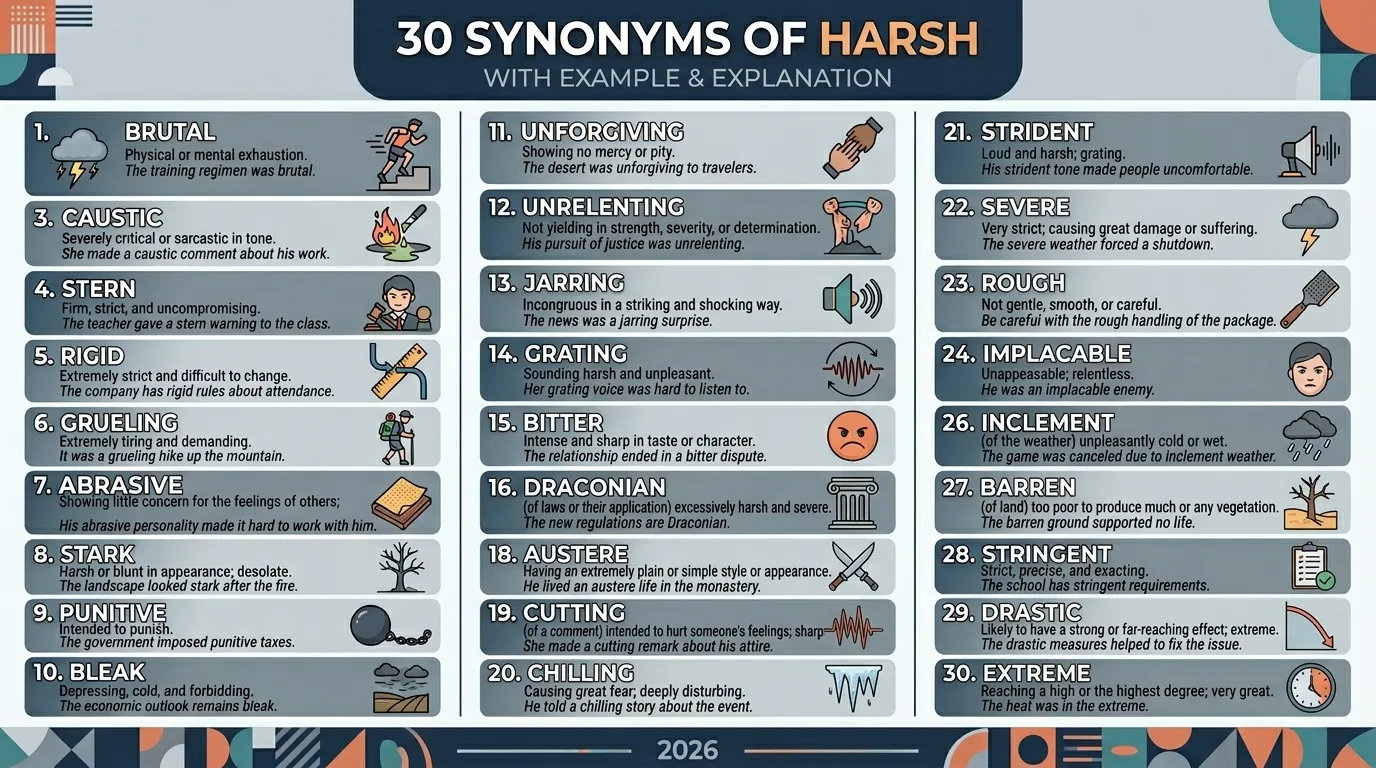
30 Synonyms of Harsh
1. Severe (Adjective)
US: /səˈvɪr/ | UK: /sɪˈvɪə/
Meaning: Very strict or serious.
Examples:
- The judge gave a severe punishment.
- Severe weather damaged many homes.
2. Strict (Adjective)
US: /strɪkt/ | UK: /strɪkt/
Meaning: Firmly enforcing rules.
Examples:
- My parents were strict about homework.
- The school has strict policies.
3. Stern (Adjective)
US: /stɜːrn/ | UK: /stɜːn/
Meaning: Serious and firm in manner.
Examples:
- The teacher gave a stern warning.
- Her stern look silenced the room.
4. Rough (Adjective)
US: /rʌf/ | UK: /rʌf/
Meaning: Not smooth or gentle.
Examples:
- The road was rough and uneven.
- He had rough hands from work.
5. Brutal (Adjective)
US: /ˈbruːtl/ | UK: /ˈbruːtəl/
Meaning: Extremely cruel or violent.
Examples:
- The soldiers faced brutal conditions.
- It was a brutal attack.
6. Cruel (Adjective)
US: /ˈkruːəl/ | UK: /ˈkruːəl/
Meaning: Causing pain intentionally.
Examples:
- The cruel remarks hurt her feelings.
- It was cruel to ignore the animal.
7. Hard (Adjective)
US: /hɑːrd/ | UK: /hɑːd/
Meaning: Difficult or tough.
Examples:
- Life was hard during that period.
- The exam was hard.
8. Tough (Adjective)
US: /tʌf/ | UK: /tʌf/
Meaning: Difficult to handle.
Examples:
- They faced a tough challenge.
- The coach was tough but fair.
9. Gruff (Adjective)
US: /ɡrʌf/ | UK: /ɡrʌf/
Meaning: Rough and unfriendly in speech.
Examples:
- His gruff voice scared the children.
- The guard gave a gruff reply.
10. Abrasive (Adjective)
US: /əˈbreɪsɪv/ | UK: /əˈbreɪsɪv/
Meaning: Harsh in behavior or speech.
Examples:
- His abrasive manner annoyed coworkers.
- She sounded abrasive during the meeting.
11. Sharp (Adjective)
US: /ʃɑːrp/ | UK: /ʃɑːp/
Meaning: Strong or cutting in tone.
Examples:
- She made a sharp comment.
- He spoke in a sharp voice.
12. Bitter (Adjective)
US: /ˈbɪtər/ | UK: /ˈbɪtə/
Meaning: Full of resentment or unpleasantness.
Examples:
- They had a bitter argument.
- He felt bitter about the decision.
13. Rigid (Adjective)
US: /ˈrɪdʒɪd/ | UK: /ˈrɪdʒɪd/
Meaning: Not flexible in thinking or rules.
Examples:
- The company has rigid regulations.
- His rigid attitude caused problems.
14. Intense (Adjective)
US: /ɪnˈtens/ | UK: /ɪnˈtens/
Meaning: Extremely strong.
Examples:
- The heat was intense.
- They felt intense pressure.
15. Ferocious (Adjective)
US: /fəˈroʊʃəs/ | UK: /fəˈrəʊʃəs/
Meaning: Fierce and violent.
Examples:
- The ferocious storm arrived suddenly.
- The animal looked ferocious.
16. Fierce (Adjective)
US: /fɪrs/ | UK: /fɪəs/
Meaning: Strong and aggressive.
Examples:
- There was fierce competition.
- A fierce wind blew all night.
17. Unkind (Adjective)
US: /ʌnˈkaɪnd/ | UK: /ʌnˈkaɪnd/
Meaning: Not kind or considerate.
Examples:
- His unkind words upset her.
- It was unkind to laugh at him.
18. Cutting (Adjective)
US: /ˈkʌtɪŋ/ | UK: /ˈkʌtɪŋ/
Meaning: Deeply hurtful.
Examples:
- She made a cutting remark.
- His cutting criticism was painful.
19. Hostile (Adjective)
US: /ˈhɑːstaɪl/ | UK: /ˈhɒstaɪl/
Meaning: Unfriendly or aggressive.
Examples:
- The crowd became hostile.
- He received a hostile response.
20. Unsympathetic (Adjective)
US: /ˌʌnsɪmpəˈθetɪk/ | UK: /ˌʌnsɪmpəˈθetɪk/
Meaning: Showing little understanding.
Examples:
- The officer seemed unsympathetic.
- She received an unsympathetic reaction.
21. Rigorous (Adjective)
US: /ˈrɪɡərəs/ | UK: /ˈrɪɡərəs/
Meaning: Very strict and careful.
Examples:
- The training was rigorous.
- Students followed a rigorous schedule.
22. Demanding (Adjective)
US: /dɪˈmændɪŋ/ | UK: /dɪˈmɑːndɪŋ/
Meaning: Requiring much effort.
Examples:
- It is a demanding job.
- The project was demanding.
23. Merciless (Adjective)
US: /ˈmɜːrsɪləs/ | UK: /ˈmɜːsɪləs/
Meaning: Showing no mercy.
Examples:
- The criticism was merciless.
- The sun was merciless all day.
24. Oppressive (Adjective)
US: /əˈpresɪv/ | UK: /əˈpresɪv/
Meaning: Uncomfortably severe.
Examples:
- The heat felt oppressive.
- They lived under oppressive rules.
25. Caustic (Adjective)
US: /ˈkɔːstɪk/ | UK: /ˈkɔːstɪk/
Meaning: Extremely critical and hurtful.
Examples:
- He made a caustic joke.
- Her caustic comments shocked everyone.
26. Unforgiving (Adjective)
US: /ˌʌnfərˈɡɪvɪŋ/ | UK: /ˌʌnfəˈɡɪvɪŋ/
Meaning: Not allowing mistakes.
Examples:
- The environment was unforgiving.
- The coach was unforgiving.
27. Exacting (Adjective)
US: /ɪɡˈzæktɪŋ/ | UK: /ɪɡˈzæktɪŋ/
Meaning: Requiring high standards.
Examples:
- She has exacting expectations.
- The work was exacting.
28. Stringent (Adjective)
US: /ˈstrɪndʒənt/ | UK: /ˈstrɪndʒənt/
Meaning: Very strict and demanding.
Examples:
- Stringent laws were introduced.
- The company follows stringent rules.
29. Acerbic (Adjective)
US: /əˈsɜːrbɪk/ | UK: /əˈsɜːbɪk/
Meaning: Sharp and critical in speech.
Examples:
- The reviewer wrote an acerbic article.
- His acerbic humor offended some people.
30. Callous (Adjective)
US: /ˈkæləs/ | UK: /ˈkæləs/
Meaning: Emotionally insensitive.
Examples:
- The callous remark hurt everyone.
- He seemed callous toward others.
Prototype Meaning
The most typical meaning of harsh is something unpleasantly severe, strict, rough, or difficult. When people hear the word, they often imagine harsh criticism, harsh weather, harsh rules, or harsh treatment that causes discomfort or emotional pain.
Prototype Categorization
- Strict Rules and Discipline: severe, strict, stern, rigorous, stringent, exacting
- Cruel Behavior: cruel, brutal, merciless, callous, hostile
- Difficult Conditions: harsh, tough, hard, demanding, oppressive, unforgiving
- Harsh Speech: abrasive, cutting, caustic, acerbic, gruff, sharp
- Strong Force or Intensity: fierce, ferocious, intense, bitter
Antonyms of Harsh
- Gentle (Adjective): Kind and soft in manner.
- Kind (Adjective): Caring and considerate.
- Mild (Adjective): Not severe or strong.
- Soft (Adjective): Pleasant and gentle.
- Compassionate (Adjective): Showing sympathy and care.
- Tender (Adjective): Gentle and loving.
- Merciful (Adjective): Showing forgiveness and kindness.
- Friendly (Adjective): Pleasant and welcoming.
- Considerate (Adjective): Thoughtful of others.
- Lenient (Adjective): Not strict or severe.
Short Questions and Answers
- What does harsh mean?
Harsh means severe, rough, strict, unpleasant, or difficult to endure. - When should harsh be used?
Use it when describing strict behavior, difficult conditions, unpleasant sounds, or strong criticism. - Is harsh positive or negative?
It is usually negative, but it can be neutral or positive when describing necessary discipline or honesty. - How is it different from similar words?
Harsh is a general word. Words like cruel focus on causing pain, while strict focuses on enforcing rules.
Conclusion
Learning the Synonyms of Harsh and Synonyms of Harsh can greatly improve your English vocabulary. Instead of repeating the same word, you can choose from many alternatives such as severe, strict, abrasive, merciless, or stringent depending on the situation. This makes your writing clearer, stronger, and more engaging. Understanding pronunciation, connotation, history, and usage also helps you communicate with confidence. Whether you are a student, writer, blogger, or English learner, expanding your vocabulary allows you to express ideas more accurately and naturally. Make vocabulary learning a daily habit, and practice using new synonyms in speaking and writing. Over time, your English skills will become richer, more fluent, and more professional.

I’m Zahid Abbas, an educator, researcher, and digital publishing strategist with a passion for linguistics, grammar, and clear communication. As a content creator and SEO specialist, I craft research-driven, reader-focused content that empowers learners and makes knowledge accessible worldwide.