The word ask means to request information, help, or something from another person. Imagine a student raising a hand in class to ask a question about homework. This simple action shows communication, curiosity, and learning. People use the word ask every day in schools, workplaces, homes, and conversations.
Because it is such a common word, writers and speakers often need synonyms to avoid repetition. Learning synonyms of ask helps English learners improve vocabulary and sound more natural. It also helps content writers choose better words for formal, polite, professional, or casual situations. In this article, you will learn the meaning of ask, its pronunciation, grammar, history, and semantic categories. You will also explore 30 useful synonyms with meanings and examples to strengthen your English writing and speaking skills.
Meaning of Ask
Definition
Ask (verb): to request information, help, permission, or an answer from someone.
Examples
- I want to ask a question.
- She decided to ask for help.
Connotative Meaning
- Positive tone: curious, polite, interested
- Negative tone: demanding, begging, bothering
- Neutral tone: requesting or questioning
Etymology
- From Old English ascian meaning “to request” or “to seek information”
- Related to old Germanic language roots
Short History of Ask
- Old English (450–1100): used as ascian for requesting or questioning
- Middle English (1100–1500): spelling changed to asken
- Modern English (1500–Present): became the common verb “ask”
Pronunciation (US & UK – IPA)
- US: /æsk/
- UK: /ɑːsk/
Syllables
- ask
Affixation Pattern of Ask
- Root: ask
- Prefix: none
- Suffix: none
Word Formation of Ask
- ask (verb)
- asking (verb/gerund)
- asked (verb)
- asker (noun)
- unasked (adjective)
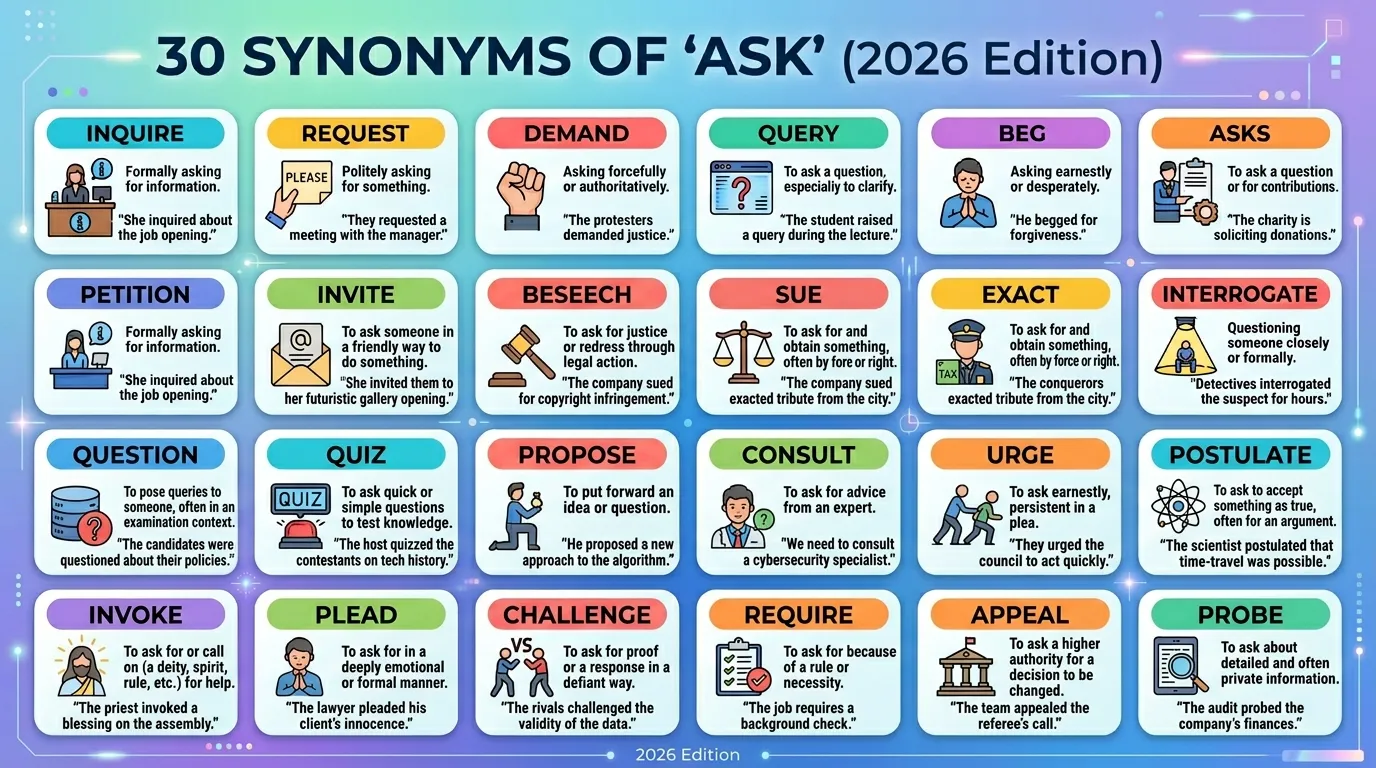
30 Synonyms of Ask
1. Question (verb)
US: /ˈkwestʃən/ | UK: /ˈkwestʃən/
Meaning: to ask something to get information
Examples:
- She will question the witness.
- Students can question the teacher.
2. Inquire (verb)
US: /ɪnˈkwaɪər/ | UK: /ɪnˈkwaɪə/
Meaning: to ask for information formally
Examples:
- I called to inquire about the job.
- He inquired about the price.
3. Request (verb)
US: /rɪˈkwest/ | UK: /rɪˈkwest/
Meaning: to politely ask for something
Examples:
- She requested more time.
- They requested a meeting.
4. Demand (verb)
US: /dɪˈmænd/ | UK: /dɪˈmɑːnd/
Meaning: to ask strongly or forcefully
Examples:
- Workers demanded better pay.
- He demanded an explanation.
5. Beg (verb)
US: /beɡ/ | UK: /beɡ/
Meaning: to ask in a desperate way
Examples:
- The child begged for candy.
- She begged him to stay.
6. Plead (verb)
US: /pliːd/ | UK: /pliːd/
Meaning: to ask emotionally or seriously
Examples:
- They pleaded for help.
- He pleaded for forgiveness.
7. Seek (verb)
US: /siːk/ | UK: /siːk/
Meaning: to try to get or find something
Examples:
- She wants to seek advice.
- They seek peace.
8. Query (verb)
US: /ˈkwɪri/ | UK: /ˈkwɪəri/
Meaning: to ask questions about something
Examples:
- He queried the report.
- Customers may query charges.
9. Interview (verb)
US: /ˈɪntərˌvjuː/ | UK: /ˈɪntəvjuː/
Meaning: to ask questions formally
Examples:
- The company will interview candidates.
- Reporters interviewed the actor.
10. Consult (verb)
US: /kənˈsʌlt/ | UK: /kənˈsʌlt/
Meaning: to ask for expert advice
Examples:
- You should consult a doctor.
- She consulted her lawyer.
11. Appeal (verb)
US: /əˈpiːl/ | UK: /əˈpiːl/
Meaning: to make a serious request
Examples:
- The family appealed for support.
- Leaders appealed for calm.
12. Petition (verb)
US: /pəˈtɪʃən/ | UK: /pəˈtɪʃən/
Meaning: to formally request something
Examples:
- Citizens petitioned the government.
- Workers petitioned for change.
13. Probe (verb)
US: /proʊb/ | UK: /prəʊb/
Meaning: to ask deeply or carefully
Examples:
- Reporters probed the issue.
- Detectives probed the suspect.
14. Examine (verb)
US: /ɪɡˈzæmɪn/ | UK: /ɪɡˈzæmɪn/
Meaning: to ask or inspect carefully
Examples:
- The lawyer examined the witness.
- Scientists examined the results.
15. Investigate (verb)
US: /ɪnˈvestɪɡeɪt/ | UK: /ɪnˈvestɪɡeɪt/
Meaning: to ask questions to discover facts
Examples:
- Police investigated the crime.
- They investigated the complaint.
16. Invite (verb)
US: /ɪnˈvaɪt/ | UK: /ɪnˈvaɪt/
Meaning: to ask someone to join or attend
Examples:
- She invited me to dinner.
- They invited guests to the party.
17. Call for (verb)
US: /kɔːl fɔːr/ | UK: /kɔːl fɔː/
Meaning: to publicly request something
Examples:
- Citizens called for justice.
- The coach called for teamwork.
18. Entreat (verb)
US: /ɪnˈtriːt/ | UK: /ɪnˈtriːt/
Meaning: to ask earnestly
Examples:
- She entreated him to listen.
- They entreated for mercy.
19. Beseech (verb)
US: /bɪˈsiːtʃ/ | UK: /bɪˈsiːtʃ/
Meaning: to ask urgently
Examples:
- He beseeched her for help.
- They beseeched the king.
20. Implore (verb)
US: /ɪmˈplɔːr/ | UK: /ɪmˈplɔː/
Meaning: to beg seriously
Examples:
- She implored him to stop.
- They implored for peace.
21. Solicit (verb)
US: /səˈlɪsɪt/ | UK: /səˈlɪsɪt/
Meaning: to ask for something formally
Examples:
- The company solicited donations.
- They solicited feedback.
22. Pray (verb)
US: /preɪ/ | UK: /preɪ/
Meaning: to ask spiritually or religiously
Examples:
- They prayed for rain.
- She prayed for safety.
23. Quiz (verb)
US: /kwɪz/ | UK: /kwɪz/
Meaning: to ask questions quickly
Examples:
- Teachers quiz students often.
- He quizzed me about history.
24. Interrogate (verb)
US: /ɪnˈterəˌɡeɪt/ | UK: /ɪnˈterəɡeɪt/
Meaning: to ask questions aggressively
Examples:
- Police interrogated the suspect.
- Detectives interrogated witnesses.
25. Canvass (verb)
US: /ˈkænvəs/ | UK: /ˈkænvəs/
Meaning: to ask many people for opinions
Examples:
- Volunteers canvassed voters.
- They canvassed the community.
26. Approach (verb)
US: /əˈproʊtʃ/ | UK: /əˈprəʊtʃ/
Meaning: to speak to someone for help or information
Examples:
- She approached the manager.
- He approached the teacher politely.
27. Invite Inquiry (verb phrase)
US: /ɪnˈvaɪt ɪnˈkwaɪəri/ | UK: /ɪnˈvaɪt ɪnˈkwaɪəri/
Meaning: to encourage questions
Examples:
- Good teachers invite inquiry.
- The program invites inquiry.
28. Request Information (verb phrase)
US: /rɪˈkwest ˌɪnfərˈmeɪʃən/ | UK: /rɪˈkwest ˌɪnfəˈmeɪʃən/
Meaning: to ask for details or facts
Examples:
- Customers may request information.
- I emailed to request information.
29. Ask Around (phrasal verb)
US: /æsk əˈraʊnd/ | UK: /ɑːsk əˈraʊnd/
Meaning: to ask many people
Examples:
- I will ask around for help.
- She asked around about the job.
30. Reach Out (phrasal verb)
US: /riːtʃ aʊt/ | UK: /riːtʃ aʊt/
Meaning: to contact someone for help or communication
Examples:
- Feel free to reach out anytime.
- He reached out to the manager.
Prototype Meaning
The most typical meaning of ask is requesting information or help from another person. When people hear the word, they usually imagine someone speaking politely, raising a question, or requesting assistance during a conversation.
Prototype Categorization
- Polite requests: request, inquire, consult
- Strong requests: demand, implore, beseech
- Formal questioning: interrogate, examine, investigate
- Friendly communication: reach out, invite, approach
Categorization helps writers choose the best synonym depending on tone, purpose, and situation.
Antonyms of Ask
- Answer (verb): to respond to a question
- Reply (verb): to give a response
- Respond (verb): to react with words or actions
- Ignore (verb): to refuse attention or response
- Refuse (verb): to say no to a request
Short Questions and Answers
What does ask mean?
- It means to request information, help, or something from another person.
When should ask be used?
- Use it when you want information, permission, support, or an answer.
Is ask positive or negative?
- It is usually neutral, but tone depends on context and manner.
How is it different from similar words?
- “Ask” is general, while “demand” is stronger and “request” is more polite.
Conclusion
Learning Synonyms of Ask and Synonyms of Ask improves vocabulary and communication skills. It helps English learners express requests, questions, and conversations more clearly and naturally. Using different synonyms also avoids repetition and makes writing more engaging and professional. These words are useful in schools, workplaces, social conversations, and formal communication. Understanding semantic categories helps writers choose the best synonym for each situation. Daily vocabulary practice builds stronger English confidence and improves both speaking and writing fluency over time.

I’m Zahid Abbas, an educator, researcher, and digital publishing strategist with a passion for linguistics, grammar, and clear communication. As a content creator and SEO specialist, I craft research-driven, reader-focused content that empowers learners and makes knowledge accessible worldwide.