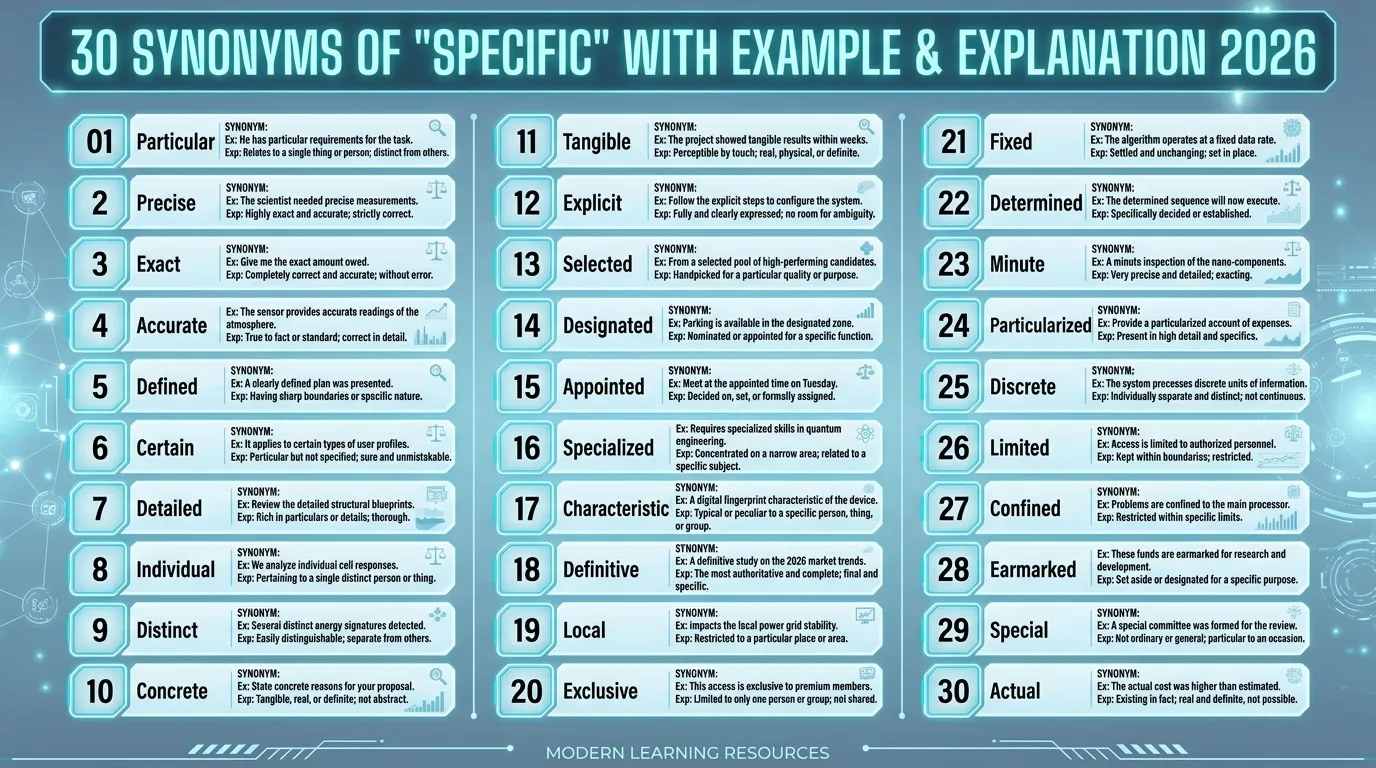
The word specific means clear, exact, and focused on one particular thing. Imagine a teacher asking students to give a specific answer instead of a general one. The teacher wants clear details, not vague ideas. In daily life, people use this word when they want accurate information or direct communication.
The word specific is common in education, business, writing, and conversation because it helps people explain ideas clearly. Learning synonyms of specific helps English learners improve vocabulary and avoid repeating the same word again and again. It also helps writers choose the best word for formal or casual situations.
In this article, you will learn the meaning of specific, its pronunciation, history, grammar, and 30 useful synonyms with examples. You will also explore semantic categories, antonyms, and simple explanations to strengthen your English skills.
Meaning of Specific
Definition
Specific (adjective): clear, exact, and connected to one particular thing.
Examples
- Please give a specific reason for your decision.
- She asked a specific question during class.
Connotative Meaning
- Positive tone: clear, accurate, detailed
- Negative tone: narrow, limited, demanding
- Neutral tone: exact or particular
Etymology
- From Latin specificus meaning “particular kind”
- Derived from species meaning “kind” or “type”
Short History:
- Old English (450–1100): no direct form of “specific”
- Middle English (1100–1500): scientific and descriptive language developed
- Modern English (1500–Present): “specific” became common in education, science, and communication
Pronunciation (US & UK – IPA)
- US: /spəˈsɪfɪk/
- UK: /spəˈsɪfɪk/
Syllables
- spe-cif-ic
Affixation Pattern of Specific
- Root: species/spec
- Prefix: none
- Suffix: -ic
Word Formation:
- specify (verb)
- specific (adjective)
- specifically (adverb)
- specification (noun)
- specificity (noun)
Synonyms of Specific
1. Exact (adjective)
US: /ɪɡˈzækt/ | UK: /ɪɡˈzækt/
Meaning: completely correct and precise
Examples:
- Give the exact number.
- Her answer was exact.
2. Precise (adjective)
US: /prɪˈsaɪs/ | UK: /prɪˈsaɪs/
Meaning: very accurate and detailed
Examples:
- He gave precise directions.
- The measurements are precise.
3. Clear (adjective)
US: /klɪr/ | UK: /klɪə/
Meaning: easy to understand
Examples:
- She gave a clear explanation.
- The instructions were clear.
4. Detailed (adjective)
US: /ˈdiːteɪld/ | UK: /ˈdiːteɪld/
Meaning: containing many facts or details
Examples:
- He wrote a detailed report.
- The guide is very detailed.
5. Particular (adjective)
US: /pərˈtɪkjələr/ | UK: /pəˈtɪkjʊlə/
Meaning: relating to one thing only
Examples:
- She wanted one particular book.
- He mentioned a particular issue.
6. Definite (adjective)
US: /ˈdefənət/ | UK: /ˈdefɪnət/
Meaning: certain and clear
Examples:
- We need a definite answer.
- She made a definite plan.
7. Explicit (adjective)
US: /ɪkˈsplɪsɪt/ | UK: /ɪkˈsplɪsɪt/
Meaning: fully clear and direct
Examples:
- The rules were explicit.
- He gave explicit instructions.
8. Distinct (adjective)
US: /dɪˈstɪŋkt/ | UK: /dɪˈstɪŋkt/
Meaning: clearly different
Examples:
- There are distinct differences.
- Her voice is distinct.
9. Concrete (adjective)
US: /ˈkɑːnkriːt/ | UK: /ˈkɒŋkriːt/
Meaning: real and definite
Examples:
- Give a concrete example.
- We need concrete evidence.
10. Direct (adjective)
US: /dəˈrekt/ | UK: /dəˈrekt/
Meaning: straight and clear
Examples:
- He gave a direct answer.
- Be direct in meetings.
11. Accurate (adjective)
US: /ˈækjərət/ | UK: /ˈækjərət/
Meaning: correct and exact
Examples:
- The report is accurate.
- She gave accurate information.
12. Defined (adjective)
US: /dɪˈfaɪnd/ | UK: /dɪˈfaɪnd/
Meaning: clearly explained
Examples:
- The goals are well defined.
- He used defined terms.
13. Focused (adjective)
US: /ˈfoʊkəst/ | UK: /ˈfəʊkəst/
Meaning: directed toward one thing
Examples:
- She stayed focused.
- The discussion was focused.
14. Narrow (adjective)
US: /ˈnæroʊ/ | UK: /ˈnærəʊ/
Meaning: limited to a small area or idea
Examples:
- The topic is too narrow.
- He has a narrow focus.
15. Pinpoint (adjective)
US: /ˈpɪnpɔɪnt/ | UK: /ˈpɪnpɔɪnt/
Meaning: extremely exact
Examples:
- She gave pinpoint details.
- The map showed the pinpoint location.
16. Unambiguous (adjective)
US: /ˌʌnæmˈbɪɡjuəs/ | UK: /ˌʌnæmˈbɪɡjuəs/
Meaning: very clear and not confusing
Examples:
- The message was unambiguous.
- Use unambiguous language.
17. Certain (adjective)
US: /ˈsɜːrtn/ | UK: /ˈsɜːtn/
Meaning: known clearly and surely
Examples:
- She is certain about it.
- The result is certain.
18. Specialized (adjective)
US: /ˈspeʃəˌlaɪzd/ | UK: /ˈspeʃəlaɪzd/
Meaning: made for a particular purpose
Examples:
- He uses specialized tools.
- The clinic offers specialized care.
19. Identified (adjective)
US: /aɪˈdentəfaɪd/ | UK: /aɪˈdentɪfaɪd/
Meaning: clearly recognized
Examples:
- The problem was identified.
- Police found the identified suspect.
20. Stated (adjective)
US: /ˈsteɪtɪd/ | UK: /ˈsteɪtɪd/
Meaning: clearly expressed in words
Examples:
- Follow the stated rules.
- The company shared its stated goals.
21. Exacting (adjective)
US: /ɪɡˈzæktɪŋ/ | UK: /ɪɡˈzæktɪŋ/
Meaning: requiring great accuracy
Examples:
- The task is exacting.
- She performs exacting work.
22. Intentional (adjective)
US: /ɪnˈtenʃənəl/ | UK: /ɪnˈtenʃənəl/
Meaning: done on purpose
Examples:
- His choice was intentional.
- She made an intentional effort.
23. Express (adjective)
US: /ɪkˈspres/ | UK: /ɪkˈspres/
Meaning: clearly stated
Examples:
- He gave express permission.
- The contract had express terms.
24. Fixed (adjective)
US: /fɪkst/ | UK: /fɪkst/
Meaning: settled and definite
Examples:
- We agreed on a fixed date.
- The meeting has a fixed time.
25. Targeted (adjective)
US: /ˈtɑːrɡətɪd/ | UK: /ˈtɑːɡɪtɪd/
Meaning: aimed at a particular group or goal
Examples:
- The campaign was targeted.
- They used targeted marketing.
26. Individual (adjective)
US: /ˌɪndəˈvɪdʒuəl/ | UK: /ˌɪndɪˈvɪdjʊəl/
Meaning: relating to one person or thing
Examples:
- Each individual case matters.
- Students received individual help.
27. Singular (adjective)
US: /ˈsɪŋɡjələr/ | UK: /ˈsɪŋɡjʊlə/
Meaning: unique or one only
Examples:
- She showed singular talent.
- The event had a singular purpose.
28. Selective (adjective)
US: /səˈlektɪv/ | UK: /sɪˈlektɪv/
Meaning: carefully choosing particular things
Examples:
- He is selective about friends.
- The school is highly selective.
29. Purposeful (adjective)
US: /ˈpɜːrpəsfəl/ | UK: /ˈpɜːpəsfəl/
Meaning: having a clear aim
Examples:
- She walked with a purposeful attitude.
- The meeting was purposeful.
30. Well-defined (adjective)
US: /ˌwel dɪˈfaɪnd/ | UK: /ˌwel dɪˈfaɪnd/
Meaning: clearly explained or shaped
Examples:
- The project has well-defined goals.
- Their roles are well-defined.
Prototype Meaning
The most common meaning of specific is something clear, exact, and focused on one detail or subject. People usually imagine direct instructions, accurate information, or clearly explained ideas.
Prototype Categorization
- Accuracy and precision: exact, precise, accurate
- Clarity and explanation: explicit, clear, defined
- Focus and purpose: focused, targeted, purposeful
- Uniqueness and limitation: singular, individual, narrow
Categorization helps writers choose the best synonym based on tone, audience, and situation.
Antonyms of Specific
- General (adjective): broad and not detailed
- Vague (adjective): unclear or uncertain
- Ambiguous (adjective): open to more than one meaning
- Unclear (adjective): difficult to understand
- Broad (adjective): covering many things
Short Questions and Answers
What does specific mean?
- It means clear, exact, and focused on one thing.
When should specific be used?
- Use it when giving clear details or exact information.
Is specific positive or negative?
- It is usually positive because it suggests clarity and accuracy.
How is it different from similar words?
- “Specific” focuses on one exact thing, while “general” refers to wider ideas.
Conclusion
Learning Synonyms of Specific and Synonyms of Specific improves vocabulary and communication skills. These words help English learners describe details, instructions, and ideas more clearly in speaking and writing. Using different synonyms also avoids repetition and makes communication more professional and engaging.
These synonyms are useful in school, business, academic writing, and everyday conversations. They help writers express accuracy, clarity, and focus with confidence. Practice using these words daily to strengthen your English fluency and improve both writing and speaking skills over time.

I’m Zahid Abbas, an educator, researcher, and digital publishing strategist with a passion for linguistics, grammar, and clear communication. As a content creator and SEO specialist, I craft research-driven, reader-focused content that empowers learners and makes knowledge accessible worldwide.