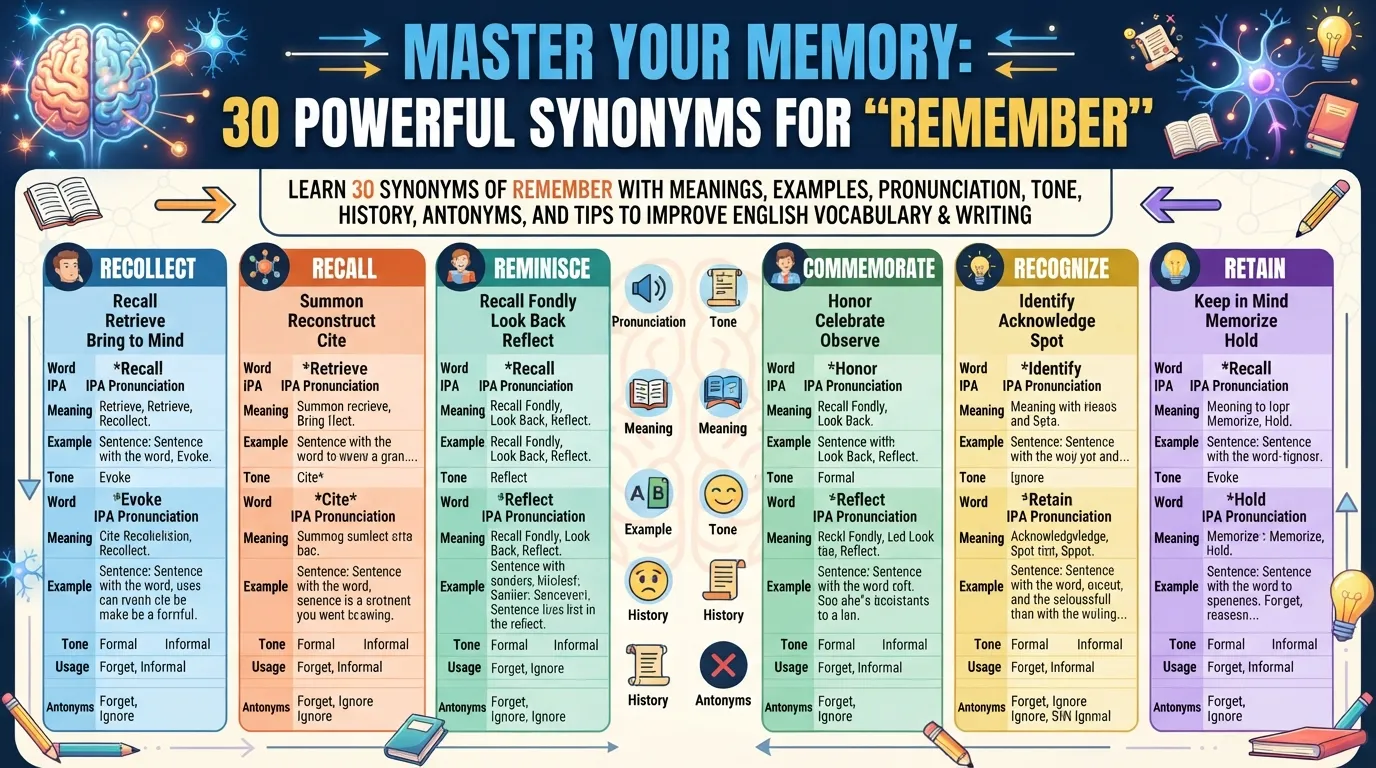
Remember means to keep something in your mind or bring a past fact, person, place, or event back to your mind. For example, you may remember your first day at school, a friend’s name, or an important task you need to do. We use remember every day because memory is part of normal life and communication.
English learners and content writers often repeat the same word many times, so learning synonyms can make their writing clearer and more interesting. Knowing the right synonym also helps you choose a word that fits the exact meaning and tone of a sentence.
In this article, you will learn the meaning of remember, its 30 useful synonyms, examples, pronunciation, connotative meaning, etymology, word formation, prototype meaning, semantic categories, and antonyms. These words can help you improve your English vocabulary for speaking, writing, study, and daily communication.
Meaning of Remember
Definition
Remember (verb): to keep information, people, events, or experiences in your mind or bring them back to your mind.
Examples
- I remember my first English teacher.
- Please remember to call me tonight.
Connotative Meaning
- Positive tone: Remembering can suggest care, love, respect, or appreciation.
- Negative tone: Remembering can sometimes bring sadness, regret, pain, or an unpleasant past event.
- Neutral tone: Remember can simply mean keeping or bringing information to mind without any strong emotion.
Etymology
- Source: English remember came through Middle English and Old French forms related to Latin rememorari.
- Original idea: The word was connected with bringing something back into the mind or memory.
- Latin connection: It is related to Latin words connected with memory and remembering.
Short History of Remember
- Old English (450–1100): Old English had several native words for remembering and thinking about something. The modern form remember was not yet the common English word.
- Middle English (1100–1500): Forms related to Old French remembrer entered English. The word developed the meaning of keeping something in the mind or calling something back to memory.
- Modern English (1500–Present): Remember became a common English verb. Its uses expanded to include remembering facts, people, events, instructions, and actions.
Pronunciation (US & UK – IPA)
- US: /rɪˈmembər/
- UK: /rɪˈmembə/
Syllables
re-mem-ber
Affixation Pattern of Remember
- Root/base: member (in the modern word structure)
- Prefix: re-
- Suffix: None in the basic form
Related Synonyms and Meanings: https://synonymhunting.com/synonyms-for-unknown/
Synonyms of Remember
1. Recall (Verb) — US /rɪˈkɔːl/ | UK /rɪˈkɔːl/
Meaning: To bring a fact, person, or event back into your mind.
Examples:
- I recall meeting her at school.
- Can you recall his name?
2. Recollect (Verb) — US /ˌrekəˈlekt/ | UK /ˌrekəˈlekt/
Meaning: To remember something from the past.
Examples:
- I recollect that old house clearly.
- She could not recollect where she put the keys.
3. Reminisce (Verb) — US /ˌreməˈnɪs/ | UK /ˌremɪˈnɪs/
Meaning: To talk or think about pleasant memories from the past.
Examples:
- We reminisced about our school days.
- They often reminisce about their childhood.
4. Retain (Verb) — US /rɪˈteɪn/ | UK /rɪˈteɪn/
Meaning: To keep information in your mind.
Examples:
- She can retain information very well.
- Reading helps students retain new words.
5. Memorize (Verb) — US /ˈmeməraɪz/ | UK /ˈmeməraɪz/
Meaning: To learn something so that you can remember it later.
Examples:
- I need to memorize these vocabulary words.
- He memorized the poem for class.
6. Mind (Verb) — US /maɪnd/ | UK /maɪnd/
Meaning: To remember or pay attention to something that needs to be done.
Examples:
- Mind the appointment tomorrow.
- Mind to bring your books with you.
7. Keep in Mind (Verb Phrase) — US /kiːp ɪn maɪnd/ | UK /kiːp ɪn maɪnd/
Meaning: To remember something when making a decision or doing something.
Examples:
- Keep in mind that the shop closes early.
- Keep in mind her advice before you decide.
8. Bear in Mind (Verb Phrase) — US /ber ɪn maɪnd/ | UK /beər ɪn maɪnd/
Meaning: To remember or consider something important.
Examples:
- Bear in mind that the road may be busy.
- Bear in mind the cost before buying it.
9. Think of (Verb Phrase) — US /θɪŋk əv/ | UK /θɪŋk əv/
Meaning: To bring someone or something into your thoughts or memory.
Examples:
- I often think of my old friends.
- Did you think of your teacher’s advice?
10. Call to Mind (Verb Phrase) — US /kɔːl tə maɪnd/ | UK /kɔːl tə maɪnd/
Meaning: To cause something to come back into your memory.
Examples:
- The song called to mind my childhood.
- Her story called to mind an old memory.
11. Bring to Mind (Verb Phrase) — US /brɪŋ tə maɪnd/ | UK /brɪŋ tə maɪnd/
Meaning: To make someone remember something.
Examples:
- This smell brings to mind my grandmother’s kitchen.
- The photo brought to mind our holiday.
12. Summon (Verb) — US /ˈsʌmən/ | UK /ˈsʌmən/
Meaning: To deliberately bring a memory or thought into your mind.
Examples:
- She tried to summon the memory of his face.
- He summoned every detail he could remember.
13. Evoke (Verb) — US /ɪˈvoʊk/ | UK /ɪˈvəʊk/
Meaning: To cause a feeling, image, or memory to come into someone’s mind.
Examples:
- The old song evoked happy memories.
- The smell of bread evoked memories of home.
14. Reawaken (Verb) — US /ˌriːəˈweɪkən/ | UK /ˌriːəˈweɪkən/
Meaning: To make an old memory or feeling become active again.
Examples:
- The visit reawakened memories of childhood.
- The photograph reawakened an old feeling.
15. Revisit (Verb) — US /riːˈvɪzɪt/ | UK /riːˈvɪzɪt/
Meaning: To think about or discuss something from the past again.
Examples:
- She revisited her memories of college.
- The book revisits important events from his childhood.
16. Cherish (Verb) — US /ˈtʃerɪʃ/ | UK /ˈtʃerɪʃ/
Meaning: To remember and value someone or something deeply.
Examples:
- I cherish the memories of my parents.
- She cherishes every moment with her children.
17. Commemorate (Verb) — US /kəˈmeməreɪt/ | UK /kəˈmeməreɪt/
Meaning: To honor and remember an important person or event.
Examples:
- The ceremony commemorates the soldiers who died.
- The city built a monument to commemorate the event.
18. Honor (Verb) — US /ˈɑːnər/ | UK /ˈɒnə/
Meaning: To show respect for and remember someone or something important.
Examples:
- We honor those who served their country.
- The award honors her years of service.
19. Memorialize (Verb) — US /məˈmɔːriəlaɪz/ | UK /məˈmɔːriəlaɪz/
Meaning: To preserve the memory of a person or event.
Examples:
- The statue memorializes the victims.
- The book memorializes an important part of local history.
20. Preserve (Verb) — US /prɪˈzɜːrv/ | UK /prɪˈzɜːv/
Meaning: To keep something from being lost or forgotten.
Examples:
- The museum helps preserve old memories and stories.
- These letters preserve his memories of the war.
21. Document (Verb) — US /ˈdɑːkjəment/ | UK /ˈdɒkjʊment/
Meaning: To record information so it can be remembered or used later.
Examples:
- The historian documented the important events.
- We should document these stories for future generations.
22. Register (Verb) — US /ˈredʒɪstər/ | UK /ˈredʒɪstə/
Meaning: To notice and remember something in your mind.
Examples:
- His name did not register with me at first.
- The warning registered in her mind later.
23. Recognize (Verb) — US /ˈrekəɡnaɪz/ | UK /ˈrekəɡnaɪz/
Meaning: To know someone or something because you have seen or learned about it before.
Examples:
- I recognized him from school.
- She recognized the song immediately.
24. Identify (Verb) — US /aɪˈdentɪfaɪ/ | UK /aɪˈdentɪfaɪ/
Meaning: To recognize or name someone or something correctly.
Examples:
- I could identify the teacher from the photo.
- He identified the place from an old memory.
25. Note (Verb) — US /noʊt/ | UK /nəʊt/
Meaning: To notice or keep something in mind.
Examples:
- Note the date of the meeting.
- Please note that the office closes at five.
26. Recall to Mind (Verb Phrase) — US /rɪˈkɔːl tə maɪnd/ | UK /rɪˈkɔːl tə maɪnd/
Meaning: To bring an old thought or memory back into your awareness.
Examples:
- The picture recalled to mind a happy summer.
- His voice recalled to mind my old friend.
27. Reflect On (Verb Phrase) — US /rɪˈflekt ɑːn/ | UK /rɪˈflekt ɒn/
Meaning: To think carefully about a past event or experience.
Examples:
- She reflected on her school years.
- He often reflects on his early career.
28. Dwell On (Verb Phrase) — US /dwel ɑːn/ | UK /dwel ɒn/
Meaning: To keep thinking about something for a long time, especially something from the past.
Examples:
- Try not to dwell on your past mistakes.
- He often dwells on old problems.
29. Keep Alive (Verb Phrase) — US /kiːp əˈlaɪv/ | UK /kiːp əˈlaɪv/
Meaning: To keep a memory, tradition, or person’s influence from being forgotten.
Examples:
- The family works to keep alive old traditions.
- Stories help keep alive the memory of her grandfather.
30. Recall From Memory (Verb Phrase) — US /rɪˈkɔːl frəm ˈmeməri/ | UK /rɪˈkɔːl frəm ˈmeməri/
Meaning: To bring information back from what you have stored in your memory.
Examples:
- I can recall from memory the main points of the lesson.
- She recalled from memory the old address.
Prototype Meaning
The most typical meaning of remember is to bring information or an experience back into your mind. When people hear the word, they usually imagine a person thinking about something they already know, such as a name, date, place, person, promise, or past event. The word can also mean not forgetting to do something, as in “Remember to lock the door.”
Prototype Categorization
- Memory and feelings: reminisce, cherish, evoke, reawaken — useful for emotional or personal memories.
- Keeping something in mind: mind, keep in mind, bear in mind, note — useful for instructions, warnings, and important information.
- Honoring the past: commemorate, honor, memorialize, keep alive — useful for people, events, traditions, and history.
- Thinking about the past: revisit, reflect on, dwell on — useful when discussing past experiences or events.
- Recording and preserving: preserve, document — useful when information is saved so that people can remember it later.
- Recognition: recognize, identify, register — useful when something becomes familiar or noticeable because of previous knowledge.
Antonyms of Remember
- Forget — fail to keep something in your mind.
- Overlook — fail to notice or consider something.
- Ignore — choose not to pay attention to something.
- Disregard — treat something as unimportant.
- Misremember — remember something incorrectly.
- Lose track of — fail to continue remembering or knowing something.
- Erase — remove something from memory or records.
- Omit — leave something out instead of including it.
Short Questions and Answers
- What does remember mean? Remember means to keep something in your mind or bring a past fact, person, event, or experience back into your mind.
- When should remember be used? Use remember for everyday situations involving facts, people, experiences, instructions, promises, and past events.
- Is remember positive or negative? Remember is neutral. Its emotional tone depends on what is being remembered. A happy memory can make it positive, while a painful memory can make it negative.
- How is remember different from similar words? Recall often means bringing information back to mind. Recollect is similar but can sound more formal. Reminisce usually means thinking or talking about past memories. Memorize means learning something so you can remember it later. Commemorate means formally honoring or remembering a person or event.
Conclusion
Learning remember and its synonyms can make your English stronger and more flexible. The word is simple, but its synonyms can express many different ideas. Recall and recollect work well for facts and memories, while reminisce suits personal memories. Words such as cherish, commemorate, and honor add emotional or respectful meaning. Other phrases, such as keep in mind and bear in mind, are useful for advice and instructions. Learning these differences helps you avoid repeating the same word in your writing and speaking. It also helps you understand English more clearly. Try learning two or three new synonyms each day and use them in your own sentences. Regular practice will build your vocabulary, improve your writing, and give you greater confidence when using English.

I’m Zahid Abbas, an educator, researcher, and digital publishing strategist with a passion for linguistics, grammar, and clear communication. As a content creator and SEO specialist, I craft research-driven, reader-focused content that empowers learners and makes knowledge accessible worldwide.










